Cell Size and Surface Area-to-Volume Ratio
From the AP Biology curriculum
TL;DR
Cells need enough surface area to exchange materials efficiently with their environment. As a cell grows, its volume increases much faster than its surface area. This decreasing surface area-to-volume ratio limits how large a cell can get.
1. The Mental Model
Imagine a busy restaurant. The kitchen is the "volume" where all the work happens, and the doors/windows are the "surface area" for getting ingredients in and food out. If the kitchen gets huge but the number of doors stays the same, it becomes impossible to feed everyone efficiently.
2. The Core Material
Why Size Matters for Cells
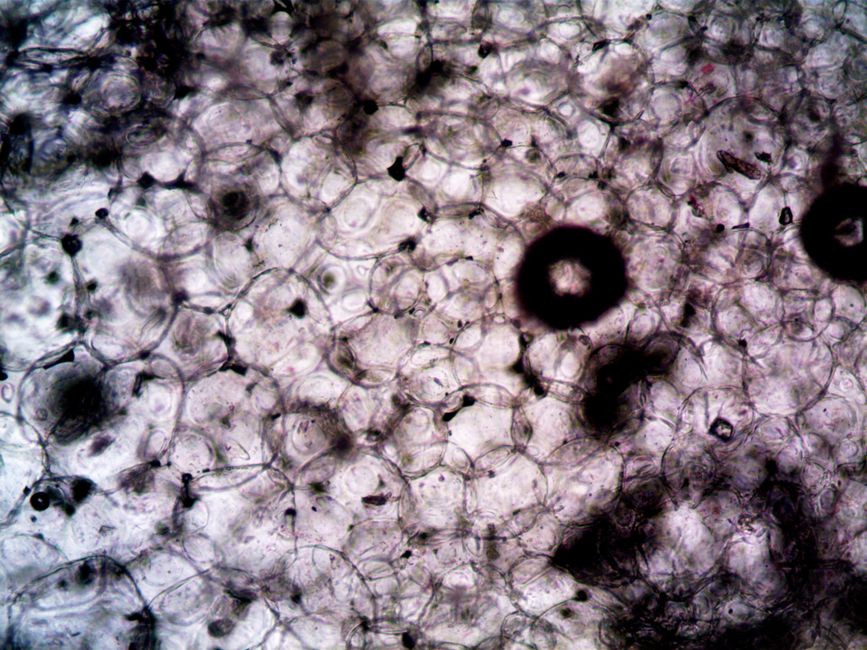
Photo by turek on Pexels
Cells are constantly taking in nutrients and oxygen, and expelling waste products like carbon dioxide. This exchange happens across the cell membrane, which is the cell's surface area. The inside of the cell, where metabolic reactions occur and organelles are located, is the cell's volume.
For a cell to survive and function properly, it needs to be able to exchange materials quickly enough to meet the demands of its internal volume. If the volume gets too large relative to the surface area, the cell can't get enough stuff in or out fast enough.
Calculating Surface Area and Volume

Photo by https://kaboompics.com/ on Pexels
Let's use a simple cube as an example, as it's easy to visualize:
- Surface Area (SA) of a cube: 6 * (side length)^2
- Volume (V) of a cube: (side length)^3
The important part is the ratio: SA/V.
Here's how that ratio changes as a cube (or cell) gets bigger:
graph TD
    A["Small Cell (1 unit side)"] --> B{"SA: 6 * (1)^2 = 6"}
    A --> C{"Volume: (1)^3 = 1"}
    D{"SA/V: 6/1 = 6"}
    B --> D
    C --> D

    E["Medium Cell (2 units side)"] --> F{"SA: 6 * (2)^2 = 24"}
    E --> G{"Volume: (2)^3 = 8"}
    H{"SA/V: 24/8 = 3"}
    F --> H
    G --> H

    I["Large Cell (3 units side)"] --> J{"SA: 6 * (3)^2 = 54"}
    I --> K{"Volume: (3)^3 = 27"}
    L{"SA/V: 54/27 = 2"}
    J --> L
    K --> L

    subgraph Trend
        D --> M["As side length increases..."]
        H --> M
        L --> M
    end
    M --> N["SA increases by x^2"]
    M --> O["Volume increases by x^3"]
    N --> P["SA/V ratio decreases!"]
    O --> P
Notice that as the side length increases, the SA/V ratio decreases. A smaller ratio means less surface area available per unit of volume. This is why cells stay small. If they get too big, they can't transport things in and out quickly enough.
Ways Cells Overcome This Limit

Photo by Markus Winkler on Pexels
Some cells have adapted to deal with this challenge without getting too big:
* Dividing: Most cells just divide into two smaller cells when they reach a certain size.
* Specialized shapes: Some cells, like nerve cells, have long, thin extensions to increase their surface area without a massive increase in volume. Intestinal cells have folds (villi and microvilli) to vastly increase absorption surface area.
3. Worked Example
Let's calculate the surface area-to-volume ratio for two hypothetical cube-shaped cells:
Cell A: Side length = 0.001 cm (10 micrometers)
- Surface Area (SA): 6 * (0.001 cm)^2 = 6 * 0.000001 cm^2 = 0.000006 cm^2
- Volume (V): (0.001 cm)^3 = 0.000000001 cm^3
- SA/V Ratio: 0.000006 cm^2 / 0.000000001 cm^3 = 6,000,000 : 1 (or simply 6,000,000)
Cell B: Side length = 0.01 cm (100 micrometers)
- Surface Area (SA): 6 * (0.01 cm)^2 = 6 * 0.0001 cm^2 = 0.0006 cm^2
- Volume (V): (0.01 cm)^3 = 0.000001 cm^3
- SA/V Ratio: 0.0006 cm^2 / 0.000001 cm^3 = 600 : 1 (or simply 600)
Even though Cell B is only 10 times larger in side length, its SA/V ratio is significantly smaller. Cell A has a much better ability to exchange materials relative to its internal needs.
4. Key Takeaways
- The cell membrane represents the cell's surface area for material exchange.
- The cell's interior where metabolism occurs represents its volume.
- As a cell grows, its volume increases at a faster rate than its surface area.
- A high surface area-to-volume ratio is crucial for efficient material exchange.
- Cells remain small or develop specialized shapes to maintain a favorable SA/V ratio.
- A low SA/V ratio limits cell size because diffusion becomes too slow to support the cell's metabolic needs.
Common Mistakes to Avoid:
* Confusing "surface area" with "volume" or mixing up their units.
* Thinking larger cells are always more efficient; they're often less efficient at material exchange.
* Forgetting that the SA/V ratio is about efficiency of exchange, not just absolute size.
* Assuming all cells are perfectly spherical or cubical for calculations; the principle applies to all shapes.
5. Now Try It
Imagine you have a single large cell that needs to divide into smaller cells to increase its overall SA/V ratio. If the original cell is a cube with a side length of 4 units, calculate its SA/V ratio. Then, imagine it divides perfectly into 8 smaller, identical cubes (each with a side length of 2 units). Calculate the SA/V ratio for one of these smaller cells. What does this tell you about the advantage of being multicellular or small?
Success looks like: You've correctly calculated the initial ratio, the ratio for one of the smaller cells, and explained how the SA/V ratio changes and why that's beneficial.
Frequently asked about Cell Size and Surface Area-to-Volume Ratio
More from AP Biology
Get the full AP Biology curriculum
Clone the complete plan to your dashboard for unlimited AI-generated notes, practice quizzes, and a personalised revision schedule.
Save this course free