Stoichiometry with Limiting Reactants and Percent Yield
From the moles curriculum
Stoichiometry with Limiting Reactants and Percent Yield
TL;DR
When you mix chemicals, one reactant usually runs out first, limiting how much product you can make. The limiting reactant determines your maximum possible product, called the theoretical yield. Your actual amount of product, the actual yield, compared to this theoretical maximum gives you the percent yield.
1. The Mental Model
Imagine making sandwiches: if you have 10 slices of bread but only 3 pieces of cheese, the cheese limits how many sandwiches you can make, even if you have tons of bread. In chemistry, it's the same: one ingredient (reactant) always runs out first, stopping the reaction.
2. The Core Material
Stoichiometry is all about the "recipes" in chemistry, using balanced equations to find out how much of one substance reacts with another, or how much product you'll get. When you have two or more reactants, you need to figure out which one is the limiting reactant because it dictates the maximum amount of product you can form.
Finding the Limiting Reactant
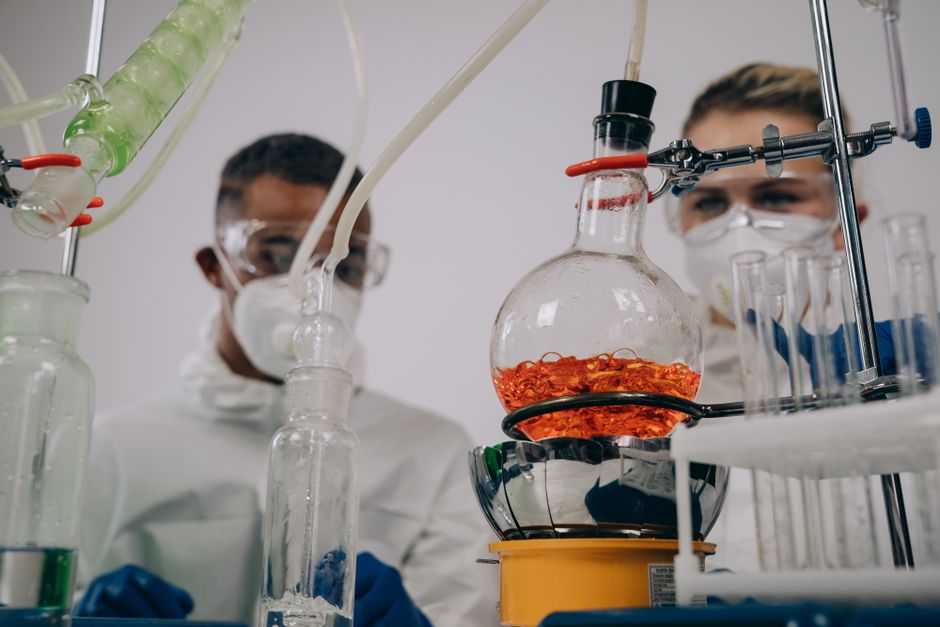
Photo by Mikhail Nilov on Pexels
To find the limiting reactant, you essentially perform two separate stoichiometry calculations. You calculate how much product each reactant could make if it reacted completely, assuming the other reactant is in excess. The reactant that produces the least amount of product is your limiting reactant.
Here's the general process:
graph TD
    A["Start with Balanced Equation"] --> B{"Given Amounts of Reactants?"}
    B --> C["Convert Reactant A to Moles"]
    B --> D["Convert Reactant B to Moles"]
    C --> E["Calculate Moles of Product from Reactant A"]
    D --> F["Calculate Moles of Product from Reactant B"]
    E --> G{"Compare Moles of Product"}
    F --> G
    G --> H["Smaller Product Amount means Limiting Reactant"]
    H --> I["This Limiting Reactant determines Theoretical Yield"]
Example Step-by-Step:
Let's say you have the reaction: 2H₂ + O₂ → 2H₂O
If you start with 4 moles of H₂ and 3 moles of O₂:
- From H₂: 4 mol H₂ × (2 mol H₂O / 2 mol H₂) = 4 mol H₂O
- From O₂: 3 mol O₂ × (2 mol H₂O / 1 mol O₂) = 6 mol H₂O
Since H₂ makes less water (4 mol H₂O vs. 6 mol H₂O), H₂ is the limiting reactant.
Theoretical Yield

Photo by Vitaly Gariev on Pexels
Once you've identified the limiting reactant, the amount of product it can form (calculated in the step above) is your theoretical yield. This is the absolute maximum amount of product you could possibly get if the reaction went perfectly. You'll usually want this in grams, so convert moles of product to grams using its molar mass.
Actual Yield and Percent Yield
Photo by Tymur Khakimov on Pexels
In the real world, reactions rarely go perfectly. You might lose some product when transferring it, or the reaction might not go to completion. The amount of product you actually collect in the lab is called the actual yield.
The percent yield tells you how efficient your reaction was. It's a ratio of what you actually got to what you theoretically could have gotten, expressed as a percentage:
Percent Yield = (Actual Yield / Theoretical Yield) × 100%
The actual yield must be measured experimentally, while the theoretical yield is calculated from stoichiometry.
3. Worked Example
Let's consider the reaction for synthesizing ammonia: N₂(g) + 3H₂(g) → 2NH₃(g)
Suppose you start with 28.0 g of N₂ and 10.0 g of H₂. After the reaction, you collect 25.0 g of NH₃. Let's find the limiting reactant, theoretical yield, and percent yield.
Molar Masses:
N₂: 28.02 g/mol
H₂: 2.02 g/mol
NH₃: 17.04 g/mol
Step 1: Convert reactants to moles.
* Moles of N₂ = 28.0 g N₂ / 28.02 g/mol = 0.999 mol N₂
* Moles of H₂ = 10.0 g H₂ / 2.02 g/mol = 4.95 mol H₂
Step 2: Calculate moles of NH₃ product from each reactant.
* From N₂: 0.999 mol N₂ × (2 mol NH₃ / 1 mol N₂) = 1.998 mol NH₃
* From H₂: 4.95 mol H₂ × (2 mol NH₃ / 3 mol H₂) = 3.30 mol NH₃
Step 3: Identify the limiting reactant.
N₂ produces 1.998 mol NH₃, while H₂ produces 3.30 mol NH₃. Since N₂ yields less product, N₂ is the limiting reactant.
Step 4: Calculate the theoretical yield (in grams) of NH₃.
The theoretical yield is based on the limiting reactant (N₂).
* Theoretical Yield NH₃ = 1.998 mol NH₃ × 17.04 g/mol = 34.05 g NH₃
Step 5: Calculate the percent yield.
You were told the actual yield was 25.0 g NH₃.
* Percent Yield = (Actual Yield / Theoretical Yield) × 100%
* Percent Yield = (25.0 g / 34.05 g) × 100% = 73.4%
4. Key Takeaways
- The limiting reactant is the one that gets completely consumed first and dictates the maximum amount of product you can form.
- The theoretical yield is the maximum amount of product that can be formed based on the limiting reactant and a perfect reaction.
- The actual yield is the amount of product you actually obtain in an experiment.
- Percent yield tells you the efficiency of your reaction, comparing your actual product to the theoretical maximum.
- Always use a balanced chemical equation for all stoichiometry calculations.
Common Mistakes to Avoid:
* Not balancing the equation first: Coefficients are crucial for mole ratios.
* Confusing actual with theoretical yield: They are distinct values; one is calculated, one is measured.
* Using the wrong units: Always ensure units cancel correctly to get your desired output (e.g., moles, grams).
* Comparing initial amounts directly: You can't just compare grams of reactants; you must convert to moles and use mole ratios to find the limiting reactant.
5. Now Try It
You're making silicon carbide (SiC) from silicon dioxide (SiO₂) and carbon (C) in an electric furnace: SiO₂(s) + 3C(s) → SiC(s) + 2CO(g). If you start with 150.0 kg of SiO₂ and 100.0 kg of C, and your actual yield of SiC is 65.0 kg, what is your theoretical yield of SiC and your percent yield? (Molar masses: SiO₂ = 60.09 g/mol, C = 12.01 g/mol, SiC = 40.11 g/mol).
What success looks like: You should be able to clearly identify the limiting reactant, calculate the theoretical yield of SiC in kg, and then determine the percent yield.
Frequently asked about Stoichiometry with Limiting Reactants and Percent Yield
Study this next
Get the full moles curriculum
Clone the complete plan to your dashboard for unlimited AI-generated notes, practice quizzes, and a personalised revision schedule.
Create Free Account