Empirical and Molecular Formulas
From the moles curriculum
Empirical and Molecular Formulas
TL;DR
Empirical and molecular formulas describe a compound's elemental makeup; the empirical formula shows the simplest whole-number ratio of atoms, while the molecular formula shows the exact number. You can find the empirical formula from percent composition by converting masses to moles and then finding the simplest ratio. To get the molecular formula, you'll need the empirical formula and the compound's molar mass.
1. The Mental Model
Think of the empirical formula as a blueprint for the basic building block of a compound, showing the fewest possible atoms. The molecular formula is like the actual structure, telling you exactly how many of each atom are in one complete unit.
2. The Core Material
When you analyze a compound, you might find its percent composition, meaning the percentage by mass of each element in it. From this, you can figure out the empirical formula.
The empirical formula is the simplest whole-number ratio of atoms in a compound. For example, hydrogen peroxide has the molecular formula H₂O₂. Its empirical formula is HO, because that's the simplest ratio (1:1). Glucose is C₆H₁₂O₆, but its empirical formula is CH₂O.
The molecular formula tells you the actual number of atoms of each element in a molecule of a compound. It's either the same as the empirical formula or a whole-number multiple of it.
Finding the Empirical Formula
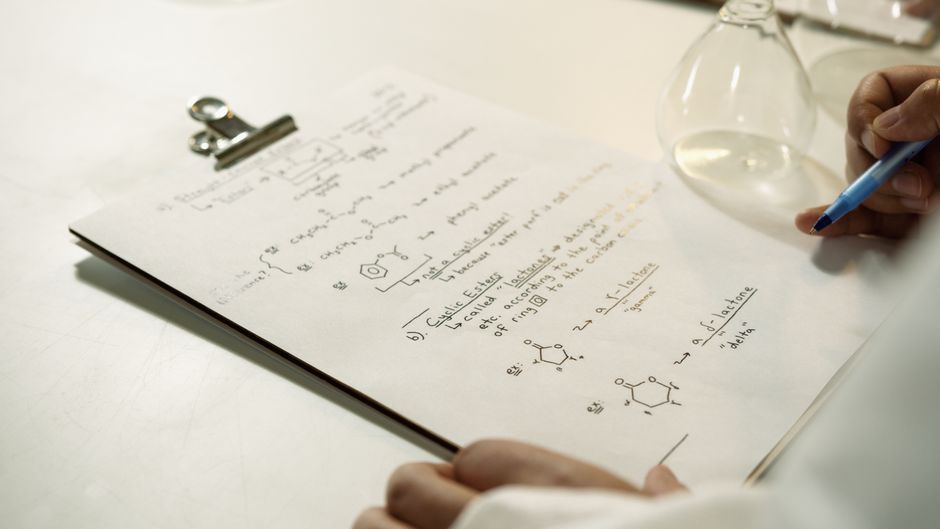
Photo by Artem Podrez on Pexels
Here's how you convert percent composition to an empirical formula:
- Assume 100g sample: This makes percentages directly translate to grams. If you have 75% carbon, you have 75g of carbon.
- Convert grams to moles: Use the atomic mass from the periodic table for each element. Moles = mass / molar mass.
- Divide by the smallest number of moles: This gives you a preliminary ratio.
- Multiply to get whole numbers (if necessary): If you have fractions (like 0.5, 0.33, 0.25), multiply all mole values by the smallest integer that turns them into whole numbers. For example, if you have 1.5 moles, multiply by 2. If you have 2.33, multiply by 3.
Finding the Molecular Formula
Photo by Artem Podrez on Pexels
Once you have the empirical formula, you can find the molecular formula if you also know the compound's actual molar mass.
- Calculate the empirical formula mass: Add up the atomic masses of all atoms in the empirical formula.
- Find the "n" factor: Divide the actual molar mass (given) by the empirical formula mass. This "n" factor tells you how many times bigger the molecular formula is than the empirical formula. It should be a whole number.
n = Molar Mass / Empirical Formula Mass - Multiply the empirical formula subscripts by "n": This gives you the molecular formula.
graph LR
    A["(Start with Percent Composition)"] --> B["(Assume 100g sample)"]
    B --> C["(Convert grams to moles for each element)"]
    C --> D["(Divide all mole values by the smallest mole value)"]
    D --> E{("Are all ratios whole numbers?")}
    E -- No --> F["(Multiply all ratios by smallest integer to get whole numbers)"]
    E -- Yes --> G["(Write Empirical Formula)"]
    F --> G
    G --> H["(Calculate Empirical Formula Mass)"]
    H --> I["(Given: Actual Molar Mass)"]
    I --> J["(Divide Actual Molar Mass by Empirical Formula Mass)"]
    J --> K["(This gives you the 'n' factor)"]
    K --> L["(Multiply Empirical Formula subscripts by 'n')"]
    L --> M["(Write Molecular Formula)"]
3. Worked Example
Let's say a compound is found to be 40.0% Carbon, 6.7% Hydrogen, and 53.3% Oxygen. Its molar mass is 180.16 g/mol.
-
Assume 100g sample:
- 40.0 g C
- 6.7 g H
- 53.3 g O
-
Convert grams to moles:
- C: 40.0 g / 12.01 g/mol = 3.33 mol C
- H: 6.7 g / 1.01 g/mol = 6.63 mol H
- O: 53.3 g / 16.00 g/mol = 3.33 mol O
-
Divide by smallest number of moles (3.33):
- C: 3.33 / 3.33 = 1
- H: 6.63 / 3.33 = 1.99 ≈ 2
- O: 3.33 / 3.33 = 1
-
Ratios are whole numbers (1:2:1). So, the empirical formula is CH₂O.
Now for the molecular formula:
-
Calculate empirical formula mass (CH₂O):
- 1 C (12.01) + 2 H (1.01) + 1 O (16.00) = 12.01 + 2.02 + 16.00 = 30.03 g/mol
-
Find "n" factor:
- Given molar mass = 180.16 g/mol
- n = 180.16 g/mol / 30.03 g/mol = 5.99 ≈ 6
-
Multiply empirical formula subscripts by "n":
- (CH₂O) * 6 = C₆H₁₂O₆
- The molecular formula is C₆H₁₂O₆. (This is glucose!)
4. Key Takeaways
- The empirical formula shows the simplest whole-number ratio of atoms in a compound.
- The molecular formula shows the exact number of atoms of each element in a compound.
- To find the empirical formula from percent composition, convert grams to moles, then divide by the smallest mole value.
- If you get non-whole numbers in your mole ratios, multiply all ratios by the smallest integer to make them whole.
- To find the molecular formula, you need the empirical formula and the compound's actual molar mass.
- The molecular formula is always a whole-number multiple of the empirical formula.
Common Mistakes to Avoid:
- Forgetting to assume a 100g sample when starting with percent composition.
- Rounding too early or incorrectly when determining mole ratios.
- Not multiplying all the mole ratios by the integer when converting to whole numbers.
- Mixing up atomic mass and molar mass when calculating empirical formula mass.
5. Now Try It
A compound is found to contain 26.5% Carbon, 2.2% Hydrogen, and 71.3% Oxygen. The actual molar mass of the compound is 90.04 g/mol. Find both the empirical and molecular formulas for this compound.
What success looks like: You should arrive at C₂HO₃ for the empirical formula and C₂H₂O₄ for the molecular formula.
Frequently asked about Empirical and Molecular Formulas
Study this next
Get the full moles curriculum
Clone the complete plan to your dashboard for unlimited AI-generated notes, practice quizzes, and a personalised revision schedule.
Create Free Account