Elements: The Basic Building Blocks
From the Science Exam due tmr its mainly on Elements, compounds, and molucules and some more stuff on the periodic table curriculum
Elements: The Basic Building Blocks
TL;DR
Everything around you is made from tiny, fundamental substances called elements, which can't be broken down further by normal chemical means. Each element is unique because of the number of protons in its atoms, and the periodic table organizes them by these properties. Understanding elements is the starting point for grasping how matter is formed and interacts.
1. The Mental Model
Think of elements as the LEGO bricks of the universe. Just like you can build countless things with different types of LEGO bricks, all matter is built from different types of elements. You can't break a single LEGO brick into smaller, different bricks; similarly, you can't break an element into other simpler substances.
2. The Core Material
You're diving into the fundamental particles that make up everything. Let's get to it!
What's an Element?
Photo by Ann H on Pexels
An element is a pure substance made up of only one type of atom. You can't break it down into simpler substances using ordinary chemical reactions. Think of gold – a pure lump of gold is made only of gold atoms. You can't chemically change gold into, say, silver.
Atoms: The Building Blocks of Elements

Photo by Google DeepMind on Pexels
Every element is defined by its atom. An atom is the smallest unit of an element that still has the chemical properties of that element.
Atoms themselves are made of even smaller particles:
* Protons: Positively charged particles found in the atom's center (the nucleus). The number of protons is what makes one element different from another. This is called the atomic number (Z).
* Neutrons: Neutral (no charge) particles also found in the nucleus. They add mass but don't change the element's identity.
* Electrons: Negatively charged particles that orbit the nucleus. They are involved in chemical bonding. In a neutral atom, the number of electrons equals the number of protons.
The Periodic Table: Elements Organized
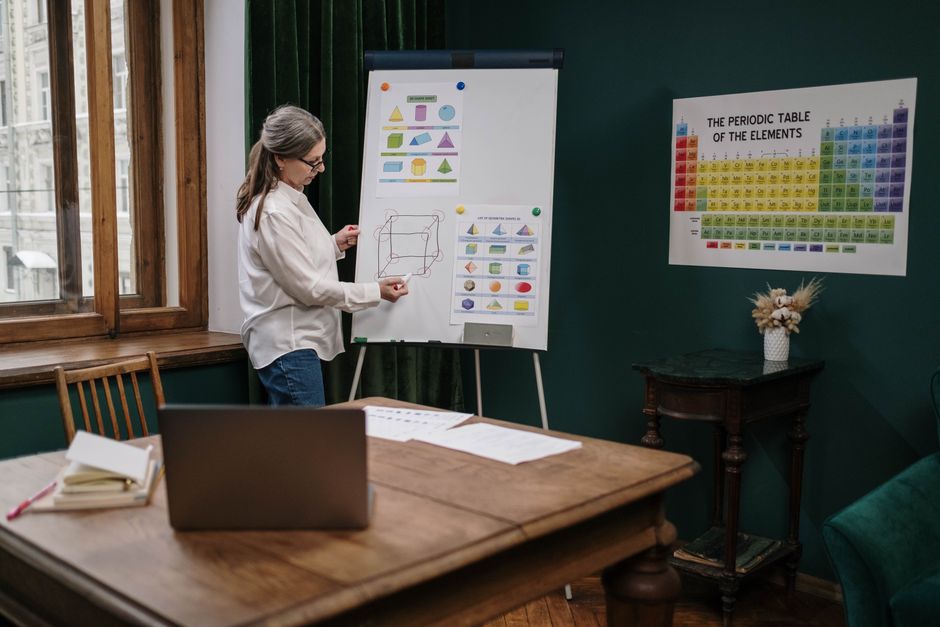
Photo by cottonbro studio on Pexels
The periodic table is your map to the elements. It organizes all known elements based on their atomic number (number of protons) and recurring chemical properties.
Here's how to read a typical periodic table entry for an element:
graph TD
    A["Atomic Number (Z)"] --> B["Symbol"]
    B --> C["Element Name"]
    C --> D["Atomic Mass (Average Mass)"]

    style A fill:#f9f,stroke:#333,stroke-width:2px
    style B fill:#ccf,stroke:#333,stroke-width:2px
    style C fill:#fcf,stroke:#333,stroke-width:2px
    style D fill:#cff,stroke:#333,stroke-width:2px
- Atomic Number (Z): This is the most important number! It tells you the number of protons in an atom of that element. It also uniquely identifies the element. For example, Hydrogen always has 1 proton, Oxygen always has 8 protons.
- Element Symbol: A one or two-letter abbreviation for the element (e.g., H for Hydrogen, O for Oxygen, Au for Gold).
- Element Name: The full name of the element.
- Atomic Mass: The average mass of an atom of that element, usually listed in "atomic mass units" (amu). This is roughly the sum of protons and neutrons.
Groups and Periods
Photo by Anna Shvets on Pexels
The periodic table isn't just a list; it's a powerful tool:
* Periods: The horizontal rows. Elements in the same period have the same number of electron shells (energy levels).
* Groups (or Families): The vertical columns. Elements in the same group often have similar chemical properties because they have the same number of valence (outermost shell) electrons. For example, Group 1 (Alkali Metals) are all very reactive metals.
3. Worked Example
Let's look at the element Oxygen on the periodic table.
You'd typically find an entry like this:
  8
  O
Oxygen
15.999
Let's break down what this tells us:
- 8: This is the atomic number (Z). It means every atom of Oxygen has exactly 8 protons. Since a neutral atom has an equal number of protons and electrons, a neutral Oxygen atom also has 8 electrons.
- O: This is the element symbol for Oxygen.
- Oxygen: This is the element name.
- 15.999: This is the atomic mass. It tells us that, on average, an Oxygen atom weighs about 16 atomic mass units. Knowing the atomic mass (roughly protons + neutrons) and the number of protons (8), you can estimate the most common number of neutrons: 16 - 8 = 8 neutrons.
So, just from that little box, you know a lot about Oxygen!
4. Key Takeaways
- An element is a pure substance made of only one type of atom, unchangeable by ordinary chemical means.
- The atomic number (number of protons) defines an element and is its unique identifier.
- Atoms are made of protons (positive, in nucleus), neutrons (neutral, in nucleus), and electrons (negative, orbiting).
- The periodic table organizes elements by atomic number and similar properties.
- Elements in the same group (vertical column) have similar chemical properties.
- Elements in the same period (horizontal row) have the same number of electron shells.
- The atomic mass tells you the average mass of an element's atoms.
Common Mistakes to Avoid:
- Don't confuse elements with compounds; compounds are made of two or more different elements chemically bonded.
- Don't think you can turn one element into another through chemical reactions; that's nuclear chemistry, which is a different ballgame.
- Don't forget that the atomic number is always the number of protons and determines the element's identity.
- Don't assume atomic mass is always a whole number; it's an average of isotopes.
5. Now Try It
Find at least three different elements on the periodic table (pick ones you're curious about!). For each element, identify its atomic number, element symbol, and element name. Then, based on its atomic number, state how many protons and how many electrons a neutral atom of that element would have. What success looks like: a clear list of three elements with their symbol, name, atomic number, and the count of protons and electrons for each.
Frequently asked about Elements: The Basic Building Blocks
Study this next
Get the full Science Exam due tmr its mainly on Elements, compounds, and molucules and some more stuff on the periodic table curriculum
Clone the complete plan to your dashboard for unlimited AI-generated notes, practice quizzes, and a personalised revision schedule.
Create Free Account