Chemical Formulas and Particle Diagrams
From the chemistry curriculum
Chemical Formulas and Particle Diagrams
TL;DR
Chemical formulas are a shorthand for showing what elements are in a substance and how many atoms of each are present. Particle diagrams visually represent these formulas, showing individual atoms and how they're connected or arranged. Together, they help us understand the composition and structure of matter.
1. The Mental Model
Imagine you're building with LEGOs. A chemical formula is like a recipe telling you exactly which colored bricks and how many of each you need. A particle diagram is like looking at the finished LEGO model, seeing how all those bricks fit together.
2. The Core Material
When we talk about chemistry, we're talking about atoms and how they combine. Chemical formulas and particle diagrams are two essential ways to describe these combinations.
Chemical Formulas: The Recipe
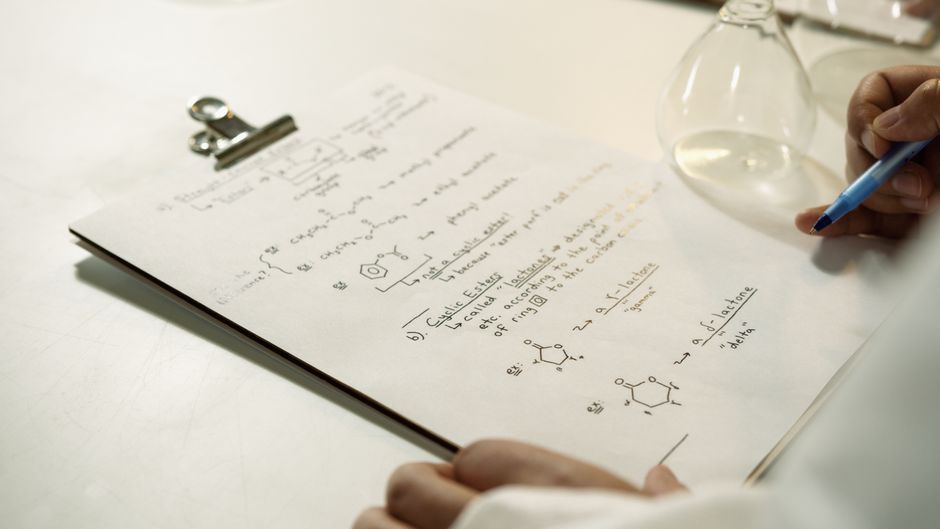
Photo by Artem Podrez on Pexels
A chemical formula uses symbols from the periodic table to represent elements and subscripts (small numbers written below and to the right of the symbol) to show how many atoms of each element are in one molecule or formula unit. If there's no subscript, it means there's just one atom of that element.
Let's look at an example: Water. Its formula is $\text{H}_2\text{O}$.
* H is the symbol for Hydrogen.
* 2 is the subscript for Hydrogen, meaning there are two hydrogen atoms.
* O is the symbol for Oxygen.
* There's no subscript for Oxygen, so there's one oxygen atom.
So, one molecule of water contains two hydrogen atoms and one oxygen atom.
Another example: Glucose, $\text{C}_6\text{H}_{12}\text{O}_6$.
* Six carbon atoms ($\text{C}$)
* Twelve hydrogen atoms ($\text{H}$)
* Six oxygen atoms ($\text{O}$)
Particle Diagrams: The Visual

Photo by Santhosh Kanthala on Pexels
Particle diagrams are visual representations of chemical formulas. They use circles or spheres (often different colors or sizes) to represent different types of atoms. These diagrams help you visualize:
- Types of atoms present: By using different representations for different elements.
- Number of each atom: By simply counting the spheres.
- How atoms are bonded: If atoms are connected, they're part of the same molecule. If they're separate, they're individual atoms or separate molecules.
- The state of matter: Sometimes, diagrams show atoms close together (liquid/solid) or far apart (gas).
Key for Particle Diagrams: It's crucial to have a consistent key for what each symbol/color represents. For example:
* Small white circle = Hydrogen (H)
* Medium red circle = Oxygen (O)
* Large black circle = Carbon (C)
Here's how you can think about translating between a formula and a diagram:
graph TD
    A["Chemical Formula (e.g., H2O)"] --> B{"Identify Elements & Counts"};
    B --> C["Assign Unique Visuals (e.g., H = small white, O = red)"];
    C --> D{"Draw Atoms According to Counts"};
    D --> E["Connect Atoms to Form Molecules (Based on bonding knowledge)"];
    E --> F["Particle Diagram (Visual representation)"];
Pure Substances vs. Mixtures in Diagrams

Photo by Mikhail Nilov on Pexels
- Pure Substance (Element): All particles are identical and consist of only one type of atom (e.g., $\text{O}_2$ gas would show pairs of identical circles).
- Pure Substance (Compound): All particles are identical and consist of two or more different types of atoms bonded together (e.g., $\text{H}_2\text{O}$ would show many identical groups of one red circle bonded to two white circles).
- Mixture: Contains two or more different types of particles (elements or compounds) that are not chemically bonded to each other. For example, a mixture of $\text{H}_2$ and $\text{O}_2$ would show separate $\text{H}_2$ molecules and separate $\text{O}_2$ molecules.
3. Worked Example
Let's say you're given the chemical formula for ammonia: $\text{NH}_3$.
-
Break down the formula:
- One Nitrogen (N) atom.
- Three Hydrogen (H) atoms.
-
Decide on your particle diagram key:
- Let's use a large blue circle for Nitrogen (N).
- Let's use a small white circle for Hydrogen (H).
-
Draw the molecule: You'd draw one large blue circle connected to three small white circles. If you were drawing a sample of ammonia gas, you'd draw several of these identical $\text{NH}_3$ molecules, spread out, as they aren't bonded to each other in a gas.
(Imagine drawing this: a blue circle in the center, with three white circles attached to it, like spokes on a wheel or legs on a tripod. Then, draw a few more identical groups of these circles scattered around the page to represent a sample.)
4. Key Takeaways
- Chemical formulas use element symbols and subscripts to show the types and counts of atoms in a substance.
- No subscript means there's only one atom of that element.
- Particle diagrams are visual models that represent atoms as spheres, often using different colors/sizes for different elements.
- Particle diagrams help visualize the composition of molecules and whether a substance is an element, compound, or mixture.
- Connected spheres in a diagram represent atoms bonded together to form a molecule.
- A key is essential for interpreting particle diagrams correctly.
Common Mistakes to Avoid:
* Confusing coefficients (numbers in front of a formula) with subscripts; subscripts are part of the molecule, coefficients tell you how many molecules there are.
* Drawing too many or too few atoms than indicated by the formula.
* Forgetting to distinguish between different types of atoms in a particle diagram (e.g., using the same color for hydrogen and oxygen).
* Drawing components of a mixture as bonded together; mixtures are just physically combined, not chemically.
5. Now Try It
For 15 minutes, practice translating between formulas and diagrams.
1. Given the formula $\text{CO}_2$ (carbon dioxide):
* Draw a particle diagram for three molecules of $\text{CO}_2$. Use a large black circle for Carbon (C) and medium red circles for Oxygen (O). Show how the atoms are connected within each molecule, and that the three molecules are separate from each other.
2. Given a particle diagram: Imagine a diagram with two separate particles. Particle A consists of one large yellow circle bonded to two small blue circles. Particle B consists of two small blue circles bonded together. Write the chemical formula for Particle A and Particle B. What kind of substance would a collection of only Particle A be (element, compound, or mixture)? What about a collection of both Particle A and Particle B?
Success looks like: You have correctly drawn the $\text{CO}_2$ molecules, clearly distinguishing between C and O. You've also correctly identified the formulas for particles A and B and classified the types of substances.
Frequently asked about Chemical Formulas and Particle Diagrams
More from chemistry
Get the full chemistry curriculum
Clone the complete plan to your dashboard for unlimited AI-generated notes, practice quizzes, and a personalised revision schedule.
Create Free Account