Acids, Bases, and Salts
From the science cbse class x curriculum
TL;DR
Acids are substances that release hydrogen ions (H⁺) in water, bases release hydroxide ions (OH⁻), and salts are formed when acids and bases react. You can tell them apart using indicators, and their strength depends on how much they ionize. This knowledge helps us understand reactions like neutralization and everyday phenomena.
1. The Mental Model
Think of acids as "H⁺ donors" and bases as "OH⁻ donors." When they meet, they cancel each other out in a reaction called neutralization, often forming water and a salt. It's like a chemical tug-of-war, where the winner determines the final solution's character.
2. The Core Material
You encounter acids, bases, and salts every day. Lemon juice is acidic, soap is basic, and table salt is, well, a salt! Understanding them helps explain lots of chemical reactions.
What are Acids?

Photo by Pixabay on Pexels
Acids are substances that, when dissolved in water, produce hydrogen ions (H⁺). These H⁺ ions quickly combine with water molecules to form hydronium ions (H₃O⁺).
- Properties of Acids:
- Sour taste (don't taste in the lab!)
- Corrosive
- Turn blue litmus paper red
- React with metals to produce hydrogen gas (H₂)
- Conduct electricity in aqueous solutions (due to ions)
- Examples: HCl (hydrochloric acid), H₂SO₄ (sulfuric acid), HNO₃ (nitric acid)
What are Bases?

Photo by Ann H on Pexels
Bases are substances that, when dissolved in water, produce hydroxide ions (OH⁻). Bases that are soluble in water are called alkalis.
- Properties of Bases:
- Bitter taste (don't taste in the lab!)
- Slippery, soapy feel
- Turn red litmus paper blue
- Conduct electricity in aqueous solutions
- Examples: NaOH (sodium hydroxide), KOH (potassium hydroxide), Ca(OH)₂ (calcium hydroxide)
Indicators
Indicators are special substances that change color depending on whether they're in an acidic or basic solution. They help you quickly identify if a substance is acidic or basic without tasting or touching.
- Litmus paper: Most common. Blue litmus turns red in acid; red litmus turns blue in base.
- Methyl orange: Red in acid, yellow in base.
- Phenolphthalein: Colorless in acid, pink in base.
- Universal Indicator/pH Paper: A mixture of indicators that shows a range of colors for different pH values, allowing you to estimate the strength.
The pH Scale

Photo by Pavel Danilyuk on Pexels
The pH scale measures how acidic or basic a solution is. It ranges from 0 to 14.
- pH < 7: Acidic (lower pH means stronger acid)
- pH = 7: Neutral (like pure water)
- pH > 7: Basic (higher pH means stronger base)
A change of one pH unit means a tenfold change in H⁺ ion concentration. So, a solution with pH 3 is ten times more acidic than a solution with pH 4.
Neutralization Reaction
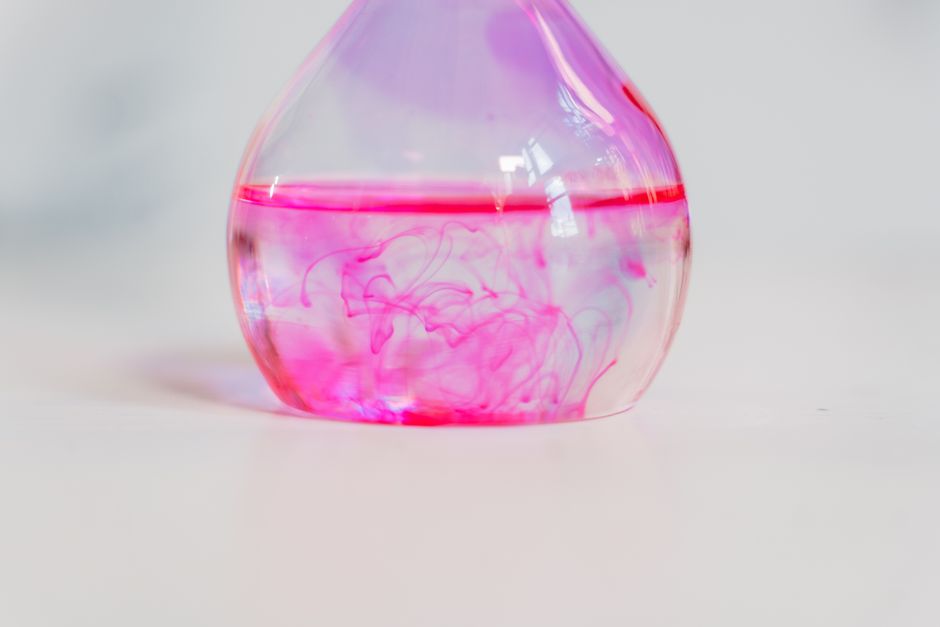
Photo by MART PRODUCTION on Pexels
When an acid reacts with a base, they neutralize each other, forming a salt and water.
Acid + Base → Salt + Water
For example:
HCl (acid) + NaOH (base) → NaCl (salt) + H₂O (water)
What are Salts?
Salts are ionic compounds formed when an acid and a base react. They usually consist of a positive ion (cation) from a base and a negative ion (anion) from an acid.
- Properties of Salts:
- Often crystalline solids
- Usually soluble in water (though some are insoluble)
- Conduct electricity in molten state or in solution
- Examples: NaCl (sodium chloride), CaCO₃ (calcium carbonate), K₂SO₄ (potassium sulfate)
Families of Acids and Bases
You can classify acids and bases by their strength (strong vs. weak) or by the number of H⁺ or OH⁻ ions they produce.
graph TD
    A["Acids, Bases & Salts"] --> B["Acids"]
    A --> C["Bases"]
    A --> D["Salts"]

    B --> B1["Definition: Produce H⁺ (or H₃O⁺) in water"]
    B --> B2["Properties: Sour, corrosive, turn blue litmus red"]
    B --> B3["Types: Strong (HCl), Weak (CH₃COOH)"]
    B1 --> B4["Examples: HCl, H₂SO₄, CH₃COOH"]

    C --> C1["Definition: Produce OH⁻ in water"]
    C --> C2["Properties: Bitter, soapy, turn red litmus blue"]
    C --> C3["Types: Strong (NaOH), Weak (NH₄OH)"]
    C1 --> C4["Examples: NaOH, Ca(OH)₂, NH₄OH"]

    D --> D1["Definition: Ionic compound from Acid + Base reaction"]
    D --> D2["Properties: Crystalline solids, conductors (molten/solution)"]
    D1 --> D3["Examples: NaCl, CuSO₄, CaCO₃"]

    B & C --> E["Indicators"]
    E --> E1["Litmus (Red/Blue)"]
    E --> E2["Phenolphthalein (Colorless/Pink)"]
    E --> E3["Methyl Orange (Red/Yellow)"]

    B & C --> F["pH Scale"]
    F --> F1["0-6: Acidic"]
    F --> F2["7: Neutral"]
    F --> F3["8-14: Basic"]

    B & C --> G["Neutralization Reaction"]
    G --> G1["Acid + Base --> Salt + Water"]
3. Worked Example
You have an unknown clear liquid. You want to determine if it's acidic, basic, or neutral.
-
Test 1: Litmus Paper
- You dip a strip of blue litmus paper into the liquid. It immediately turns red.
- Conclusion so far: The liquid is acidic.
-
Test 2: Phenolphthalein Indicator
- You add a few drops of phenolphthalein indicator to a small sample of the liquid. The solution remains colorless.
- Conclusion so far: This confirms it's acidic because phenolphthalein stays colorless in acidic solutions and turns pink in basic ones.
-
Test 3: Universal Indicator Paper
- You dip a piece of universal indicator paper into the liquid. The paper turns an orange-red color.
- Conclusion: By comparing this color to the pH chart provided with the universal indicator, you estimate the pH to be around 3-4. This strongly confirms the liquid is an acid, specifically a moderately strong one.
Combining all three tests, you can confidently say the unknown liquid is an acid with a pH around 3-4.
4. Key Takeaways
- Acids produce H⁺ ions (or H₃O⁺) in water, taste sour, and turn blue litmus red.
- Bases produce OH⁻ ions in water, feel soapy, and turn red litmus blue.
- The pH scale (0-14) measures acidity/basicity: <7 is acidic, 7 is neutral, >7 is basic.
- Indicators like litmus, phenolphthalein, or universal indicator help identify acids and bases by color change.
- Neutralization is when an acid and a base react to form a salt and water.
- Salts are ionic compounds formed from the reaction of acids and bases.
- Strong acids/bases ionize completely in water, while weak ones ionize partially.
Common mistakes you should avoid:
- Tasting or touching unknown chemicals: Always use indicators and safety equipment.
- Confusing strong with concentrated: A dilute strong acid can be less harmful than a concentrated weak acid. Strength refers to ionization, concentration to amount dissolved.
- Assuming all salts are neutral: Some salts can be acidic or basic depending on the strength of the acid and base they came from.
- Thinking H⁺ ions exist alone: In water, H⁺ ions immediately form H₃O⁺.
- Mixing up indicator colors: Remember blue litmus for bases (blue for B), red litmus for acids (red for A).
5. Now Try It
You have three unlabeled solutions: Solution A, Solution B, and Solution C. You perform the following tests:
* Adding Solution A to red litmus paper turns it blue.
* Adding Solution B to blue litmus paper causes no change. When you add Solution B to red litmus paper, it also causes no change.
* Adding Solution C to blue litmus paper turns it red.
Identify which solution is acidic, which is basic, and which is neutral. What would happen if you mixed Solution A and Solution C? What kind of reaction would that be?
Success looks like: Correctly identifying each solution's nature and describing the outcome of mixing A and C, including the type of reaction.
Frequently asked about Acids, Bases, and Salts
Study this next
Get the full science cbse class x curriculum
Clone the complete plan to your dashboard for unlimited AI-generated notes, practice quizzes, and a personalised revision schedule.
Save this course free