Chemical Reactions and Equations
From the science cbse class x curriculum
TL;DR
Chemical reactions are processes where old bonds break and new ones form, changing substances into new ones with different properties. You'll learn to represent these changes using chemical equations, balancing them to follow the law of conservation of mass. Understanding these reactions helps explain everything from cooking to corrosion.
1. The Mental Model
Think of chemical reactions like taking apart LEGO structures and building new ones with the same bricks. You're not losing or gaining bricks, just rearranging them.
2. The Core Material
Chemical reactions are fundamental to chemistry. They're all about transformation. When substances react, their atoms rearrange to form new substances. You can often tell a reaction has happened by observing changes like a change in color, temperature, state, or the formation of a gas or precipitate.
What's a Chemical Equation?

Photo by Vitaly Gariev on Pexels
A chemical equation is a shorthand way to represent a chemical reaction using chemical formulas. It shows the reactants (starting materials) on the left side and the products (new substances formed) on the right side, separated by an arrow ($\to$).
For example, when hydrogen gas reacts with oxygen gas to form water:
H$_2$ + O$_2$ $\to$ H$_2$O
The 'H$_2$' and 'O$_2$' are reactants, and 'H$_2$O' is the product.
Balancing Chemical Equations
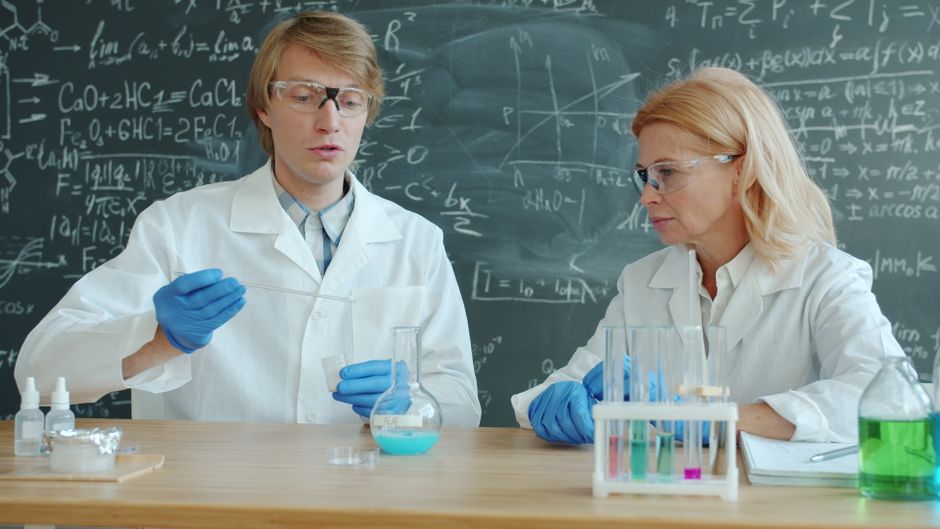
Photo by Vitaly Gariev on Pexels
The Law of Conservation of Mass states that mass can neither be created nor destroyed in a chemical reaction. This means the total number of atoms of each element must be the same on both sides of a balanced chemical equation. You balance an equation by placing coefficients (whole numbers) in front of the chemical formulas. Never change the subscripts in a formula, as that changes the substance itself!
Let's balance the water formation equation:
H$_2$ + O$_2$ $\to$ H$_2$O
- Count atoms:
- Reactants: H=2, O=2
- Products: H=2, O=1
- Balance oxygen: To get 2 oxygen atoms on the product side, put a '2' in front of H$_2$O.
H$_2$ + O$_2$ $\to$ 2H$_2$O - Recount and balance hydrogen:
- Reactants: H=2, O=2
- Products: H=4, O=2
Now hydrogen is unbalanced. To get 4 hydrogen atoms on the reactant side, put a '2' in front of H$_2$.
2H$_2$ + O$_2$ $\to$ 2H$_2$O
- Final count:
- Reactants: H=4, O=2
- Products: H=4, O=2
It's balanced!
Types of Chemical Reactions

Photo by Ron Lach on Pexels
There are several main types of reactions, and understanding them helps predict products and reaction behavior.
graph TD
    A["Chemical Reaction"] --> B["Combination Reaction (A + B -> AB)"]
    A --> C["Decomposition Reaction (AB -> A + B)"]
    A --> D["Displacement Reaction (A + BC -> AC + B)"]
    A --> E["Double Displacement Reaction (AB + CD -> AD + CB)"]
    A --> F["Redox Reaction (Oxidation & Reduction occur simultaneously)"]
- Combination Reaction: Two or more reactants combine to form a single product. (e.g., C + O$_2$ $\to$ CO$_2$)
- Decomposition Reaction: A single reactant breaks down into two or more simpler products. These often require energy (heat, light, electricity). (e.g., 2H$_2$O $\to$ 2H$_2$ + O$_2$)
- Displacement Reaction: A more reactive element displaces a less reactive element from its compound. (e.g., Fe + CuSO$_4$ $\to$ FeSO$_4$ + Cu)
- Double Displacement Reaction: Two different atoms or groups of atoms exchange places, usually in aqueous solutions, often forming a precipitate, gas, or water. (e.g., AgNO$_3$ + NaCl $\to$ AgCl(s) + NaNO$_3$)
- Redox Reactions: These involve both oxidation (loss of electrons or gain of oxygen) and reduction (gain of electrons or loss of oxygen) happening at the same time. Many reactions you'll study are redox.
Exothermic and Endothermic Reactions
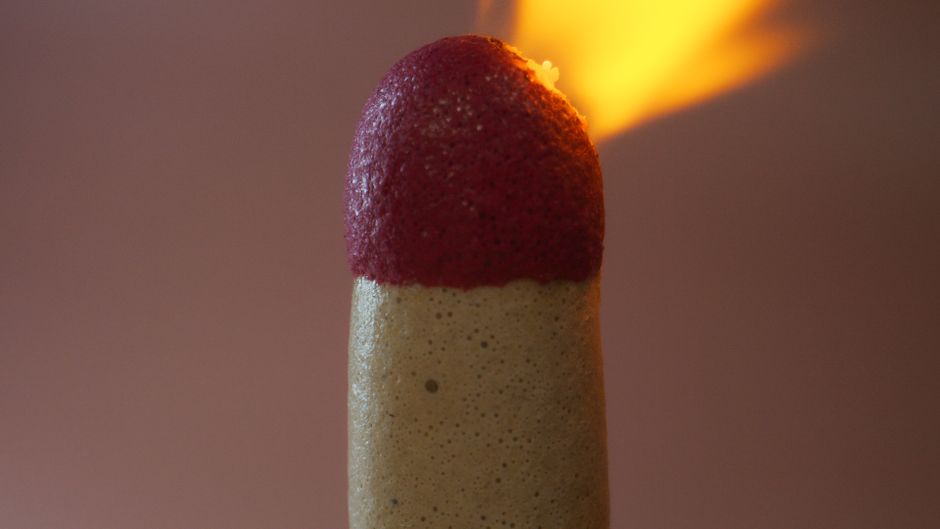
Photo by Tima Miroshnichenko on Pexels
- Exothermic reactions release energy, usually as heat, making the surroundings warmer. (e.g., burning wood).
- Endothermic reactions absorb energy, usually as heat, making the surroundings cooler. (e.g., dissolving ammonium chloride in water).
3. Worked Example
Let's balance the combustion of propane (C$_3$H$_8$) with oxygen (O$_2$) to produce carbon dioxide (CO$_2$) and water (H$_2$O).
Equation: C$_3$H$_8$ + O$_2$ $\to$ CO$_2$ + H$_2$O
- Balance Carbon (C):
- Reactants: C=3, H=8, O=2
- Products: C=1, H=2, O=3
Place '3' in front of CO$_2$:
C$_3$H$_8$ + O$_2$ $\to$ 3CO$_2$ + H$_2$O
- Balance Hydrogen (H):
- Reactants: C=3, H=8, O=2
- Products: C=3, H=2, O=(3*2)+1 = 7
Place '4' in front of H$_2$O (since 8 H atoms are needed):
C$_3$H$_8$ + O$_2$ $\to$ 3CO$_2$ + 4H$_2$O
- Balance Oxygen (O):
- Reactants: C=3, H=8, O=2
- Products: C=3, H=8, O=(3*2)+(4*1) = 6+4 = 10
Place '5' in front of O$_2$ (since 10 O atoms are needed):
C$_3$H$_8$ + 5O$_2$ $\to$ 3CO$_2$ + 4H$_2$O
- Final check:
- Reactants: C=3, H=8, O=10
- Products: C=3, H=8, O=10
It's balanced!
4. Key Takeaways
- Chemical reactions transform reactants into new products by rearranging atoms.
- Chemical equations use formulas to represent these reactions, with reactants on the left and products on the right.
- Balancing equations ensures the Law of Conservation of Mass is followed, meaning the number of atoms of each element is equal on both sides.
- Common reaction types include combination, decomposition, displacement, and double displacement.
-
Exothermic reactions release energy, while endothermic reactions absorb it.
-
Common Mistakes to Avoid:
- Never change the subscripts in a chemical formula when balancing; only use coefficients.
- Don't forget to count all atoms of an element if it appears in multiple compounds on one side of the equation.
- Assuming a reaction is balanced just because the number of compounds on each side is equal.
- Not knowing the basic types of reactions can make it harder to predict products.
5. Now Try It
Take the reaction between aluminum metal (Al) and copper(II) chloride (CuCl$_2$) to form aluminum chloride (AlCl$_3$) and copper metal (Cu).
- Write the unbalanced chemical equation for this reaction.
- Balance the equation using coefficients.
- Identify what type of reaction it is (combination, decomposition, displacement, or double displacement).
Success looks like a correctly balanced equation and accurate classification of the reaction type. You should have the same number of Al, Cu, and Cl atoms on both sides.
Frequently asked about Chemical Reactions and Equations
Study this next
Get the full science cbse class x curriculum
Clone the complete plan to your dashboard for unlimited AI-generated notes, practice quizzes, and a personalised revision schedule.
Save this course free