Introduction to Measurement
From the science curriculum
TL;DR
Measurement is how we figure out how much of something there is using a consistent system. It helps us describe the world precisely and is super important for science and everyday life. Every measurement has a number and a unit, and it always has some level of uncertainty.
1. The Mental Model
Think of measurement as putting a ruler up to the world. You're trying to describe something physical, like length or weight, using a shared language that everyone understands. It's how we go from "that's a big dog" to "that dog weighs 30 kilograms."
2. The Core Material
When you measure something, you're comparing it to a standard. That standard is called a unit. For example, when you measure length in "meters," you're comparing the object's length to a universally agreed-upon length called a meter. Without units, numbers are meaningless; "5" doesn't tell you much, but "5 meters" or "5 seconds" does.
Why Measure?

Photo by Castorly Stock on Pexels
Measurement helps us:
* Describe: Clearly state properties of objects or events.
* Compare: See how things are different or similar.
* Predict: Understand how things might behave in the future (e.g., how long it takes for water to boil).
* Control: Adjust processes to get desired outcomes (e.g., adding a specific amount of ingredient to a recipe).
Common Units (and why they matter)

Photo by Ann H on Pexels
Most of the world uses the International System of Units (SI), also known as the metric system. It's based on powers of 10, which makes conversions easy.
Here are some fundamental SI units you'll use a lot:
* Length: Meter (m)
* Mass: Kilogram (kg) - not grams! A kilogram is the base unit.
* Time: Second (s)
* Temperature: Kelvin (K) - though Celsius (°C) is also widely used in science.
* Amount of substance: Mole (mol)
Let's look at how these fundamental units relate to what you're measuring:
graph TD
    A["What are you measuring?"] --> B{"Physical Property"}

    B -- "Distance, height, width" --> C["Length"]
    C --> C1["Unit: Meter (m)"]

    B -- "How much 'stuff'?" --> D["Mass"]
    D --> D1["Unit: Kilogram (kg)"]

    B -- "Duration" --> E["Time"]
    E --> E1["Unit: Second (s)"]

    B -- "How hot or cold?" --> F["Temperature"]
    F --> F1["Unit: Kelvin (K) or Celsius (°C)"]

    B -- "Number of particles" --> G["Amount of Substance"]
    G --> G1["Unit: Mole (mol)"]
Precision vs. Accuracy
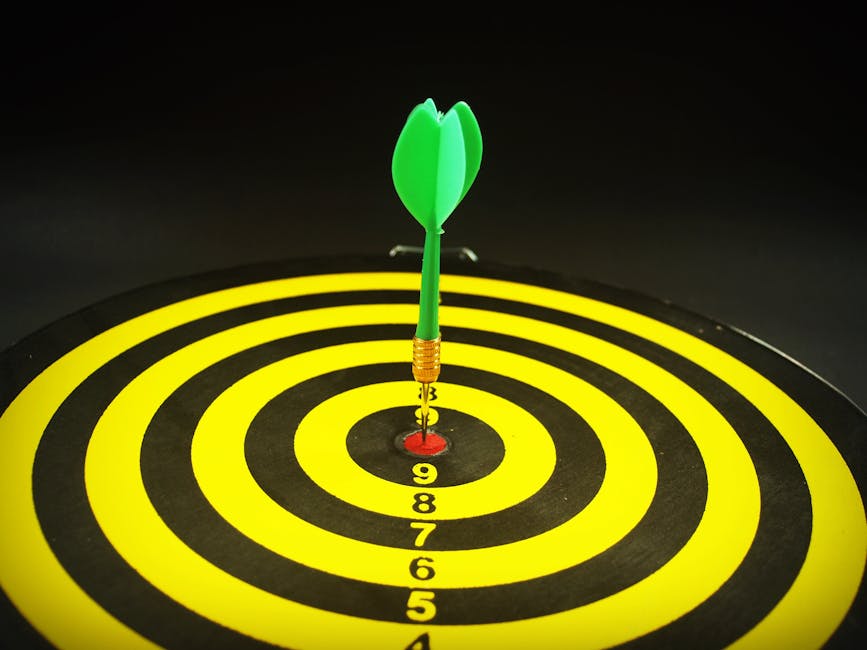
Photo by icon0 com on Pexels
These terms are often confused, but they mean different things:
* Accuracy: How close your measurement is to the true value. If you weigh 70 kg, and your scale says 70.1 kg, that's pretty accurate.
* Precision: How close multiple measurements are to each other. If you weigh yourself three times and get 70.1 kg, 70.0 kg, and 70.2 kg, your measurements are precise (they're close to each other). They're also accurate in this case!
You can have precise measurements that aren't accurate (e.g., your scale always reads 5 kg too high, so you get 75.1, 75.0, 75.2 kg), or accurate measurements that aren't precise (your scale reads 68, 70, 72 kg, averaging 70, but they're not close together). Ideally, you want both!
Uncertainty in Measurement
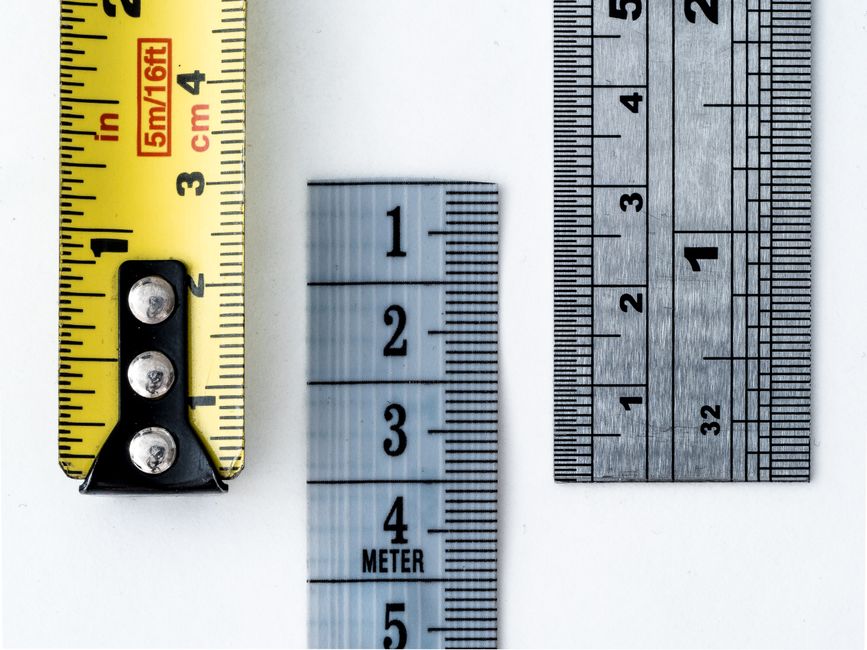
Photo by William Warby on Pexels
No measurement is perfect. There's always some uncertainty or error. This isn't a mistake; it's just a part of the process. It comes from:
* Limitations of the instrument: A ruler might only have markings down to millimeters.
* Human error: You might read the ruler slightly incorrectly.
* Environmental factors: Temperature changes can affect a measuring device.
You should always try to estimate the uncertainty in your measurements. For example, if you measure a length as 10.5 cm, and you're confident it's between 10.4 cm and 10.6 cm, you might write it as 10.5 ± 0.1 cm.
3. Worked Example
Let's say you need to measure the length of your phone.
- Choose your tool: You grab a standard ruler marked in centimeters and millimeters.
- Align: You line up the "0" mark of the ruler with one end of your phone.
- Read: You look at the other end of the phone. It falls between 16.2 cm and 16.3 cm. It looks closer to 16.2 cm.
- Estimate uncertainty: Since your ruler has millimeter markings, you can confidently read to the nearest millimeter (0.1 cm). You might estimate it to the next decimal place by eye. Let's say you judge it to be 16.25 cm.
- Record: You record the length as 16.25 cm. Given the ruler's precision, you might state the uncertainty. For a standard ruler, it's often half of the smallest increment, so ±0.05 cm. Your final measurement would be 16.25 ± 0.05 cm.
4. Key Takeaways
- Every measurement includes a numerical value and a specific unit.
- The International System of Units (SI) is the globally preferred system for scientific measurement.
- Accuracy describes how close a measurement is to the true value.
- Precision describes how consistent repeated measurements are with each other.
- All measurements inherently contain some level of uncertainty due to instruments and human factors.
-
Estimating and reporting uncertainty is crucial for a complete measurement.
-
Common Mistakes to Avoid:
- Forgetting to include units after your numbers.
- Confusing accuracy with precision.
- Not considering the limitations of your measuring tools.
- Writing down too many digits than your measurement tool actually allows (false precision).
5. Now Try It
Find three different objects around you (e.g., a pen, a book, your foot). Use a ruler or measuring tape to measure the length of each object. For each measurement, write down the value, the unit, and your best estimate of the uncertainty. Think about why you chose that uncertainty value based on your measuring tool.
Frequently asked about Introduction to Measurement
Study this next
Get the full science curriculum
Clone the complete plan to your dashboard for unlimited AI-generated notes, practice quizzes, and a personalised revision schedule.
Save this course free