Leavening Agents: Chemical Aeration
From the food science and technology curriculum
TL;DR
Chemical leavening agents create gas (usually carbon dioxide) through a reaction, which gets trapped in dough or batter, making baked goods light and airy. These reactions need an acid, a base, and often liquid and heat to work effectively. Understanding the different types helps you control the texture and rise of your baked products.
1. The Mental Model
Think of chemical leavening like a tiny, controlled explosion happening inside your dough. Acid and base ingredients react, releasing gas that expands, creating bubbles and making your food puff up. This process is key to achieving a tender, open crumb in things like cakes, muffins, and quick breads.
2. The Core Material
When we talk about chemical aeration, we're referring to ingredients that produce gas, typically carbon dioxide ($\text{CO}_2$), right in your batter or dough. This gas gets trapped, expands during baking, and creates that desirable light and airy texture. The two main components for most chemical leavening are an acid and a base.
How Baking Soda Works
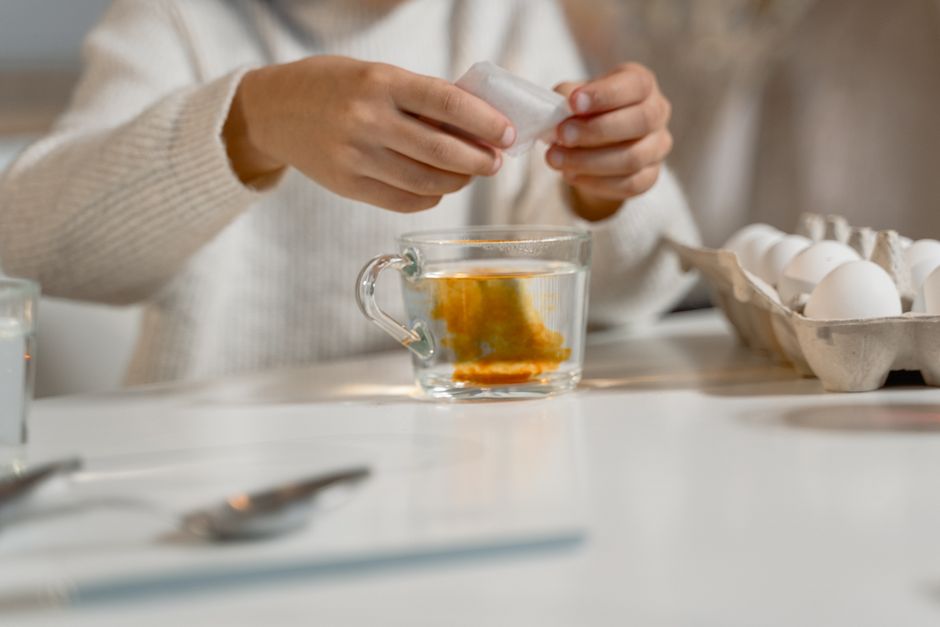
Photo by Tima Miroshnichenko on Pexels
Baking soda is pure sodium bicarbonate ($\text{NaHCO}_3$), a basic compound. For it to work, it must react with an acid. When combined with an acid (like buttermilk, yogurt, lemon juice, or even brown sugar) and a liquid, it produces $\text{CO}_2$ gas quickly.
The general reaction is:
$\text{NaHCO}_3 \text{ (base)} + \text{Acid} + \text{Liquid} \longrightarrow \text{Salt} + \text{Water} + \text{CO}_2 \text{ (gas)}$
Baking soda reacts very fast once wet. If you don't bake soon after mixing, a lot of the gas can escape, leading to a dense product. It also needs enough acid to neutralize it; too much baking soda without enough acid can leave a metallic or soapy aftertaste.
How Baking Powder Works
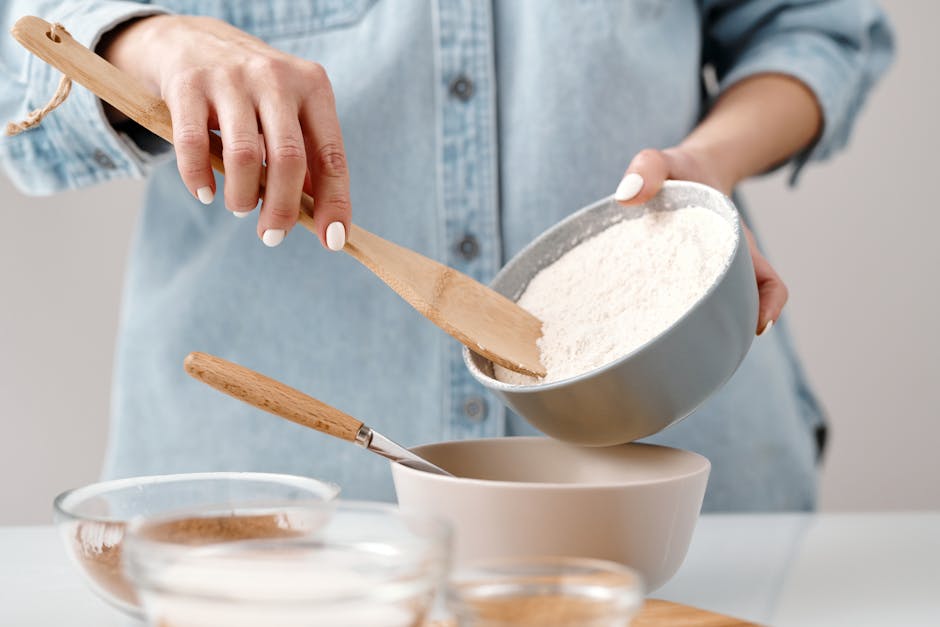
Photo by Nicole Michalou on Pexels
Baking powder is more convenient because it's a complete leavening system. It contains:
1. Baking soda (the base)
2. One or more powdered acids (e.g., cream of tartar, sodium aluminum sulfate, monocalcium phosphate)
3. A starch (like cornstarch) to keep the acid and base separate and absorb moisture, preventing premature reaction.
Baking powder is classified by its action:
* Single-acting baking powder: Contains only one acid that reacts immediately upon contact with liquid at room temperature. Like baking soda, it needs to be baked quickly.
* Double-acting baking powder: Contains at least two different acids. One acid reacts with liquid at room temperature (providing initial lift), and another acid reacts when heated in the oven (providing a second burst of lift). This gives you more flexibility in baking time. Most baking powders you buy today are double-acting.
The advantage of baking powder is that you don't need additional acidic ingredients in your recipe. It's formulated to provide a balanced rise.
Factors Affecting Chemical Leavening
Photo by Djordje Vezilic on Pexels
Several factors influence how well these agents perform:
* Moisture: Both baking soda and baking powder need liquid to dissolve the ingredients and allow the acid-base reaction to occur.
* Temperature: Heat accelerates chemical reactions. Double-acting baking powders specifically rely on heat for their second rise.
* Mixing: Overmixing can develop gluten too much, creating a strong network that traps gas less effectively, or it can cause already formed gas bubbles to escape. Undermixing might leave pockets of unreacted ingredients.
* Ingredient Balance: The ratio of acid to base is crucial. Too much base leads to soapy flavors; too much acid can interfere with taste and texture.
graph TD
    A["Chemical Leavening Agents"] --> B["Baking Soda (Sodium Bicarbonate)"]
    A --> C["Baking Powder"]

    B --> D["Needs an external Acid (e.g., Buttermilk, Lemon Juice)"]
    B --> E["Reacts quickly with liquid"]
    B --> F["Produces CO2 gas"]
    B --> G["Needs quick baking after mixing"]

    C --> H["Contains Baking Soda + Acid(s) + Starch"]
    C --> I["No external acid needed"]
    C --> J["Single-Acting"]
    C --> K["Double-Acting"]

    J --> L["Reacts with liquid at room temp"]
    K --> M["Reacts with liquid (initial lift)"]
    K --> N["Reacts with heat in oven (secondary lift)"]

    D & E & F --> P["Result: CO2 bubbles, provides lift"]
    G --> P
    I & L & M & N --> P
3. Worked Example
Let's say you're making muffins. Your recipe calls for 1 cup of all-purpose flour, 1/2 cup of sugar, 1/4 cup of milk, 1 egg, and 2 teaspoons of double-acting baking powder.
- Mixing: As you combine the wet and dry ingredients, the liquid from the milk and egg dissolves some of the components in the baking powder. The first acid in the double-acting baking powder immediately reacts with the baking soda present within the powder. This produces a small amount of $\text{CO}_2$ gas, creating tiny bubbles that start to aerate the batter even before it hits the oven. This initial rise provides some early lightness.
- Oven Heat: You place the muffin tin, filled with batter, into a preheated 375°F (190°C) oven. As the batter heats up, the second acid in the baking powder (the heat-activated acid) starts to react with the remaining baking soda. This generates a second, more significant burst of $\text{CO}_2$ gas.
- Expansion and Structure: This newly produced gas, along with the expansion of the existing gas bubbles due to heat, causes the muffins to rise dramatically. Simultaneously, the heat causes the egg proteins to coagulate and the flour starch to gelatinize, setting the structure of the muffin around these expanded gas pockets.
- Final Product: The result is a muffin with a light, tender crumb and a nicely domed top, achieved by the controlled, two-stage gas production from the double-acting baking powder.
If you had used baking soda in this recipe (without an added acidic ingredient like buttermilk), your muffins would likely be dense, flat, and might have a slightly off-flavor, because the baking soda wouldn't have enough acid to react with and produce sufficient gas.
4. Key Takeaways
- Chemical leavening agents create gas (usually $\text{CO}_2$) through an acid-base reaction, making baked goods rise.
- Baking soda ($\text{NaHCO}_3$) is a base and needs an added acidic ingredient to react and produce gas.
- Baking powder is a complete leavening system containing baking soda, one or more acids, and a starch.
- Double-acting baking powder provides lift in two stages: once when wet and again when heated in the oven.
- Moisture and heat are essential for activating chemical leavening agents effectively.
- The balance of acid and base prevents off-flavors and ensures proper texture.
Common Mistakes to Avoid:
- Using old or expired leavening agents; they lose their potency over time.
- Substituting baking soda for baking powder (or vice-versa) without adjusting other ingredients for acid/base balance.
- Overmixing batter with leavening agents, which can cause gas to escape, leading to a dense product.
- Not baking soon enough after mixing when using baking soda or single-acting baking powder.
5. Now Try It
Find two different recipes: one that uses only baking soda (e.g., a buttermilk biscuit recipe) and another that uses only double-acting baking powder (e.g., a standard muffin recipe). Read through each ingredients list and method, and identify how the leavening agent is activated in each. Consider when the gas production is primarily happening (mixing vs. baking) and what other ingredients contribute to or balance the leavening. Write down your observations for both recipes.
Frequently asked about Leavening Agents: Chemical Aeration
More from food science and technology
Get the full food science and technology curriculum
Clone the complete plan to your dashboard for unlimited AI-generated notes, practice quizzes, and a personalised revision schedule.
Save this course free