Foundations of Functions
From the Quadratic,Linear, Exponential Function curriculum
Foundations of Functions
TL;DR
Functions are like machines: you put something in, they do a specific job, and you get something out. They help us describe relationships between quantities, like how the amount of ingredients affects a recipe's yield. Understanding functions is key to building predictive models and solving real-world problems.
1. The Mental Model
Think of a function as a reliable recipe. You provide the ingredients (input), follow the steps exactly, and consistently get the same delicious dish (output). It's a clear, predictable relationship.
2. The Core Material
What is a Function?

Photo by Ann H on Pexels
In math, a function is a special relationship where each input has exactly one output. That's the core idea. You can't put in '2' and sometimes get '4' and sometimes get '5' from the same function. It has to be consistent.
We often write functions like f(x) = ... where f is the name of the function, x is the input (also called the independent variable), and f(x) represents the output (also called the dependent variable).
Domain and Range
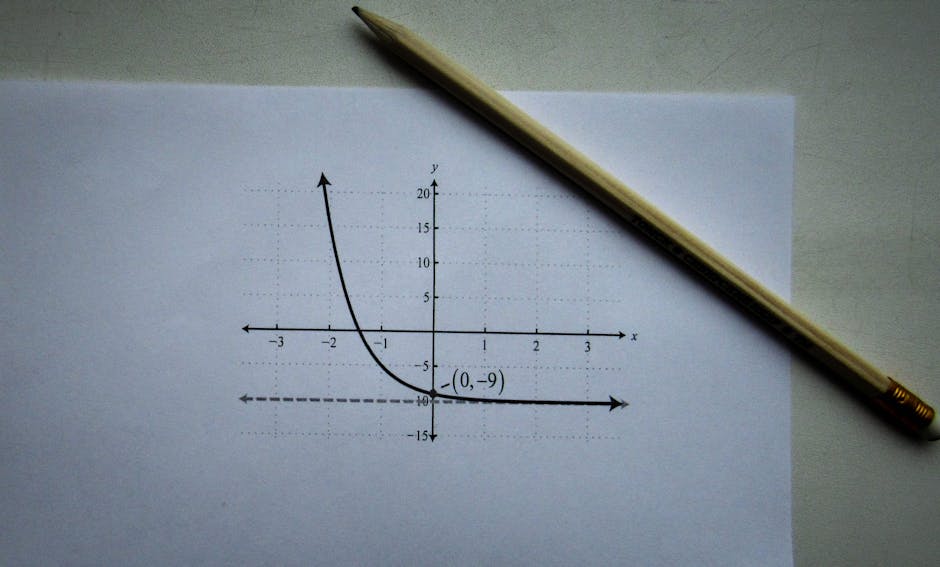
Photo by Sergey Meshkov on Pexels
- Domain: This is the set of all possible inputs that the function can accept. For many functions you'll see, the domain might be all real numbers. But sometimes, there are restrictions. For instance, you can't take the square root of a negative number in the real number system, so the domain for
f(x) = sqrt(x)would bex >= 0. - Range: This is the set of all possible outputs the function can produce. For
f(x) = x^2, no matter what real number you square, the outputf(x)will always be zero or positive, so the range isf(x) >= 0.
Representing Functions

Photo by Google DeepMind on Pexels
You'll encounter functions represented in several ways:
1. Equation: f(x) = 2x + 1
2. Table of Values:
| x | f(x) |
| --- | ---- |
| 0 | 1 |
| 1 | 3 |
| 2 | 5 |
3. Graph: A line on a coordinate plane where for every x-value, there's only one y-value.
4. Verbal Description: "The output is one more than twice the input."
The Vertical Line Test

Photo by Nataliya Vaitkevich on Pexels
A quick way to check if a graph represents a function is the Vertical Line Test. If you can draw any vertical line that intersects the graph more than once, then it's not a function. This is because multiple intersections mean one input (x-value) has multiple outputs (y-values), which violates the definition of a function.
graph TD
    A["Start: You have a relationship (like a graph)"] --> B{"Does each input (x) have ONLY one output (y)?"};
    B -- "No (e.g., a circle)" --> C["It's NOT a function"];
    B -- "Yes (e.g., a line, a parabola)" --> D["It IS a function"];
    D --> E["End: Understand the relationship type"];
3. Worked Example
Let's look at the function f(x) = x^2 + 3.
-
Identify the input (x) and output (f(x)).
- Input:
x - Output:
f(x)ory
- Input:
-
Calculate outputs for specific inputs:
- If
x = 0, thenf(0) = (0)^2 + 3 = 0 + 3 = 3. - If
x = 2, thenf(2) = (2)^2 + 3 = 4 + 3 = 7. - If
x = -1, thenf(-1) = (-1)^2 + 3 = 1 + 3 = 4.
- If
-
Determine its domain and range:
- Domain: Can you square any real number and add 3? Yes. So, the domain is all real numbers (often written as
(-∞, ∞)). - Range: What are the possible outputs? Since
x^2is always0or positive, the smallestx^2can be is0. So, the smallestf(x)can be is0 + 3 = 3. Therefore, the range is all real numbers greater than or equal to 3 (written as[3, ∞)).
- Domain: Can you square any real number and add 3? Yes. So, the domain is all real numbers (often written as
4. Key Takeaways
- A function assigns exactly one output to each input.
- The domain is all possible inputs; the range is all possible outputs.
- You can represent functions with equations, tables, graphs, or words.
- The Vertical Line Test quickly tells you if a graph is a function.
f(x)is just a fancy way of saying "the output value when the input is x."
Common Mistakes to Avoid:
- Don't confuse the function name f with the input x or the output f(x).
- Forgetting that the vertical line test applies to the graph, not the table or equation.
- Assuming the domain is always all real numbers; always check for restrictions like division by zero or square roots of negatives.
- Mixing up domain (inputs/x-values) with range (outputs/y-values).
5. Now Try It
Given the function g(x) = 1/(x-4):
- Calculate
g(0),g(3), andg(5). - Determine the domain of
g(x). Why can'txbe a certain value? - Explain, in your own words, what the range of
g(x)would be (you don't need to write it in interval notation, just describe it).
Success looks like: You correctly calculate the outputs, identify the single problematic input for the domain, and describe the set of possible outputs.
Frequently asked about Foundations of Functions
Study this next
Get the full Quadratic,Linear, Exponential Function curriculum
Clone the complete plan to your dashboard for unlimited AI-generated notes, practice quizzes, and a personalised revision schedule.
Create Free Account