Foundations of Quadratic Functions
From the Algebra 2 chapter 2 curriculum
Foundations of Quadratic Functions
TL;DR
Quadratic functions create U-shaped graphs called parabolas, described by an equation with an $x^2$ term. You can graph them by finding key points like the vertex and intercepts. Knowing these basics helps you understand and solve many real-world problems.
1. The Mental Model
Imagine throwing a ball; its path through the air is a parabola. Quadratic functions describe this kind of curve, showing you how one thing changes in relation to another, but not in a straight line. They always involve an $x^2$ term.
2. The Core Material
Quadratic functions are super important in Algebra 2. They're equations that can be written in the standard form: $f(x) = ax^2 + bx + c$, where 'a' can't be zero. If 'a' were zero, it wouldn't be a quadratic anymore, just a linear line!
The graph of a quadratic function is called a parabola. This parabola is always a smooth, symmetrical U-shape.
The 'a' value: Stretch, Shrink, and Direction

Photo by Ann H on Pexels
The 'a' coefficient tells you a lot about the parabola's shape:
* If $a > 0$ (a is positive), the parabola opens upwards (like a smile 🙂).
* If $a < 0$ (a is negative), the parabola opens downwards (like a frown 🙁).
* A larger absolute value of 'a' (e.g., $a=3$ vs. $a=1$) makes the parabola appear "skinnier" or stretched vertically.
* A smaller absolute value of 'a' (e.g., $a=0.5$ vs. $a=1$) makes the parabola appear "wider" or compressed vertically.
The 'c' value: The Y-intercept
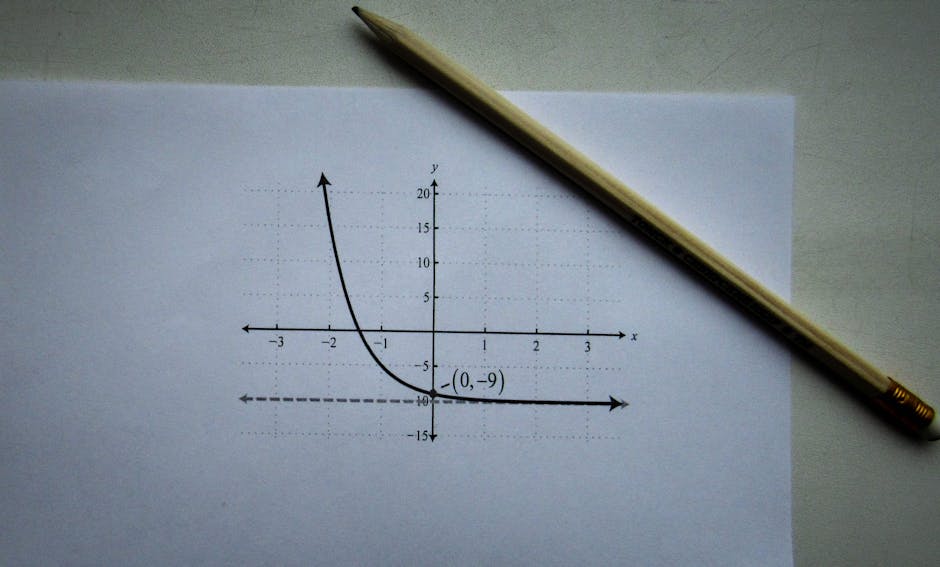
Photo by Sergey Meshkov on Pexels
The 'c' coefficient is the easiest to find on the graph. It's always the y-intercept, meaning where the parabola crosses the y-axis. To see why, just plug in $x=0$ into the standard form: $f(0) = a(0)^2 + b(0) + c = c$. So, the y-intercept is always $(0, c)$.
The Vertex: Turning Point

Photo by Collin Hanson on Pexels
The vertex is the most important point on a parabola. It's the turning point – either the lowest point (if the parabola opens up) or the highest point (if it opens down).
You can find the x-coordinate of the vertex using the formula: $x = -b / (2a)$.
Once you have the x-coordinate, plug it back into the original quadratic function to find the y-coordinate of the vertex. So, the vertex is $(-b / (2a), f(-b / (2a)))$.
The Axis of Symmetry
Photo by Afsyah - on Pexels
Every parabola has a vertical line that cuts it perfectly in half, called the axis of symmetry. This line always passes right through the vertex. Its equation is simply $x = -b / (2a)$. This means that for every point on one side of the axis, there's a mirror image point on the other side.
Graphing a Parabola Step-by-Step
Here's a simple process to sketch a parabola:
graph TD
    A["Start"] --> B{"Is 'a' positive or negative?"};
    B -- "a > 0" --> C["Parabola opens UP"];
    B -- "a < 0" --> D["Parabola opens DOWN"];
    C --> E["Find Vertex x-coord: x = -b/(2a)"];
    D --> E;
    E --> F["Plug x-coord into f(x) to find Vertex y-coord"];
    F --> G["Plot Vertex (x, y)"];
    G --> H["Find y-intercept: (0, c)"];
    H --> I["Plot y-intercept"];
    I --> J["Use axis of symmetry (x = Vertex x-coord) to find mirror point for y-intercept"];
    J --> K["Plot mirror point"];
    K --> L["Optionally, pick one more x-value, calculate f(x), and plot that point and its mirror"];
    L --> M["Draw a smooth, symmetrical curve through the points"];
    M --> N["End"];
3. Worked Example
Let's graph the function $f(x) = x^2 - 4x + 3$.
- Direction: Here, $a = 1$. Since $a > 0$, the parabola opens upwards.
- Y-intercept: $c = 3$. So, the y-intercept is $(0, 3)$.
- Vertex:
- x-coordinate: $x = -(-4) / (2 * 1) = 4 / 2 = 2$.
- y-coordinate: $f(2) = (2)^2 - 4(2) + 3 = 4 - 8 + 3 = -1$.
- The vertex is $(2, -1)$.
- Axis of Symmetry: $x = 2$.
- Mirror Point for Y-intercept: The y-intercept is $(0, 3)$, which is 2 units to the left of the axis of symmetry ($x=2$). So, its mirror point will be 2 units to the right of the axis of symmetry: $(2 + 2, 3) = (4, 3)$.
- Plot and Draw: You'd plot $(2, -1)$, $(0, 3)$, and $(4, 3)$, then draw a smooth parabola through them.
4. Key Takeaways
- A quadratic function's graph is a parabola, a symmetrical U-shape.
- The sign of 'a' ($ax^2$) determines if the parabola opens up (positive 'a') or down (negative 'a').
- The absolute value of 'a' controls how wide or narrow the parabola is.
- The 'c' term is always the y-intercept, located at $(0, c)$.
- The vertex is the parabola's turning point, found at $x = -b / (2a)$.
- The axis of symmetry is a vertical line through the vertex, with the equation $x = -b / (2a)$.
- You can graph a parabola using its direction, vertex, y-intercept, and a mirrored point.
Common Mistakes to Avoid:
- Forgetting the negative sign in the vertex formula $x = -b / (2a)$.
- Calculating the x-coordinate of the vertex but not plugging it back in to find the y-coordinate.
- Drawing a parabola as a V-shape instead of a smooth, curved U-shape.
- Confusing the y-intercept $(0, c)$ with the x-intercepts (where $f(x)=0$).
5. Now Try It
Graph the quadratic function $f(x) = -x^2 + 6x - 5$. Identify the direction it opens, find its vertex, y-intercept, and axis of symmetry. Plot these points and at least one other point (and its mirror) to sketch the parabola.
What success looks like: Your graph will be a downward-opening parabola with its vertex at $(3, 4)$, a y-intercept at $(0, -5)$, and an axis of symmetry at $x=3$. You'll also have a point at $(6, -5)$ as the mirror of the y-intercept.
Frequently asked about Foundations of Quadratic Functions
Get the full Algebra 2 chapter 2 curriculum
Clone the complete plan to your dashboard for unlimited AI-generated notes, practice quizzes, and a personalised revision schedule.
Create Free Account