Stereochemistry and Conformational Analysis
From the organic chemistry curriculum
Stereochemistry and Conformational Analysis
TL;DR
Stereochemistry is about how atoms are arranged in 3D space, which can drastically change a molecule's properties. Conformational analysis specifically looks at how molecules can twist and bend around single bonds. Understanding these concepts helps you predict a molecule's reactivity and behavior.
1. The Mental Model
Imagine molecules aren't flat drawings but 3D puzzles. Stereochemistry tells you if two puzzle pieces, even with the same atoms connected, are mirror images or completely different. Conformational analysis is like seeing how one puzzle piece can twist and turn without breaking, affecting its shape.
2. The Core Material
Chirality and Stereocenters

Photo by Noel Aph on Pexels
A molecule is chiral if it's non-superimposable on its mirror image, just like your left hand isn't superimposable on your right hand. The most common cause of chirality in organic molecules is a stereocenter (often called a chiral center). This is typically a carbon atom bonded to four different groups.
When a molecule has one stereocenter, it's always chiral. If it has multiple, it might be chiral. Two molecules that are non-superimposable mirror images are called enantiomers. They have identical physical properties (like boiling point, melting point) except for how they rotate plane-polarized light.
R/S Configuration
Photo by Steve A Johnson on Pexels
We use the Cahn-Ingold-Prelog (CIP) rules to assign an absolute configuration (R or S) to each stereocenter.
- Prioritize the groups attached to the stereocenter based on atomic number. Higher atomic number = higher priority. If the first atoms are the same, move to the next atoms along the chain until you find a difference.
- Orient the molecule so the lowest priority group (usually H) is pointing away from you (into the page/screen, on a dash).
- Trace a path from priority 1 to 2 to 3.
- If the path is clockwise, it's R (Rectus, right).
- If the path is counter-clockwise, it's S (Sinister, left).
- If the lowest priority group is pointing towards you (out of the page/screen, on a wedge), do the opposite of what you see (clockwise = S, counter-clockwise = R).
Diastereomers and Meso Compounds

Photo by Ivan S on Pexels
When you have molecules with two or more stereocenters:
* Diastereomers are stereoisomers that are not mirror images. They have different physical and chemical properties.
* A meso compound is a molecule that has stereocenters but is achiral overall due to an internal plane of symmetry. This means it's superimposable on its mirror image.
graph TD
    A["Molecule (Same Formula)"] --> B{Are they isomers?};
    B -- No --> C["Not Isomers"];
    B -- Yes --> D{Are they stereoisomers?};
    D -- No --> E["Constitutional Isomers (different connectivity)"];
    D -- Yes --> F{Are they mirror images?};
    F -- Yes --> G{Are they superimposable?};
    G -- Yes --> H["Identical Molecules"];
    G -- No --> I["Enantiomers (non-superimposable mirror images)"];
    F -- No --> J["Diastereomers (not mirror images)"];
Conformational Analysis
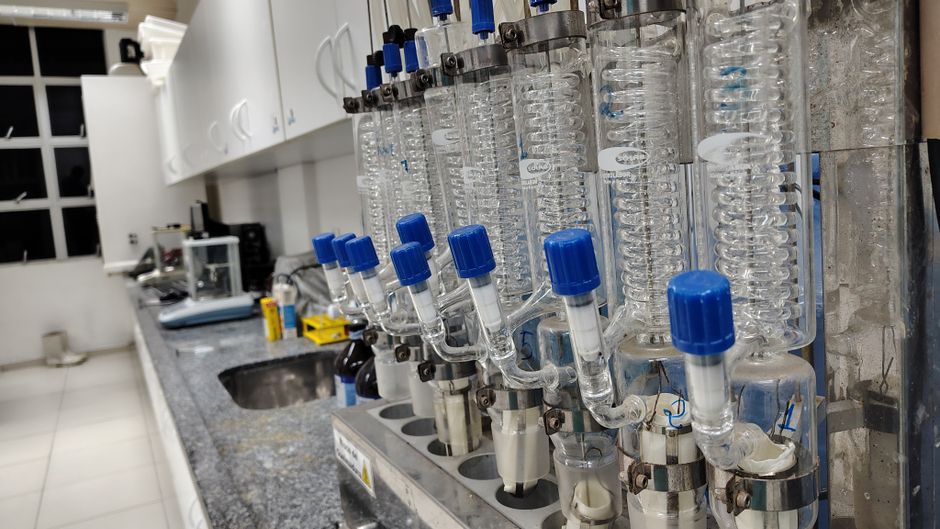
Photo by Kleison Leopoldino on Pexels
This deals with the different 3D arrangements (conformations) a molecule can adopt by rotation around single bonds. Different conformations have different energies.
- Newman Projections are a great way to visualize conformations by looking down a specific bond. The front carbon is a dot, the back carbon is a circle. Groups on the front carbon attach to the dot, groups on the back carbon attach to the circle.
- Staggered conformations have groups on adjacent carbons as far apart as possible (lower energy, more stable).
- Eclipsed conformations have groups directly in front of each other (higher energy, less stable).
- Cyclohexane Conformations: Cyclohexane isn't flat; it puckers to relieve angle strain and torsional strain. The most stable conformation is the chair conformation.
- Groups can be in axial (up/down) or equatorial (around the 'equator') positions.
- Chair flips interconvert axial and equatorial positions (an axial group becomes equatorial and vice-versa, but its 'up' or 'down' orientation remains).
- Bulky groups prefer equatorial positions to minimize steric strain (1,3-diaxial interactions).
3. Worked Example
Let's assign R/S configuration to 2-butanol.
The structure is CH₃CH(OH)CH₂CH₃. The chiral center is C2, bonded to:
1. -OH
2. -CH₃
3. -H
4. -CH₂CH₃
Step 1: Prioritize groups on the chiral carbon.
* -OH: O (atomic number 8) is highest priority. (1)
* -CH₂CH₃: C (atomic number 6) attached to C.
* -CH₃: C (atomic number 6) attached to H.
* -H: H (atomic number 1) is lowest priority. (4)
Comparing -CH₂CH₃ and -CH₃:
* For -CH₂CH₃, the carbon is attached to C, H, H.
* For -CH₃, the carbon is attached to H, H, H.
* So, -CH₂CH₃ gets priority 2, and -CH₃ gets priority 3.
Priorities:
1. -OH
2. -CH₂CH₃
3. -CH₃
4. -H
Step 2: Orient the molecule. Let's draw it with the H (priority 4) on a dashed wedge (pointing away):
      OH (1)
      |
   C2 -- CH2CH3 (2)
  / \
(4) H   CH3 (3)
(Imagine H going into the page, OH coming out slightly, CH2CH3 to the right, CH3 to the left.)
Step 3: Trace the path 1 → 2 → 3.
Starting from OH (1), going to CH₂CH₃ (2), then to CH₃ (3): this path is clockwise.
Since the lowest priority group (H) is pointing away, the configuration is R.
So, this specific enantiomer is (R)-2-butanol.
4. Key Takeaways
- Chiral molecules are non-superimposable on their mirror images, usually due to a stereocenter.
- Enantiomers are non-superimposable mirror images and have identical physical properties except for optical rotation.
- R/S notation assigns absolute configuration to stereocenters using CIP rules.
- Diastereomers are stereoisomers that are not mirror images and have different properties.
- Meso compounds have stereocenters but are achiral due to an internal plane of symmetry.
- Conformational analysis describes how molecules twist around single bonds, affecting stability.
- Newman projections visualize rotations, with staggered conformations being more stable than eclipsed.
- Cyclohexane's chair conformation is the most stable, and bulky groups prefer equatorial positions.
Common Mistakes to Avoid:
- Not correctly identifying all four different groups around a potential stereocenter.
- Incorrectly assigning priorities in R/S rules, especially when comparing groups with the same first atom.
- Forgetting to flip the R/S assignment if the lowest priority group is pointing towards you.
- Confusing axial and equatorial positions or incorrectly performing a chair flip.
5. Now Try It
Draw both chair conformations for trans-1,2-dimethylcyclohexane. Label each methyl group as axial or equatorial in both conformations. Then, determine which of the two chair conformations is more stable and explain why in one sentence.
Success looks like: Two distinct chair drawings, with correct axial/equatorial labels for each methyl group in both chairs, and a clear explanation for the more stable conformation.
Frequently asked about Stereochemistry and Conformational Analysis
Study this next
Get the full organic chemistry curriculum
Clone the complete plan to your dashboard for unlimited AI-generated notes, practice quizzes, and a personalised revision schedule.
Create Free Account