Introduction to Python and Basic Data Types
From the https://youtu. curriculum
Introduction to Python and Basic Data Types
TL;DR
Python is a popular, easy-to-read programming language that lets you tell computers what to do. At its core, Python handles different types of information, like numbers and text, which are called data types. Understanding these data types is essential for writing effective and error-free code.
1. The Mental Model
Think of Python as a set of instructions you're giving to a very obedient, but unintelligent, assistant. This assistant needs you to be very specific about what kind of information you're giving it and what you want it to do with that information.
2. The Core Material
Python is an interpreted, high-level, general-purpose programming language. Created by Guido van Rossum and first released in 1991, Python's design philosophy emphasizes code readability with its notable use of significant whitespace. This means you don't need to put semicolons at the end of every line, and the way you indent your code actually matters.
Getting Started with Python

Photo by cottonbro studio on Pexels
You don't need a huge setup to start. You can use an online interpreter or install Python on your computer. When you run Python, you're interacting with its "interpreter," which executes your code line by line.
Let's look at the "Hello, World!" program, which is the traditional first step in learning any new language:
print("Hello, World!")
When you run this, Python simply displays Hello, World! on your screen. The print() part is a built-in function that outputs data.
Variables: Naming Your Data

Photo by Rashed Paykary on Pexels
A variable is like a named container for a piece of information. You give it a name, and then you can store different kinds of data in it.
message = "Welcome to Python!" # 'message' is the variable name
print(message)
In this example, message holds the text "Welcome to Python!". You can change what's inside a variable at any time.
age = 30
print(age)

age = 31 # Now 'age' holds a different value
print(age)
Basic Data Types in Python
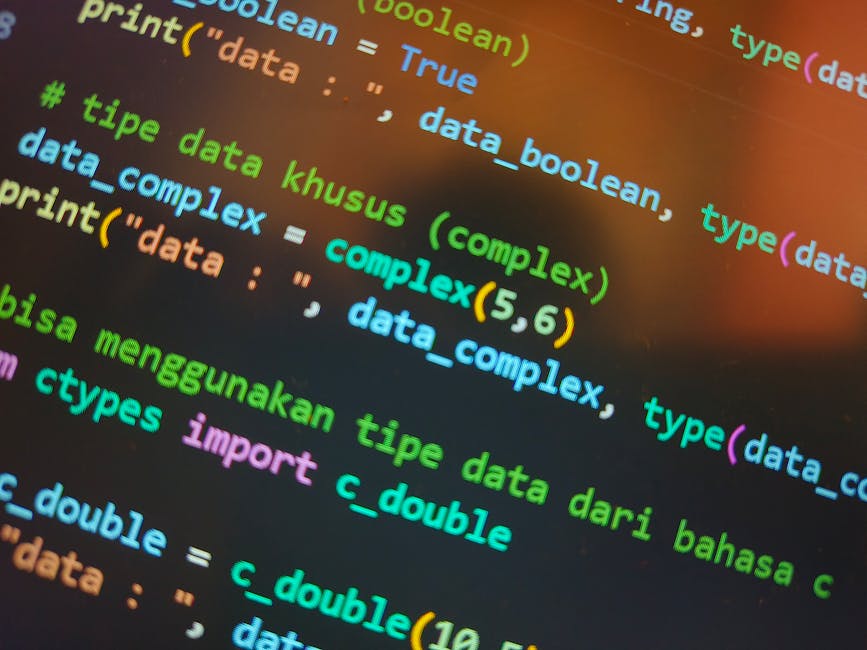
Photo by Seraphfim Gallery on Pexels
Python automatically figures out what kind of data you're storing. Here are the most common basic types:
Numbers
There are two main types of numbers you'll use:
- Integers (
int): Whole numbers, positive or negative, without decimals.
python my_integer = 10 another_integer = -5 - Floating-point numbers (
float): Numbers that have a decimal point.
python
    my_float = 3.14
    another_float = 0.5
You can perform standard math operations:
a = 10
b = 3
print(a + b) # Addition: 13
print(a - b) # Subtraction: 7
print(a * b) # Multiplication: 30
print(a / b) # Division: 3.333... (always a float)
print(a // b) # Floor division: 3 (gets the whole part)
print(a % b) # Modulo: 1 (gets the remainder)
Strings
Strings (str) are sequences of characters, like letters, numbers, or symbols. You define them using single quotes (') or double quotes (").
greeting = "Hello"
name = 'Alice'
multiline_string = """This is a string
that spans multiple lines."""

print(greeting + ", " + name + "!") # You can combine (concatenate) strings
Booleans
Booleans (bool) represent truth values: True or False. They're fundamental for making decisions in your code.
is_sunny = True
is_raining = False

print(is_sunny)
print(is_raining)
You'll use these in conditional statements (which we'll cover later) to control the flow of your program.
Checking Data Types

Photo by Kampus Production on Pexels
You can always check the type of a variable using the type() function.
x = 10
y = 3.14
z = "Python"
is_active = True

print(type(x))
print(type(y))
print(type(z))
print(type(is_active))
This will output p```mermaid
graph TD
A["Start: Writing Python Code"] --> B{"Need to store information?"}
B -- "Yes" --> C["Choose a Variable Name"]
C --> D["Assign Value to Variable"]
D --> E{{"What kind of information?"}}
E -- "Whole Number" --> F["int(e.g.,age = 30)"]
E -- "Decimal Number" --> G["float(e.g.,price = 19.99)"]
E -- "Text/Characters" --> H["str(e.g.,name = 'Bob')"]
E -- "True/False Value" --> I["bool(e.g.,is_valid = True)"]
F --> J["Use Variable in Program"]
G --> J
H --> J
I --> J
B -- "No" --> K["Work directly with values (e.g.,print(5 + 3)`)"]
K --> L["Continue Coding"]
J --> L
L --> M["End: Program Logic"]
## 3. Worked Example
Let's build a small snippet that calculates a simple bill and uses different data types.

```python
# Cafe billing system

# --- Inputs (using different data types) ---
coffee_price = 3.50        # float
sandwich_price = 7.99      # float
customer_name = "Jamie"    # string
has_discount = True        # boolean
discount_percentage = 0.10 # float (10%)

# --- Calculations ---
num_coffees = 2            # int
num_sandwiches = 1         # int

subtotal_coffee = coffee_price * num_coffees
subtotal_sandwich = sandwich_price * num_sandwiches

total_bill = subtotal_coffee + subtotal_sandwich

# Apply discount if applicable
if has_discount:
    total_bill = total_bill * (1 - discount_percentage)
    print(f"Applying {discount_percentage*100}% discount for {customer_name}.")
else:
    print(f"No discount applied for {customer_name}.")

# --- Output ---
print(f"Hello, {customer_name}!")
print(f"Your coffee subtotal: ${subtotal_coffee:.2f}")
print(f"Your sandwich subtotal: ${subtotal_sandwich:.2f}")
print(f"Your final bill is: ${total_bill:.2f}")
This code first sets up prices and customer info. It then calculates subtotals based on int quantities, sums them for total_bill (a float), and conditionally applies a float discount if has_discount (a boolean) is True. Finally, it prints a user-friendly summary using str values.
4. Key Takeaways
- Python is a user-friendly language that's easy to read and write.
- Variables are named containers used to store different kinds of data.
- Basic data types include integers (
int), floating-point numbers (float), strings (str), and Booleans (bool). intis for whole numbers,floatis for numbers with decimal points.stris for any text, enclosed in single or double quotes.boolis forTrueorFalsevalues, used for making decisions.- You can check a variable's data type with the
type()function.
Common Mistakes to Avoid:
- Forgetting quotes around strings (e.g., name = John instead of name = "John").
- Mixing data types unexpectedly, like trying to add a number and a string directly without converting one (e.g., print(5 + "apples")).
- Using variable names that aren't descriptive (e.g., x = 5 when age = 5 is clearer).
- Confusing integer division (//) with regular division (/) when you need a specific type of result.
5. Now Try It
Create a short Python script that:
1. Stores your favorite movie title in a string variable.
2. Stores its release year (an integer) in another variable.
3. Stores its average rating (a float, e.g., 8.5) in a third variable.
4. Stores whether you recommend it (True or False) in a boolean variable.
5. Prints out each piece of information, clearly labeled, using f-strings (like print(f"Title: {movie_title}")).
Success looks like: Seeing your movie details printed clearly on the screen, each value correctly corresponding to its assigned variable and data type.
Frequently asked about Introduction to Python and Basic Data Types
Get the full https://youtu. curriculum
Clone the complete plan to your dashboard for unlimited AI-generated notes, practice quizzes, and a personalised revision schedule.
Create Free Account