Bridge Types
From the Fundamentals of Bridge Engineering curriculum
TL;DR
Bridge types are categorized primarily by how they transfer loads to their supports, influencing their span length, cost, and aesthetics. Each type, like beam, arch, suspension, or cable-stayed, has distinct structural behaviors and best use cases. Understanding these types is crucial for selecting the right bridge for a specific site and function.
1. The Mental Model
Imagine a bridge as a specialized pathway across an obstacle. Its "type" describes the fundamental engineering trick it uses to hold itself up and carry weight across that gap, essentially defining its skeleton and how it handles the forces acting upon it.
2. The Core Material
Bridge types are distinguished by their structural form and how they resist forces like gravity, wind, and seismic activity. The main goal is to efficiently transfer the vertical loads (weight of traffic, bridge itself) into horizontal or vertical reactions at the supports.
Let's break down the most common types:
2.1 Beam Bridges

Photo by Mike van Schoonderwalt on Pexels
These are the simplest and most common. A beam bridge works by directly supporting the deck on horizontal beams (girders) that span between two supports. The beams are under bending – the top compresses and the bottom stretches.
- How they work: The deck sits on top of beams. Loads push down, causing the beams to flex. The supports at each end carry these downward forces.
- Pros: Easy to design and construct, cost-effective for shorter spans.
- Cons: Limited span length due to bending stress.
- Examples: Most highway overpasses, short river crossings.
2.2 Arch Bridges
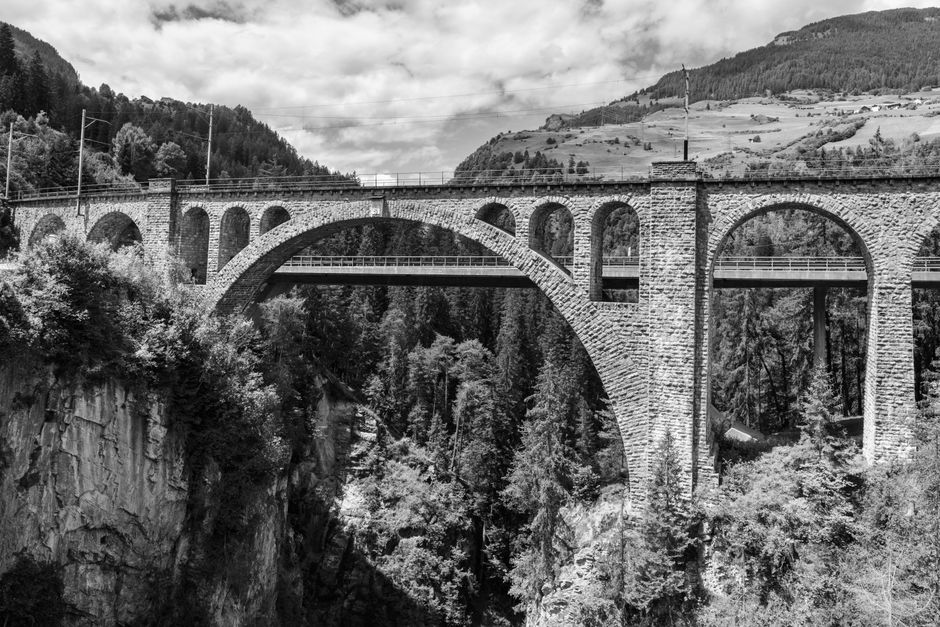
Photo by Susanne Jutzeler, suju-foto on Pexels
Arch bridges transfer loads outward along a curved structure to abutments at each end. The curved shape means the primary force within the arch is compression.
- How they work: The arch form converts vertical loads into outward horizontal thrust at the supports. Think of squeezing the top of an arch – it wants to spread outwards.
- Pros: Very strong in compression, can span longer distances than beam bridges, often aesthetically pleasing.
- Cons: Requires strong abutments to resist horizontal thrust; can be more complex to build.
- Examples: Roman aqueducts, Sydney Harbour Bridge, New River Gorge Bridge.
2.3 Truss Bridges

Photo by Kent Dolezal on Pexels
A truss bridge uses a framework of interconnected triangles to form a rigid structure. Triangles are inherently stable shapes, and members within the truss are primarily subjected to tension or compression forces, not bending.
- How they work: Loads are distributed through the triangular network, making each member efficiently carry either a pulling (tension) or pushing (compression) force.
- Pros: Very efficient use of material for moderate to long spans, strong and rigid.
- Cons: Can be visually heavier; more complex fabrication and assembly.
- Examples: Many historic railway bridges, some modern highway bridges.
2.4 Suspension Bridges

Photo by Claudio Mota on Pexels
These bridges use large main cables draped over tall towers, anchored at each end. The bridge deck hangs from these main cables via vertical suspender cables. The main cables are primarily in tension.
- How they work: The deck's weight is transferred to the suspenders, then to the main cables, which pull horizontally on the anchorages and vertically on the towers. The towers push straight down into the ground.
- Pros: Can span very long distances (longest bridge type), elegant appearance.
- Cons: High construction cost and complexity, vulnerable to wind forces, requires massive anchorages.
- Examples: Golden Gate Bridge, Akashi Kaikyō Bridge.
2.5 Cable-Stayed Bridges
Similar to suspension bridges in appearance, cable-stayed bridges feature a deck supported by cables directly connected to one or more towers (pylons). Unlike suspension bridges, the cables are attached in a fan-like or parallel pattern directly from the tower to various points along the deck. The cables are in tension.
- How they work: The cables transfer the deck's weight directly to the tower, which then carries both vertical load (from the cables) and bending forces (from the deck's own weight between cable attachments) down to the foundation.
- Pros: Excellent for medium-long spans (longer than truss, shorter than suspension), less material than suspension, quicker to build.
- Cons: Requires strong towers and foundations, complex cable installation.
- Examples: Millau Viaduct, Erasmus Bridge.
Here's a diagram summarizing the primary load paths for each type:
graph TD
    A["Bridge Type"] --> B{"Primary Load Transfer Mechanism"}

    B --> C["Beam Bridge: Bending (Beams)"]
    C --> C1[("Supports Vertical Load Directly")]

    B --> D["Arch Bridge: Compression (Arch)"]
    D --> D1[("Converts Vertical Load to Horizontal Thrust")]

    B --> E["Truss Bridge: Tension/Compression (Members)"]
    E --> E1[("Distributes Load Through Triangles")]

    B --> F["Suspension Bridge: Tension (Main Cables)"]
    F --> F1[("Longest Spans, Deck 'Hangs'")]

    B --> G["Cable-Stayed Bridge: Tension (Stay Cables)"]
    G --> G1[("Medium-Long Spans, Cables Directly Support Deck")]
2.6 Hybrid Bridges
Often, engineers combine elements of these basic types to optimize performance, cost, or aesthetics for specific challenges. For example, a Beam-Arch hybrid might use an arch for main load transfer and beams for a flatter deck.
3. Worked Example
Imagine you're designing a bridge to cross a 200-meter-wide river in a relatively flat, stable area.
- Beam Bridge: A simple beam bridge would likely require very deep and heavy beams for a 200m span, making it uneconomical and possibly impractical due to material weight and height clearance. The bending stresses would be enormous.
- Arch Bridge: An arch bridge could work well, providing a strong, elegant solution. However, it would require significant excavation and strong foundations on both banks to resist the outward thrust. This might be costly if the soil isn't ideal.
- Truss Bridge: A truss bridge is a strong contender for a 200m span. It would be relatively economical in material and construction, offering a rigid structure. You'd calculate the forces in each truss member (tension or compression) and size them accordingly.
- Suspension Bridge: While capable of the span, a suspension bridge would be overkill and overly expensive for just 200m. The massive cables and anchorages aren't justified for this span.
- Cable-Stayed Bridge: This is a very strong candidate. A cable-stayed bridge with one or two towers would elegantly span 200m. The cables efficiently transfer the load, and construction can often proceed segmentally, which is advantageous. The towers are less massive than suspension bridge towers for this span, and no huge anchorages are needed.
For a 200m span over a river, a Truss Bridge or a Cable-Stayed Bridge would likely be the most appropriate and cost-effective choices, depending on aesthetics, specific site conditions, and budget. A simple beam bridge is too limited, and a suspension bridge is too much. An arch bridge is possible but might be more expensive due to foundation requirements.
4. Key Takeaways
- Bridge types are defined by their fundamental load-carrying mechanism.
- Beam bridges are simple and good for short spans, resisting loads through bending.
- Arch bridges are strong in compression and convert vertical loads into horizontal thrust.
- Truss bridges use triangular frameworks to transfer loads through tension and compression in their members, efficient for moderate spans.
- Suspension bridges are best for the longest spans, carrying loads through tension in their main cables.
- Cable-stayed bridges are a versatile option for medium-long spans, with cables directly supporting the deck from towers.
- The best bridge type depends on span length, site conditions, cost, and aesthetics.
Common mistakes to avoid:
- Underestimating foundation requirements: Especially for arch bridges (thrust) and suspension/cable-stayed bridges (tower loads, anchorages).
- Over-specifying: Using a complex, expensive bridge type when a simpler, cheaper one would suffice for the span.
- Ignoring environmental factors: Wind loading is critical for long-span suspension and cable-stayed bridges; seismic activity impacts all types.
- Focusing only on initial cost: Life-cycle cost, including maintenance, is equally important.
5. Now Try It
You need to cross a new 60-meter-wide highway with a pedestrian bridge. You want something aesthetically pleasing but also economical and quick to build. Based on what you've learned, sketch out two different bridge types that would be suitable for this scenario, noting why each is a good fit and what their primary load transfer mechanism would be. Success looks like you identifying two appropriate bridge types for that span and justifying your choice with a brief explanation of their structural action.
Frequently asked about Bridge Types
Study this next
Get the full Fundamentals of Bridge Engineering curriculum
Clone the complete plan to your dashboard for unlimited AI-generated notes, practice quizzes, and a personalised revision schedule.
Save this course free