GCSE Chemistry: Organic Chemistry and Chemical Analysis
From the GCSE Prep curriculum
TL;DR
Organic chemistry explores compounds based on carbon, mainly focusing on hydrocarbons and their reactions. Chemical analysis involves methods to identify substances and determine their purity or quantity. Together, these topics help us understand the vast world of carbon compounds and how to test for them.
1. The Mental Model
Imagine carbon as a super-friendly atom that loves to bond with almost anything, especially other carbons, forming long chains and rings. Chemical analysis is like being a detective, using different tests to figure out what's in a sample.
2. The Core Material
Organic Chemistry: The World of Carbon

Photo by Nishant Aneja on Pexels
Organic chemistry is all about compounds containing carbon atoms. Carbon can form four bonds, which allows it to create an incredibly diverse range of molecules.
Hydrocarbons
These are the simplest organic compounds, made only of carbon and hydrogen atoms.
* Alkanes: Saturated hydrocarbons (only single bonds between carbon atoms). They're unreactive, often used as fuels.
* General formula: CnH2n+2
* Examples: Methane (CH4), Ethane (C2H6), Propane (C3H8)
* Alkenes: Unsaturated hydrocarbons (contain at least one carbon-carbon double bond). The double bond makes them more reactive than alkanes.
* General formula: CnH2n
* Examples: Ethene (C2H4), Propene (C3H6)
* Crude Oil: A fossil fuel, a mixture of many different hydrocarbons (mostly alkanes) formed over millions of years. It's separated into useful fractions by fractional distillation.
* Longer chains have higher boiling points and are found at the bottom of the fractionating column.
* Shorter chains have lower boiling points and rise to the top.
* Cracking: Large, less useful hydrocarbon molecules are broken down into smaller, more useful alkanes and alkenes using heat (thermal cracking) or a catalyst (catalytic cracking). This is important because there's more demand for smaller, lighter fractions like petrol.
Reactions of Hydrocarbons
- Combustion: Both alkanes and alkenes burn in oxygen.
- Complete combustion: Enough oxygen produces carbon dioxide and water. (e.g., CH4 + 2O2 → CO2 + 2H2O)
- Incomplete combustion: Limited oxygen produces carbon monoxide (a toxic gas), carbon (soot), and water.
- Addition Reactions (for Alkenes): The double bond in alkenes can open up to add other atoms. This is why alkenes are more reactive.
- With Bromine Water: Alkenes decolorize bromine water (orange to colourless). This is a key test to distinguish alkanes from alkenes. (Alkanes don't react with bromine water in the dark).
- Hydrogenation: Adding hydrogen to an alkene to form an alkane (used in hardening vegetable oils).
- Hydration: Adding steam to an alkene to form an alcohol.
- Polymerisation: Many small alkene molecules (monomers) join together to form a very large molecule (polymer). (e.g., ethene → poly(ethene)).
Chemical Analysis: Identifying Substances
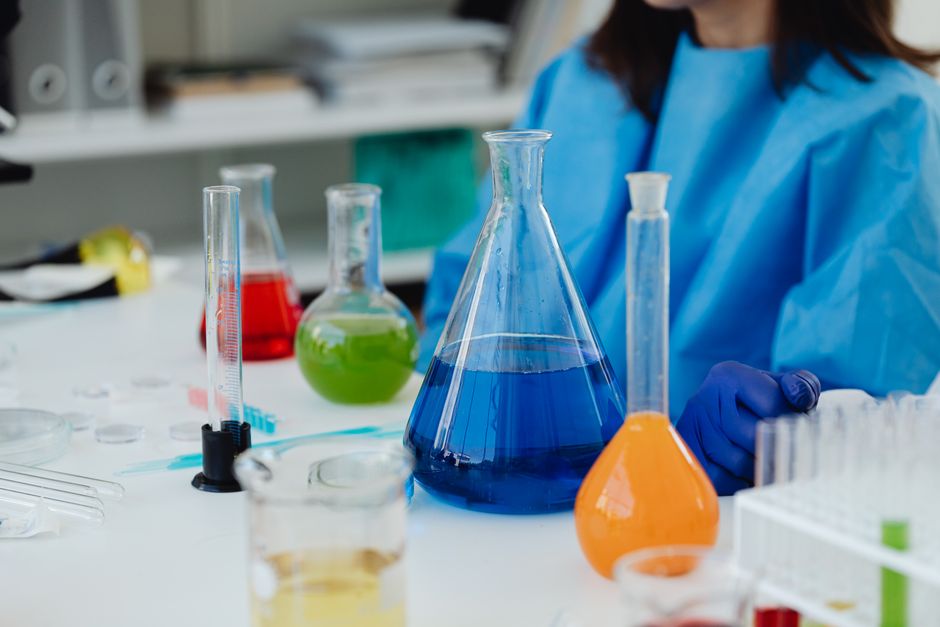
Photo by https://kaboompics.com/ on Pexels
Tests for Specific Gases
- Hydrogen (H2): "Pop" test. A lighted splint extinguishes with a squeaky pop.
- Oxygen (O2): Relights a glowing splint.
- Carbon Dioxide (CO2): Turns limewater (calcium hydroxide solution) cloudy.
- Chlorine (Cl2): Bleaches damp litmus paper (turns it white).
Tests for Anions (Negative Ions)
- Carbonates (CO3^2-): Add dilute acid. Effervescence (fizzing) occurs, producing CO2 (test with limewater).
- Halides (Cl^-, Br^-, I^-): Add dilute nitric acid, then silver nitrate solution.
- Chloride (Cl^-): White precipitate of AgCl.
- Bromide (Br^-): Cream precipitate of AgBr.
- Iodide (I^-): Yellow precipitate of AgI.
- Sulfates (SO4^2-): Add dilute hydrochloric acid, then barium chloride solution.
- Sulfate (SO4^2-): White precipitate of BaSO4.
Tests for Cations (Positive Ions) - Metal Ions
- Flame Tests: Heat a sample of the metal ion compound in a Bunsen burner flame (using a clean platinum wire).
- Lithium (Li^+): Crimson red
- Sodium (Na^+): Orange-yellow
- Potassium (K^+): Lilac
- Calcium (Ca^2+): Brick red
- Copper (Cu^2+): Blue-green
- Sodium Hydroxide Solution Test: Add sodium hydroxide solution dropwise to a solution of the metal ion.
- Copper (Cu^2+): Blue precipitate of copper hydroxide.
- Iron(II) (Fe^2+): Green precipitate of iron(II) hydroxide.
- Iron(III) (Fe^3+): Brown precipitate of iron(III) hydroxide.
- Aluminium (Al^3+): White precipitate of aluminium hydroxide, which dissolves in excess NaOH to form a colourless solution.
- Calcium (Ca^2+): White precipitate of calcium hydroxide (does not dissolve in excess NaOH).
- Magnesium (Mg^2+): White precipitate of magnesium hydroxide (does not dissolve in excess NaOH).
Purity and Chromatography
- Pure substance: Melts and boils at a specific, fixed temperature.
- Impure substance (mixture): Melts and boils over a range of temperatures.
- Chromatography (e.g., Paper Chromatography): A technique to separate mixtures and test for purity.
- Separates substances based on their differential solubility in a solvent and their attraction to the stationary phase (e.g., paper).
- A pure substance will show only one spot on a chromatogram.
- Rf value: Retention factor, calculated as (distance moved by substance) / (distance moved by solvent front). Used to identify substances.
Here's a diagram showing the process of identifying an unknown gas:
graph TD
    A["Unknown Gas Sample"] --> B{Does it relight a glowing splint?};
    B -- Yes --> C["Gas is Oxygen"];
    B -- No --> D{Does it extinguish a lighted splint with a pop?};
    D -- Yes --> E["Gas is Hydrogen"];
    D -- No --> F{Does it turn limewater cloudy?};
    F -- Yes --> G["Gas is Carbon Dioxide"];
    F -- No --> H{Does it bleach damp litmus paper?};
    H -- Yes --> I["Gas is Chlorine"];
    H -- No --> J["Another Gas or Mixture"];
3. Worked Example
Let's say you have an unknown liquid, and you suspect it might be an alkene, but you also want to check for the presence of a chloride ion.
- Test for Alkene: You take a small sample of the unknown liquid and add a few drops of orange bromine water to it. If the bromine water turns colourless, it indicates the presence of a carbon-carbon double bond, meaning it's likely an alkene. If it stays orange, it's probably an alkane or another saturated compound.
- Test for Chloride Ion: To a separate small sample of the unknown liquid (or a solution made from it if it's not water-soluble), you first add a few drops of dilute nitric acid. This removes any interfering carbonate ions. Then, you add a few drops of silver nitrate solution. If a white precipitate forms, that confirms the presence of chloride ions (AgCl).
4. Key Takeaways
- Organic chemistry focuses on carbon compounds, with alkanes being saturated (single bonds) and alkenes unsaturated (double bonds).
- Alkenes are more reactive than alkanes due to their double bond and undergo addition reactions.
- Crude oil is separated by fractional distillation, and larger hydrocarbons can be broken down by cracking.
- Key gas tests involve using a glowing splint for oxygen, a lighted splint for hydrogen, limewater for carbon dioxide, and damp litmus for chlorine.
- Anion tests use dilute acid then silver nitrate for halides and dilute acid then barium chloride for sulfates.
- Cation tests include distinctive flame colours and characteristic precipitates with sodium hydroxide solution.
- Chromatography separates mixtures, and the Rf value helps identify substances.
Common Mistakes to Avoid:
- Mixing up the tests for oxygen (glowing splint) and hydrogen (lighted splint).
- Forgetting to add dilute acid before testing for halides or sulfates, as carbonates can give misleading results.
- Not knowing the specific colours for precipitates or flame tests; these are often required facts.
- Assuming a pure substance will always melt at exactly 0°C or boil at 100°C; these are only for pure water.
- Confusing complete and incomplete combustion products; remember carbon monoxide and soot from incomplete combustion.
5. Now Try It
Imagine you're in a lab and given three unlabelled test tubes: one contains propene, one contains propane, and one contains a solution of potassium chloride. Your task is to identify each substance using chemical tests you've learned. Describe the step-by-step process you would follow, the reagents you would use, and the observations you would expect for each test tube to correctly identify them all. What would success look like for each tube?
Frequently asked about GCSE Chemistry: Organic Chemistry and Chemical Analysis
More from GCSE Prep
Get the full GCSE Prep curriculum
Clone the complete plan to your dashboard for unlimited AI-generated notes, practice quizzes, and a personalised revision schedule.
Save this course free