GCSE Chemistry: Quantitative Chemistry, Energy Changes, Rates and Equilibria
From the GCSE Prep curriculum
TL;DR
This topic is all about understanding how much 'stuff' reacts, how much energy is involved, and how fast reactions happen, including when they can go both ways. You'll learn to calculate amounts using moles, figure out if reactions get hot or cold, and see what speeds them up or slows them down. It's about predicting and explaining chemical behaviour using numbers and principles.
1. The Mental Model
Imagine chemistry as a carefully balanced kitchen. Quantitative chemistry is like knowing your recipe's exact ingredient amounts. Energy changes are like knowing if you need to heat or cool your dish. Rates and equilibria are about how fast you cook and if your ingredients can turn back into their original form.
2. The Core Material
This part of chemistry brings together several big ideas about how chemical reactions work. You'll often use math to understand and predict what's happening.
Quantitative Chemistry: The 'How Much?'

Photo by Vitaly Gariev on Pexels
Quantitative chemistry is all about measuring and calculating amounts. The mole is the central concept here.
- Moles (n): A mole is just a way to count a huge number of particles (like atoms or molecules). One mole of any substance contains 6.02 x 10^23 particles (Avogadro's constant). It's like a 'dozen' for incredibly tiny things.
- Moles from Mass: You can find the number of moles (n) if you know the mass (m) of a substance and its Relative Formula Mass (Mr).
n = m / Mr
WhereMris the sum of the relative atomic masses (Ar) of all atoms in the formula. - Moles from Concentration and Volume (for solutions):
n = c x v
Wherecis concentration (mol/dm³) andvis volume (dm³). Remember to convert cm³ to dm³ by dividing by 1000.
- Moles from Mass: You can find the number of moles (n) if you know the mass (m) of a substance and its Relative Formula Mass (Mr).
- Stoichiometry: This is using balanced chemical equations to work out the amounts of reactants and products. The big numbers in front of the chemical formulas tell you the mole ratio of the substances reacting.
For example,2H₂ + O₂ → 2H₂Omeans 2 moles of hydrogen react with 1 mole of oxygen to produce 2 moles of water. - Limiting Reactant: In many reactions, one reactant gets used up before the others. This is the limiting reactant, and it determines how much product can be formed. The other reactant(s) are in excess.
- Percentage Yield: Real-life reactions don't always produce as much product as theoretical calculations suggest.
Percentage Yield = (Actual Yield / Theoretical Yield) x 100
Energy Changes: The 'Hot or Cold?'
Every chemical reaction involves energy. It's either absorbed or released.
- Exothermic Reactions: These reactions release energy (usually as heat) to the surroundings. The surroundings get hotter. Examples: combustion, neutralisation. The products have less energy than the reactants.
- Endothermic Reactions: These reactions absorb energy (usually as heat) from the surroundings. The surroundings get colder. Examples: thermal decomposition, dissolving some salts in water. The products have more energy than the reactants.
- Activation Energy: This is the minimum amount of energy needed for a reaction to start. Think of it as a 'push' to get the reaction going.
Rates of Reaction: The 'How Fast?'
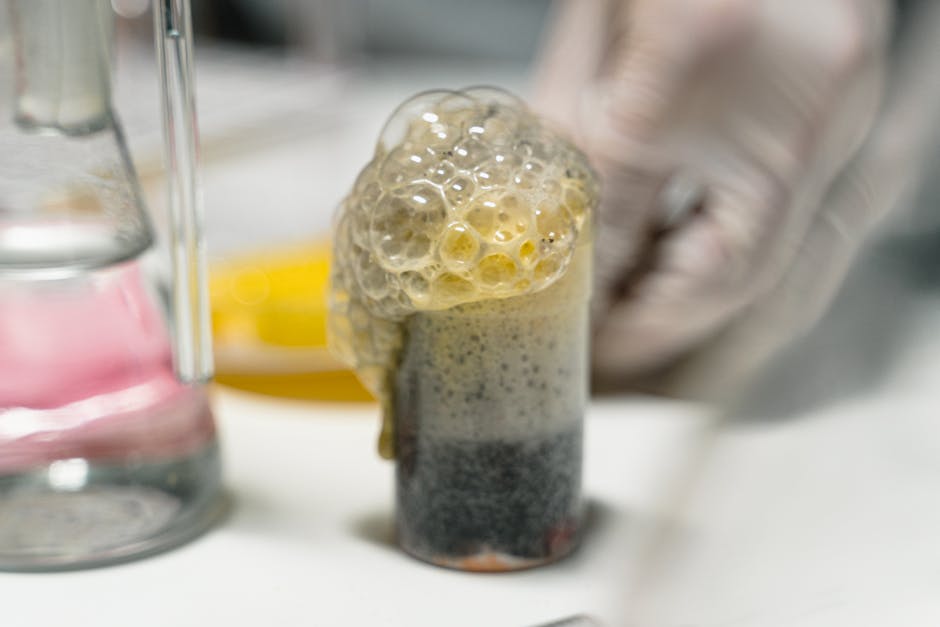
Photo by MART PRODUCTION on Pexels
The rate of reaction tells you how quickly reactants are used up or how quickly products are formed. It's often measured in terms of change in mass, volume, or concentration over time.
- Collision Theory: For a reaction to occur, reactant particles must:
- Collide with each other.
- Collide with sufficient energy (at least the activation energy).
- Collide with the correct orientation.
- Factors Affecting Reaction Rate:
- Temperature: Higher temperature means particles have more kinetic energy, move faster, and collide more frequently and with more energy. So, reaction rate increases.
- Concentration (or Pressure for gases): Higher concentration (more particles per unit volume) means more frequent collisions. So, reaction rate increases.
- Surface Area (for solids): Breaking a solid into smaller pieces increases its surface area, meaning more particles are exposed and available to react. So, reaction rate increases.
- Catalyst: A catalyst is a substance that speeds up a reaction without being used up itself. It does this by providing an alternative reaction pathway with a lower activation energy.
Reversible Reactions and Equilibria: The 'Back and Forth?'

Photo by Ron Lach on Pexels
Some reactions can go in both directions.
- Reversible Reactions: These are reactions where the products can react to form the original reactants. We use a double arrow (
⇌) to show this, e.g.,A + B ⇌ C + D. - Equilibrium: In a reversible reaction, when the rate of the forward reaction (reactants to products) becomes equal to the rate of the reverse reaction (products to reactants), the system is at equilibrium.
- At equilibrium, the concentrations of reactants and products remain constant (though not necessarily equal).
- It's a dynamic equilibrium: reactions are still happening, but there's no net change.
- Le Chatelier's Principle: This principle helps us predict how a system at equilibrium will respond to changes. If conditions are changed, the equilibrium will shift to counteract that change.
- Temperature:
- Increasing temperature favours the endothermic reaction (to absorb the extra heat).
- Decreasing temperature favours the exothermic reaction (to release heat and warm up).
- Pressure (for gases):
- Increasing pressure favours the side of the reaction with fewer moles of gas (to reduce the pressure).
- Decreasing pressure favours the side with more moles of gas (to increase the pressure).
- Concentration:
- Increasing the concentration of a reactant shifts the equilibrium to the right (to use up the added reactant).
- Increasing the concentration of a product shifts the equilibrium to the left (to use up the added product).
- Catalysts do NOT affect the position of equilibrium; they just help it be reached faster.
- Temperature:
graph TD
    A["Factors Affecting Reaction Rate"] --> B1("Temperature (↑ energy, ↑ collisions)")
    A --> B2("Concentration/Pressure (↑ particles, ↑ collisions)")
    A --> B3("Surface Area (↑ exposure, ↑ collisions)")
    A --> B4("Catalyst (↓ activation energy)")
    B1 --> C("Faster Rate")
    B2 --> C
    B3 --> C
    B4 --> C
3. Worked Example
Let's look at calculating moles and using stoichiometry.
Problem: Magnesium reacts with hydrochloric acid according to the equation:
Mg(s) + 2HCl(aq) → MgCl₂(aq) + H₂(g)
If you react 6.0 g of magnesium (Ar of Mg = 24) with excess hydrochloric acid, what mass of hydrogen gas (Ar of H = 1) is produced?
Step 1: Calculate moles of magnesium.
Mr of Mg = 24
n = m / Mr = 6.0 g / 24 g/mol = 0.25 mol of Mg
Step 2: Use the mole ratio from the balanced equation.
From the equation, 1 mole of Mg produces 1 mole of H₂.
So, 0.25 mol of Mg will produce 0.25 mol of H₂.
Step 3: Calculate the mass of hydrogen produced.
Mr of H₂ = 2 x 1 = 2
m = n x Mr = 0.25 mol x 2 g/mol = 0.50 g of H₂
So, 0.50 g of hydrogen gas would be produced.
4. Key Takeaways
- The mole is a fundamental unit for counting particles and converting between mass, concentration, and volume in reactions.
- Exothermic reactions release energy (heat up surroundings), while endothermic reactions absorb energy (cool down surroundings).
- Reaction rates depend on collision frequency and energy; catalysts provide an alternative pathway with lower activation energy.
- Le Chatelier's Principle predicts how reversible reactions at equilibrium will shift to counteract changes in temperature, pressure, or concentration.
- Balanced chemical equations are crucial for working out mole ratios and calculating reactant/product amounts.
- Always check if a reactant is limiting, as it determines the maximum possible product.
Common Mistakes to Avoid:
- Forgetting to balance chemical equations before doing mole calculations.
- Not converting units (e.g., cm³ to dm³) correctly for concentration calculations.
- Confusing exothermic (release) and endothermic (absorb) reactions.
- Assuming a catalyst changes the position of equilibrium – it only speeds up reaching it.
- Not considering the state symbols (especially for pressure effects on gases) when applying Le Chatelier's Principle.
5. Now Try It
You have 4.9 g of sulfuric acid (H₂SO₄) reacting with sodium hydroxide (NaOH) via the equation:
H₂SO₄ + 2NaOH → Na₂SO₄ + 2H₂O
The Ar values are: H=1, O=16, S=32, Na=23.
Your task is to calculate the mass of sodium sulfate (Na₂SO₄) produced, assuming the sodium hydroxide is in excess. You have 15 minutes. Success means you can clearly show your steps for calculating moles of sulfuric acid, using the mole ratio, and then calculating the mass of sodium sulfate.
Frequently asked about GCSE Chemistry: Quantitative Chemistry, Energy Changes, Rates and Equilibria
More from GCSE Prep
Get the full GCSE Prep curriculum
Clone the complete plan to your dashboard for unlimited AI-generated notes, practice quizzes, and a personalised revision schedule.
Save this course free