GCSE Physics: Energy, Electricity and the Particle Model of Matter
From the GCSE Prep curriculum
TL;DR
This topic explores how energy moves and changes, how electricity powers our world through circuits and charges, and how the tiny particles in matter behave to give it its properties. You'll learn about different energy stores and transfers, the basics of current, voltage, and resistance, and how particles in solids, liquids, and gases act. It's all about understanding the fundamental ways the universe works around us.
1. The Mental Model
Think of energy as a kind of "currency" that can be stored and transferred, but never created or destroyed. Electricity is like a flow of tiny charged particles, powering things when they move through a circuit. Everything around you, from a rock to the air you breathe, is made of incredibly small particles, and how they move and arrange themselves determines what that "stuff" is like.
2. The Core Material
Energy: Stores and Transfers

Photo by Atlantic Ambience on Pexels
Energy is all around us, constantly changing from one form to another. It's not "used up," but rather transferred from one store to another, often with some wasted as heat.
Here are the main energy stores you need to know:
* Kinetic: Energy due to movement (e.g., a moving car, a thrown ball).
* Thermal (Heat): Energy related to the temperature of an object (e.g., a hot mug of tea, a radiator).
* Chemical: Energy stored in the bonds between atoms and molecules (e.g., food, fuel, batteries).
* Gravitational Potential: Energy stored in an object due to its height in a gravitational field (e.g., a book on a shelf, water behind a dam).
* Elastic Potential: Energy stored in a stretched or squashed object (e.g., a stretched spring, a pulled elastic band).
* Electrostatic: Energy stored due to the separation of electric charges (e.g., a charged capacitor, static electricity).
* Magnetic: Energy stored due to magnetic fields (e.g., a magnet stuck to a fridge).
* Nuclear: Energy stored in the nucleus of an atom (e.g., nuclear power, radioactive decay).
And the main energy transfers:
* Mechanical Work: Force moving an object through a distance (e.g., pushing a trolley).
* Electrical Work: Moving charge through a potential difference (e.g., current flowing through a wire).
* Heating: Energy transferred due to a temperature difference (e.g., conduction, convection, radiation).
* Radiation: Energy transferred by waves (e.g., light waves from the sun, sound waves from a speaker).
The Law of Conservation of Energy is crucial: Energy cannot be created or destroyed, only transferred from one store to another.
graph TD
    A["Initial Energy Store"] --> B["Energy Transfer Mechanism"]
    B --> C["Desired Energy Store"]
    B --> D["Wasted Energy Store (e.g., Thermal)"]

    A -- "e.g., Chemical in fuel" --> B1["Burning (Heating)"]
    A -- "e.g., Gravitational Potential in a ball" --> B2["Falling (Mechanical Work)"]
    A -- "e.g., Chemical in battery" --> B3["Circuit (Electrical Work)"]

    B1 --> C1["Kinetic in car"]
    B1 --> D1["Thermal to surroundings"]
    B2 --> C2["Kinetic at bottom"]
    B2 --> D2["Sound, Air Resistance (Thermal)"]
    B3 --> C3["Light from bulb"]
    B3 --> D3["Thermal from wire"]
Electricity: Circuits, Charge, and Power
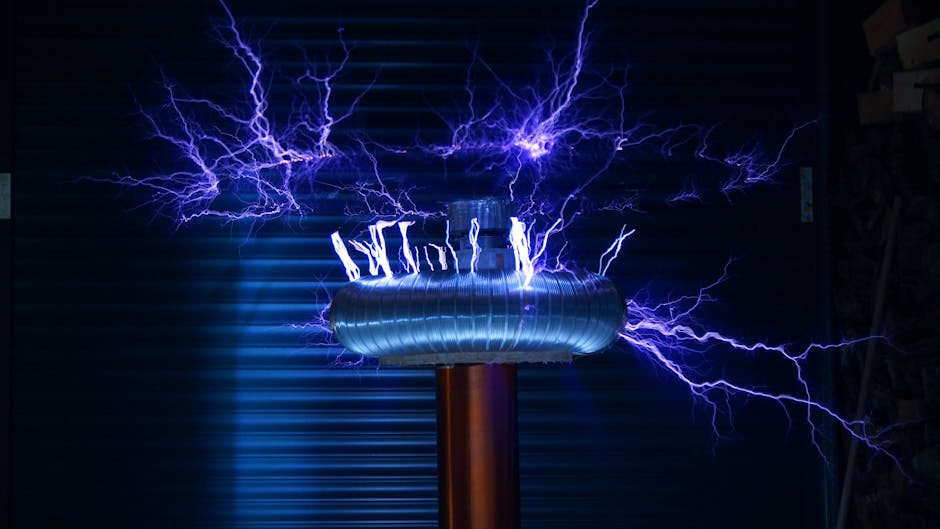
Photo by Killian Eon on Pexels
Electricity is the flow of electric charge. In most circuits, this charge is carried by electrons moving through wires.
- Current (I): The rate of flow of charge. Measured in Amperes (A).
$Current (A) = \frac{Charge (Coulombs)}{Time (seconds)}$ - Potential Difference (Voltage, V): The energy transferred per unit charge. It's the "push" that makes the charge move. Measured in Volts (V).
$Voltage (V) = \frac{Energy (Joules)}{Charge (Coulombs)}$ - Resistance (R): How much a component opposes the flow of current. Measured in Ohms (Ω). Components with high resistance restrict current more, converting electrical energy into heat and light.
- Ohm's Law: Relates voltage, current, and resistance.
$Voltage (V) = Current (A) \times Resistance (Ω)$
Circuits:
* Series Circuit: Components are connected one after another in a single loop.
* Current is the same everywhere.
* Voltage is shared across components.
* Total resistance is the sum of individual resistances.
* Parallel Circuit: Components are connected across each other, providing multiple paths for current.
* Voltage is the same across each parallel branch.
* Current splits, with more current going through paths of lower resistance.
* Total resistance is less than the smallest individual resistance.
Power (P): The rate at which energy is transferred. Measured in Watts (W).
$Power (W) = Current (A) \times Voltage (V)$
$Power (W) = Current^2 (A^2) \times Resistance (Ω)$
$Power (W) = \frac{Voltage^2 (V^2)}{Resistance (Ω)}$
The Particle Model of Matter

Photo by Santhosh Kanthala on Pexels
The particle model helps us understand the properties of solids, liquids, and gases based on how their tiny particles (atoms or molecules) are arranged and move.
- Solids:
- Particles are tightly packed in a regular arrangement.
- They vibrate in fixed positions.
- Have a fixed shape and volume. High density.
- Liquids:
- Particles are close together but randomly arranged.
- They can slide past each other.
- Have a fixed volume but take the shape of their container. Moderate density.
- Gases:
- Particles are far apart and randomly arranged.
- They move rapidly and randomly, colliding with each other and container walls.
- Have no fixed shape or volume; they fill their container. Low density.
Changes of State:
* Melting: Solid → Liquid (gains energy)
* Freezing: Liquid → Solid (loses energy)
* Boiling/Evaporation: Liquid → Gas (gains energy)
* Condensation: Gas → Liquid (loses energy)
* Sublimation: Solid → Gas (gains energy directly)
* Deposition: Gas → Solid (loses energy directly)
When a substance changes state, the temperature doesn't change, even though energy is being added or removed. This energy is called latent heat and is used to break or form the bonds between particles, rather than increasing their kinetic energy.
3. Worked Example
Let's say you have a circuit with a 12V battery and two resistors connected in series: R1 = 4Ω and R2 = 8Ω.
-
Calculate the total resistance (R_total):
In a series circuit, R_total = R1 + R2
R_total = 4Ω + 8Ω = 12Ω -
Calculate the total current (I_total) flowing through the circuit:
Using Ohm's Law: V = I × R, so I = V / R
I_total = 12V / 12Ω = 1A -
Calculate the voltage across each resistor:
Since the current is the same everywhere in a series circuit (1A):
Voltage across R1 (V1) = I_total × R1 = 1A × 4Ω = 4V
Voltage across R2 (V2) = I_total × R2 = 1A × 8Ω = 8V
Check: V1 + V2 = 4V + 8V = 12V, which equals the battery voltage. Correct! -
Calculate the total power supplied by the battery:
Using P = I × V
Power = 1A × 12V = 12W
4. Key Takeaways
- Energy is conserved: it's never created or destroyed, only transferred between stores (like kinetic, thermal, chemical, gravitational potential).
- Electrical current is the flow of charge, driven by voltage, and opposed by resistance, as described by Ohm's Law (V=IR).
- Series circuits have the same current throughout, while parallel circuits have the same voltage across branches.
- Power is the rate of energy transfer, calculated as P=IV (and its variations).
- The particle model explains properties of matter: solids have fixed, vibrating particles; liquids have particles that slide past each other; gases have fast, randomly moving particles.
- Changes of state involve latent heat, where energy is used to change particle arrangement, not temperature.
Common Mistakes to Avoid:
- Confusing energy transfer with energy creation or destruction.
- Mixing up series and parallel circuit rules for current and voltage.
- Forgetting units or using the wrong ones (e.g., using Joules for power).
- Thinking temperature changes during a phase change (it stays constant due to latent heat).
- Not understanding that resistance turns electrical energy into other forms like heat and light.
5. Now Try It
Imagine you're designing a kettle that heats water. Describe the energy transfers involved from when you plug it in and switch it on, until the water boils. Then, explain in terms of the particle model what happens to the water particles as it heats up and then boils. What success looks like: You should clearly identify the initial energy store, the main transfer mechanisms, the useful energy store, and any wasted energy. For the particle model, describe the changes in particle arrangement and movement at different stages.
Frequently asked about GCSE Physics: Energy, Electricity and the Particle Model of Matter
More from GCSE Prep
Get the full GCSE Prep curriculum
Clone the complete plan to your dashboard for unlimited AI-generated notes, practice quizzes, and a personalised revision schedule.
Save this course free