Molecular Geometry and Lewis Structures
From the nche222 curriculum
TL;DR
Lewis structures help us visualize how atoms share electrons and bond within a molecule, giving us a flat 2D representation. Molecular geometry then takes these structures and predicts the molecule's 3D shape, which is crucial for understanding its properties. The VSEPR theory is key to determining these 3D shapes by minimizing electron pair repulsion.
1. The Mental Model
Think of Lewis structures as the blueprint of a house, showing where all the rooms (atoms) and connections (bonds) are. Molecular geometry is then what the finished house looks like in 3D, including its overall shape and how much space it takes up.
2. The Core Material
Understanding molecular geometry starts with drawing correct Lewis structures. A Lewis structure shows all valence electrons as dots (lone pairs) or lines (bonds) around the atoms. Once you have the Lewis structure, you can determine the 3D arrangement using the Valence Shell Electron Pair Repulsion (VSEPR) theory.
Drawing Lewis Structures
- Count Total Valence Electrons: Sum the valence electrons for all atoms in the molecule. For ions, add an electron for each negative charge and subtract one for each positive charge.
- Determine Central Atom: Usually the least electronegative atom (never hydrogen).
- Draw Skeletal Structure: Connect the central atom to terminal atoms with single bonds.
- Distribute Remaining Electrons: Place lone pairs on terminal atoms first to satisfy their octets (except H, which needs 2).
- Place Remaining Electrons on Central Atom: If any electrons are left, place them on the central atom as lone pairs.
- Form Multiple Bonds (If Needed): If the central atom doesn't have an octet, convert lone pairs from terminal atoms into double or triple bonds with the central atom.
Predicting Molecular Geometry (VSEPR Theory)
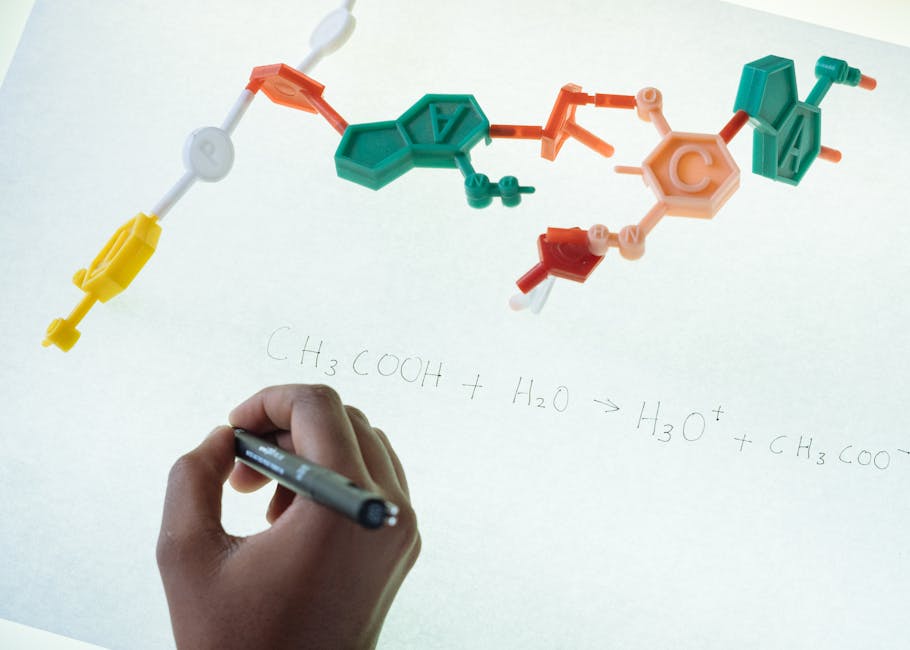
Photo by RF._.studio _ on Pexels
VSEPR theory states that electron groups (lone pairs and bonding pairs) around the central atom will arrange themselves as far apart as possible to minimize repulsion. The number of electron groups determines the electron geometry, and the arrangement of atoms determines the molecular geometry.
Here's how to apply VSEPR:
- Draw the Lewis Structure: This is your starting point.
- Count Electron Groups around the Central Atom:
- A single bond, double bond, or triple bond each count as ONE electron group.
- A lone pair counts as ONE electron group.
- Determine Electron Geometry: Based on the total number of electron groups:
- 2 electron groups: Linear (180°)
- 3 electron groups: Trigonal Planar (120°)
- 4 electron groups: Tetrahedral (109.5°)
- 5 electron groups: Trigonal Bipyramidal (90°, 120°)
- 6 electron groups: Octahedral (90°)
- Determine Molecular Geometry: This is where you consider only the atoms and ignore the lone pairs in the final shape description, though the lone pairs still influence the bond angles.
Here’s a diagram illustrating the relationship between electron groups, lone pairs, and molecular geometry:
graph TD
    A["Count Electron Groups"] --> B{"2 Electron Groups"};
    B --> C["Electron Geometry: Linear"];
    C --> D["Molecular Geometry: Linear (0 lone pairs)"];

    A --> E{"3 Electron Groups"};
    E --> F["Electron Geometry: Trigonal Planar"];
    F --> G["Molecular Geometry: Trigonal Planar (0 lone pairs)"];
    F --> H["Molecular Geometry: Bent (1 lone pair)"];

    A --> I{"4 Electron Groups"};
    I --> J["Electron Geometry: Tetrahedral"];
    J --> K["Molecular Geometry: Tetrahedral (0 lone pairs)"];
    J --> L["Molecular Geometry: Trigonal Pyramidal (1 lone pair)"];
    J --> M["Molecular Geometry: Bent (2 lone pairs)"];

    A --> N{"5 Electron Groups"};
    N --> O["Electron Geometry: Trigonal Bipyramidal"];
    O --> P["Molecular Geometry: Trigonal Bipyramidal (0 lone pairs)"];
    O --> Q["Molecular Geometry: Seesaw (1 lone pair)"];
    O --> R["Molecular Geometry: T-shaped (2 lone pairs)"];
    O --> S["Molecular Geometry: Linear (3 lone pairs)"];

    A --> T{"6 Electron Groups"};
    T --> U["Electron Geometry: Octahedral"];
    U --> V["Molecular Geometry: Octahedral (0 lone pairs)"];
    U --> W["Molecular Geometry: Square Pyramidal (1 lone pair)"];
    U --> X["Molecular Geometry: Square Planar (2 lone pairs)"];
3. Worked Example
Let's determine the Lewis structure and molecular geometry of water (H₂O).
- Count Valence Electrons: Oxygen (Group 16) has 6 valence electrons. Each Hydrogen (Group 1) has 1 valence electron. Total = 6 + (2 * 1) = 8 valence electrons.
- Central Atom: Oxygen is less electronegative than hydrogen, so O is central.
- Skeletal Structure: H—O—H (uses 4 electrons for two single bonds).
- Distribute Remaining Electrons: 8 (total) - 4 (bonded) = 4 electrons remaining.
-
Place on Central Atom: Place the 4 remaining electrons as two lone pairs on oxygen.
The Lewis structure is: H—O—H with two lone pairs on Oxygen.
..
  H—O—H
     ..
6. Count Electron Groups (VSEPR): Oxygen has two single bonds and two lone pairs. That's a total of 4 electron groups.
7. Electron Geometry: With 4 electron groups, the electron geometry is Tetrahedral.
8. Molecular Geometry: With 4 electron groups and 2 lone pairs, the molecular geometry is Bent. The bond angle will be approximately 104.5° (slightly less than the ideal 109.5° due to lone pair-lone pair repulsion being greater than bond pair-bond pair repulsion).
4. Key Takeaways
- Lewis structures show the connectivity and electron distribution in 2D.
- VSEPR theory helps predict 3D molecular shapes by minimizing electron repulsion.
- Electron groups (bonds and lone pairs) determine the electron geometry.
- The number of lone pairs, along with electron geometry, determines the molecular geometry.
- Lone pairs exert more repulsion than bonding pairs, which can reduce bond angles.
- Molecular shape is critical for a molecule's physical and chemical properties.
- Always start with a correct Lewis structure before attempting VSEPR.
5. Now Try It
Determine the Lewis structure, electron geometry, and molecular geometry for Carbon Dioxide (CO₂). What are the approximate bond angles? What would success look like? You'd have the correct Lewis structure, correctly identify the number of electron groups around the central carbon atom, state the electron geometry (linear, trigonal planar, etc.), and finally, the molecular geometry, along with the bond angles.
Frequently asked about Molecular Geometry and Lewis Structures
More from nche222
Get the full nche222 curriculum
Clone the complete plan to your dashboard for unlimited AI-generated notes, practice quizzes, and a personalised revision schedule.
Save this course free