Analogue Modulation Techniques
From the analogue digital comms curriculum
TL;DR
Analogue modulation techniques let us send information over long distances by modifying a high-frequency carrier wave with our analogue message signal. The three main types are Amplitude Modulation (AM), Frequency Modulation (FM), and Phase Modulation (PM), each changing a different property of the carrier. Choosing the right technique depends on factors like bandwidth, noise immunity, and power efficiency for your specific application.
1. The Mental Model
Imagine you want to send a secret message across a noisy room. Instead of just shouting, which might get lost, you decide to sing your message by varying the pitch (frequency) or loudness (amplitude) of your voice on top of a constant hum. Analogue modulation is like that: your message "rides" on a carrier wave, making it easier to transmit.
2. The Core Material
Analogue modulation is all about impressing a low-frequency analogue message signal onto a high-frequency carrier wave. This higher frequency makes the signal suitable for efficient transmission over airwaves or cables. The carrier wave has three main properties we can vary: its amplitude, frequency, or phase. Each variation gives us a different modulation technique.
Amplitude Modulation (AM)
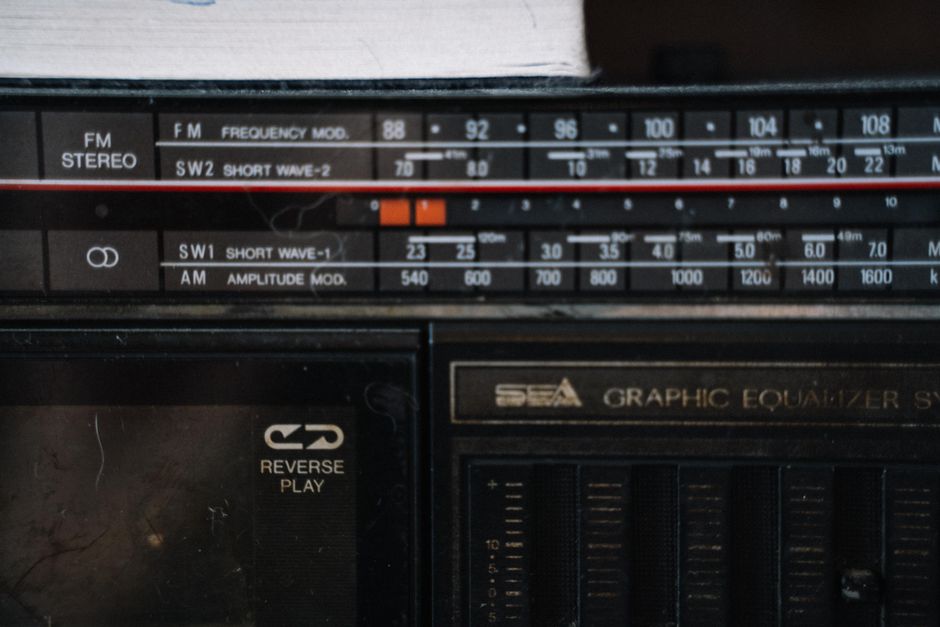
Photo by Anna Tarazevich on Pexels
In AM, the amplitude of the carrier wave is varied in proportion to the instantaneous amplitude of the message signal. The frequency and phase of the carrier remain constant.
- How it works: When your message signal goes high, the carrier's amplitude gets larger. When your message goes low, the carrier's amplitude gets smaller.
- Advantages: Relatively simple to implement (modulators and demodulators are not complex).
- Disadvantages: Susceptible to noise (since noise often affects amplitude, it can easily corrupt the signal). Requires more transmission power.
- Bandwidth: Generally, the bandwidth needed for AM is twice the bandwidth of the message signal ($BW = 2f_m$, where $f_m$ is the highest frequency component of the message signal).
Frequency Modulation (FM)

Photo by wal_ 172619 on Pexels
In FM, the frequency of the carrier wave is varied in proportion to the instantaneous amplitude of the message signal. The amplitude and phase of the carrier remain constant.
- How it works: When your message signal goes high, the carrier's frequency increases. When your message goes low, the carrier's frequency decreases. The carrier's amplitude stays the same.
- Advantages: Much better noise immunity than AM (since most noise affects amplitude, not frequency). Constant power transmission.
- Disadvantages: Requires more complex circuitry. Consumes significantly more bandwidth than AM.
- Bandwidth: The bandwidth for FM is given by Carson's Rule: $BW = 2(\Delta f + f_m)$, where $\Delta f$ is the maximum frequency deviation and $f_m$ is the highest frequency component of the message signal.
Phase Modulation (PM)
In PM, the phase of the carrier wave is varied in proportion to the instantaneous amplitude of the message signal. The amplitude and frequency of the carrier remain constant (though a change in phase inherently causes a momentary change in instantaneous frequency).
- How it works: When your message signal goes high, the carrier's phase shifts in one direction. When it goes low, it shifts in the other.
- Relationship to FM: PM is very closely related to FM. You can think of FM as integrating the message signal before applying PM, or PM as differentiating the message signal before applying FM. For this reason, they're often grouped together as "angle modulation" techniques.
- Advantages: Similar noise immunity benefits to FM.
- Disadvantages: Similar bandwidth requirements and circuit complexity to FM.
Here's a diagram to help visualize the relationship between the message signal and the modulated carrier for each type:
graph TD
    A["Message Signal (Baseband)"]
    subgraph Carrier Wave Properties
        C["Amplitude"]
        D["Frequency"]
        E["Phase"]
    end

    A --> B["Modulator"]

    subgraph Modulation Techniques
        B --> AM["Amplitude Modulation (AM)"]
        B --> FM["Frequency Modulation (FM)"]
        B --> PM["Phase Modulation (PM)"]
    end

    AM --> C_AM["Varies Amplitude of Carrier"]
    FM --> D_FM["Varies Frequency of Carrier"]
    PM --> E_PM["Varies Phase of Carrier"]

    C_AM --> Tx_AM["AM Transmitted Signal"]
    D_FM --> Tx_FM["FM Transmitted Signal"]
    E_PM --> Tx_PM["PM Transmitted Signal"]
3. Worked Example
Let's say you have an audio message signal, $m(t)$, with a maximum frequency of $f_m = 5 \text{ kHz}$. You want to transmit this using AM and FM.
Scenario 1: Amplitude Modulation (AM)
- Goal: Calculate the required bandwidth.
- Formula: $BW = 2f_m$
- Calculation: $BW = 2 \times 5 \text{ kHz} = 10 \text{ kHz}$
- Result: You'd need a bandwidth of $10 \text{ kHz}$ to transmit this audio signal using AM. This is relatively narrow, but remember AM is more prone to noise.
Scenario 2: Frequency Modulation (FM)
- Goal: Calculate the required bandwidth using Carson's Rule. Assume a maximum frequency deviation ($\Delta f$) of $75 \text{ kHz}$ (a typical value for broadcast FM radio).
- Formula: $BW = 2(\Delta f + f_m)$
- Calculation: $BW = 2(75 \text{ kHz} + 5 \text{ kHz}) = 2(80 \text{ kHz}) = 160 \text{ kHz}$
- Result: You'd need a bandwidth of $160 \text{ kHz}$ for FM. This is significantly wider than AM, but the signal would be much more robust against noise. This difference highlights the trade-off between bandwidth and noise performance.
4. Key Takeaways
- Analogue modulation techniques modify a carrier wave's properties (amplitude, frequency, or phase) with a message signal for efficient transmission.
- Amplitude Modulation (AM) varies the carrier's amplitude, is simple but susceptible to noise and has lower power efficiency.
- Frequency Modulation (FM) varies the carrier's frequency, offers excellent noise immunity, but uses more bandwidth and is more complex.
- Phase Modulation (PM) varies the carrier's phase and is closely related to FM, sharing similar advantages and disadvantages.
- The choice between AM, FM, or PM depends on application requirements like desired noise immunity, available bandwidth, and circuit complexity.
- Bandwidth for AM is $2f_m$, while for FM (using Carson's Rule) it's $2(\Delta f + f_m)$, showing FM's typically larger spectral footprint.
- Noise primarily affects the amplitude of a signal, making AM less robust than FM or PM.
Common Mistakes to Avoid:
- Confusing AM and FM: Remember AM changes "loudness" (amplitude), FM changes "pitch" (frequency).
- Underestimating Bandwidth: Don't forget that modulation expands the signal's bandwidth; it's never just the message signal's bandwidth.
- Ignoring Noise: Thinking that all modulation types handle noise equally well. AM is notably worse than FM/PM in noisy environments.
- Assuming Complexity: Believing one method is inherently "better" without considering the trade-offs in implementation and performance.
5. Now Try It
For a voice signal with a maximum frequency of $3.5 \text{ kHz}$:
- Calculate the required bandwidth if you use AM.
- Calculate the required bandwidth if you use FM, assuming a maximum frequency deviation ($\Delta f$) of $50 \text{ kHz}$.
- Based on your results, if you had limited bandwidth available but were transmitting over a very noisy channel, which modulation technique would you initially lean towards, and why?
Success looks like correctly calculating both bandwidths and providing a brief, reasoned explanation for your preferred choice in the noisy channel scenario, understanding the trade-offs involved.
Frequently asked about Analogue Modulation Techniques
Study this next
Get the full analogue digital comms curriculum
Clone the complete plan to your dashboard for unlimited AI-generated notes, practice quizzes, and a personalised revision schedule.
Save this course free