Reactions of Metals with Acids
From the chem sa 1 8 curriculum
TL;DR
Metals react with acids to produce a salt and hydrogen gas, with more reactive metals reacting more vigorously. The reactivity series helps predict whether a reaction will occur and its speed. This is a single displacement reaction where the metal displaces hydrogen from the acid.
1. The Mental Model
Think of it like a competition: a metal wants to "kick out" hydrogen from an acid. If the metal is more reactive than hydrogen, it wins, and you see bubbles (hydrogen gas) and get a new substance (a salt). If it's less reactive, nothing happens.
2. The Core Material
When a metal reacts with an acid, it's a type of single displacement reaction. The general equation is:
Metal + Acid → Salt + Hydrogen gas
Let's break down what's happening:
- Metal: This is an element from the left side of the periodic table, like magnesium (Mg), zinc (Zn), iron (Fe), or copper (Cu).
- Acid: Common acids are hydrochloric acid (HCl), sulfuric acid (H₂SO₄), and nitric acid (HNO₃).
- Salt: This isn't just table salt (NaCl)! In chemistry, a salt is an ionic compound formed when the metal cation combines with the anion from the acid. For example, if zinc reacts with hydrochloric acid, the salt is zinc chloride (ZnCl₂).
- Hydrogen gas (H₂): This is the gas you'll see bubbling out of the solution. It's diatomic, meaning it exists as H₂ molecules.
Reactivity Series and Predicting Reactions
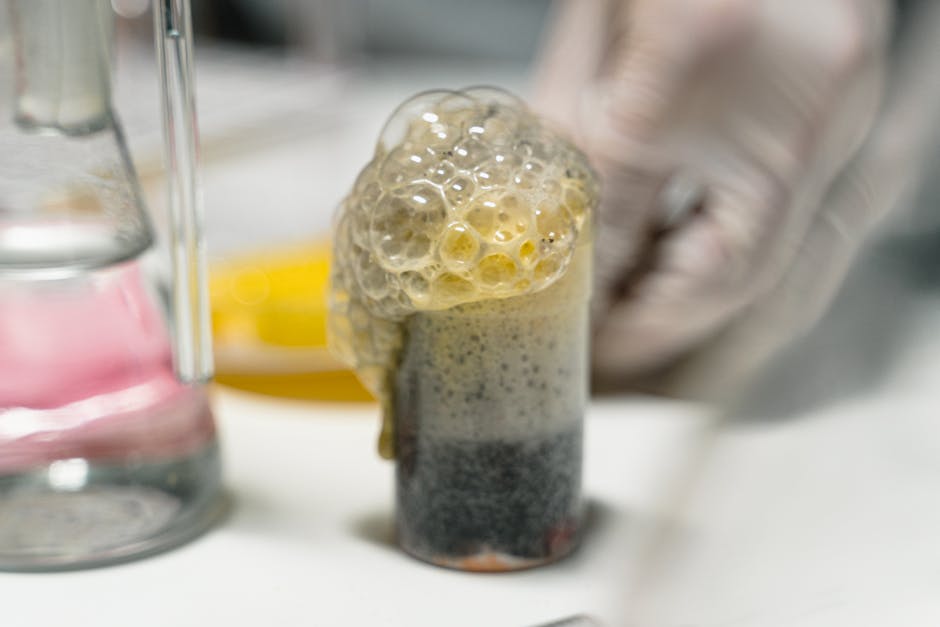
Photo by MART PRODUCTION on Pexels
Not all metals react with all acids, and some react more strongly than others. This is where the Reactivity Series comes in handy. It's a list of metals arranged in order of decreasing reactivity.
Here's a simplified version:
Potassium (K)
Sodium (Na)
Calcium (Ca)
Magnesium (Mg)
Aluminum (Al)
Zinc (Zn)
Iron (Fe)
Lead (Pb)
(Hydrogen - H)
Copper (Cu)
Silver (Ag)
Gold (Au)
Platinum (Pt)
- Metals above hydrogen in the series will react with dilute acids to produce hydrogen gas and a salt. The further up they are, the more vigorously they react.
- Metals below hydrogen in the series (like copper, silver, gold) will generally not react with dilute acids.
Visualizing the Reaction Process

Photo by Ron Lach on Pexels
Here's how you can think about the steps involved:
graph TD
    A["Metal (solid) + Acid (solution)"] --> B["Metal loses electrons (oxidized)"]
    B --> C["Hydrogen ions in acid gain electrons (reduced)"]
    C --> D["Hydrogen gas forms (bubbles)"]
    D --> E["Metal ions combine with acid's anion"]
    E --> F["Salt forms (dissolved or precipitate)"]
Examples of Reactions
-
Magnesium + Hydrochloric Acid:
Mg(s) + 2HCl(aq) → MgCl₂(aq) + H₂(g)
(You'd see vigorous bubbling here because Mg is quite reactive.) -
Zinc + Sulfuric Acid:
Zn(s) + H₂SO₄(aq) → ZnSO₄(aq) + H₂(g)
(Again, bubbling would be observed, but perhaps slightly less vigorous than magnesium.) -
Copper + Hydrochloric Acid:
Cu(s) + HCl(aq) → No reaction
(Copper is below hydrogen in the reactivity series, so it won't displace hydrogen from dilute HCl.)
Factors Affecting Reaction Rate
Photo by Vitaly Gariev on Pexels
- Reactivity of the metal: More reactive metals react faster.
- Concentration of the acid: Higher concentration generally means a faster reaction.
- Surface area of the metal: A powdered metal will react faster than a solid lump because more of its surface is exposed.
- Temperature: Higher temperatures usually lead to faster reactions.
3. Worked Example
Let's consider the reaction between Iron (Fe) and Sulfuric Acid (H₂SO₄).
- Identify the reactants: We have solid iron and aqueous sulfuric acid.
- Check reactivity: Iron (Fe) is above hydrogen in the reactivity series. So, a reaction will occur.
- Predict the products:
- The metal (iron) will displace hydrogen from the acid.
- Hydrogen gas (H₂) will be produced.
- The remaining iron ion (Fe²⁺ or Fe³⁺, typically Fe²⁺ with dilute acids) will combine with the sulfate ion (SO₄²⁻) from the sulfuric acid to form iron(II) sulfate (FeSO₄).
- Write the unbalanced equation:
Fe(s) + H₂SO₄(aq) → FeSO₄(aq) + H₂(g) - Balance the equation: In this case, it's already balanced.
- Observation: You would observe bubbles of hydrogen gas forming on the surface of the iron, and the iron would slowly dissolve as iron(II) sulfate is formed.
4. Key Takeaways
- Metals more reactive than hydrogen displace it from acids to form a salt and hydrogen gas.
- The reactivity series is crucial for predicting whether a metal will react with an acid.
- The general word equation is Metal + Acid → Salt + Hydrogen.
- The "salt" formed is an ionic compound of the metal and the acid's anion.
- Reaction speed is influenced by metal reactivity, acid concentration, surface area, and temperature.
Common Mistakes to Avoid:
- Forgetting to check the reactivity series before assuming a reaction will happen.
- Not balancing the chemical equation correctly, especially the hydrogen and the acid's anion.
- Assuming "salt" only means NaCl; remember it's a broad chemical term.
- Incorrectly writing hydrogen as H instead of H₂ (it's diatomic).
5. Now Try It
You have magnesium ribbon and dilute hydrochloric acid. Write the balanced chemical equation for the reaction, predict what you'd observe, and briefly explain why this reaction happens based on the reactivity series. Aim to complete this in about 15 minutes.
Frequently asked about Reactions of Metals with Acids
More from chem sa 1 8
Get the full chem sa 1 8 curriculum
Clone the complete plan to your dashboard for unlimited AI-generated notes, practice quizzes, and a personalised revision schedule.
Save this course free