Reactions of Metals with Water
From the chem sa 1 8 curriculum
TL;DR
Metals react with water to form hydrogen gas and either a metal hydroxide or a metal oxide, depending on the metal's reactivity and water temperature. More reactive metals react vigorously, while less reactive ones react slowly or not at all. You can use the reactivity series to predict how a metal will react with water.
1. The Mental Model
Think of metal reacting with water as an exchange. The metal "wants" to give up electrons, and water provides a way for that to happen, releasing hydrogen gas as a result. The more eager the metal is to give up electrons, the more vigorous the reaction.
2. The Core Material
When metals react with water, it's typically a redox (reduction-oxidation) reaction. The metal atoms lose electrons (are oxidized), and hydrogen ions in water gain electrons (are reduced) to form hydrogen gas (H₂).
The general word equations are:
1. Reactive Metal + Cold Water → Metal Hydroxide + Hydrogen Gas
2. Less Reactive Metal + Steam → Metal Oxide + Hydrogen Gas
Let's break down the types of reactions based on metal reactivity:
Highly Reactive Metals (Group 1 - Alkali Metals: Li, Na, K, Rb, Cs)

Photo by MART PRODUCTION on Pexels
These metals react very vigorously with cold water. They're so reactive they displace hydrogen from water readily. The reaction is often exothermic (releases heat), and the hydrogen gas produced can ignite, sometimes explosively.
Example: Sodium (Na) with water
2Na(s) + 2H₂O(l) → 2NaOH(aq) + H₂(g)
Here, sodium forms sodium hydroxide (a strong base) and hydrogen gas.
Moderately Reactive Metals (Group 2 - Alkaline Earth Metals: Mg, Ca, Sr, Ba; also Al, Zn, Fe)

Photo by Pixabay on Pexels
These metals react less vigorously than alkali metals.
* Calcium (Ca) reacts steadily with cold water, producing calcium hydroxide and hydrogen gas. You'll see bubbles forming.
Ca(s) + 2H₂O(l) → Ca(OH)₂(aq) + H₂(g)
* Magnesium (Mg) reacts very slowly with cold water, but more readily with steam. With steam, it forms magnesium oxide and hydrogen gas.
Mg(s) + H₂O(g) → MgO(s) + H₂(g)
Less Reactive Metals (e.g., Lead, Copper, Silver, Gold, Platinum)
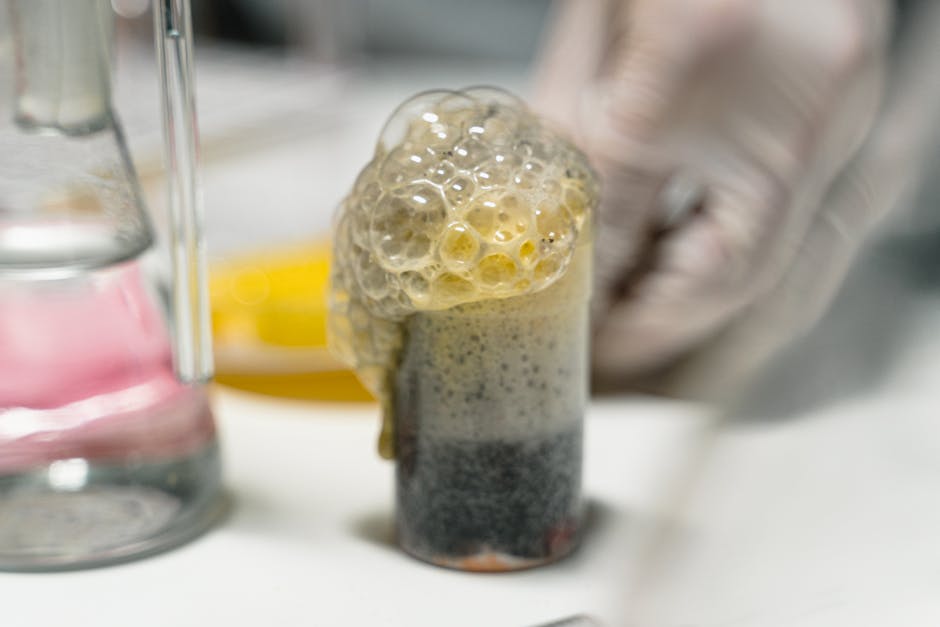
Photo by MART PRODUCTION on Pexels
These metals generally do not react with water, even steam. They are below hydrogen in the reactivity series, meaning they are less likely to lose electrons than hydrogen.
The Reactivity Series
The reactivity series helps you predict how metals will react with water (and acids). Metals higher up are more reactive.
graph TD
    A["Most Reactive (e.g., K, Na, Ca)"] --> B["Reacts vigorously with cold water"]
    B --> C["Forms hydroxide + H₂"]
    D["Moderately Reactive (e.g., Mg, Al, Zn, Fe)"] --> E["Reacts slowly with cold water (or with steam)"]
    E --> F["Forms hydroxide (cold) or oxide (steam) + H₂"]
    G["Least Reactive (e.g., Cu, Ag, Au)"] --> H["No reaction with water or steam"]
Factors Affecting Reaction Rate
- Reactivity of the Metal: As discussed, the higher the metal in the reactivity series, the faster and more vigorous the reaction.
- Temperature of Water: Higher temperatures (steam) generally increase the reaction rate for moderately reactive metals. Very reactive metals will react vigorously even with cold water.
- Surface Area: A larger surface area of the metal (e.g., powder instead of a chunk) means more sites for reaction, leading to a faster rate.
3. Worked Example
Let's consider the reaction of potassium (K) with water.
- Identify the metal's reactivity: Potassium is an alkali metal, very high in the reactivity series. This means it will react very vigorously with cold water.
- Predict the products: Highly reactive metals reacting with cold water produce a metal hydroxide and hydrogen gas. So, potassium hydroxide and hydrogen gas will be formed.
- Write the chemical equation:
- Potassium (K) reacts with water (H₂O).
- Products are potassium hydroxide (KOH) and hydrogen gas (H₂).
- The unbalanced equation:
K(s) + H₂O(l) → KOH(aq) + H₂(g) - To balance, you need two potassium atoms and two water molecules to produce two potassium hydroxide molecules and one hydrogen molecule:
2K(s) + 2H₂O(l) → 2KOH(aq) + H₂(g)
- Observe the reaction: You'd expect a very rapid, exothermic reaction. The potassium would float, melt into a sphere, dart around the water, and often ignite the hydrogen gas, producing a lilac flame (characteristic of potassium).
4. Key Takeaways
- The reactivity series is your best tool for predicting how metals react with water.
- Highly reactive metals (like alkali metals) react vigorously with cold water to form metal hydroxides and hydrogen gas.
- Moderately reactive metals react slowly with cold water or more readily with steam, forming hydroxides (cold water) or oxides (steam) and hydrogen gas.
- Less reactive metals generally don't react with water or steam at all.
- All these reactions involve the metal losing electrons (oxidation) and hydrogen in water gaining electrons (reduction).
- Heat and surface area can increase the reaction rate, especially for less reactive metals.
Common Mistakes to Avoid
- Assuming all metals react the same way with water; reactivity is key.
- Forgetting that hydrogen gas is a product in most reactions.
- Confusing metal hydroxides with metal oxides; the water temperature often dictates which is formed for moderately reactive metals.
- Not balancing the chemical equations correctly after determining products.
5. Now Try It
Imagine you have a piece of zinc metal. Describe its reaction with:
1. Cold water
2. Steam (hot water vapor)
For each, predict if a reaction occurs, what the products would be, and write the balanced chemical equation. Think about zinc's position in the reactivity series relative to magnesium and iron. What would success look like? You'd have two clear descriptions, each with a correctly balanced equation showing either zinc hydroxide or zinc oxide formed.
Frequently asked about Reactions of Metals with Water
More from chem sa 1 8
Get the full chem sa 1 8 curriculum
Clone the complete plan to your dashboard for unlimited AI-generated notes, practice quizzes, and a personalised revision schedule.
Save this course free