Product Rule
From the calculus curriculum
TL;DR
When you need to find the derivative of a function that's made up of two other functions multiplied together, you can't just multiply their derivatives. Instead, you use the Product Rule, which gives you a specific formula to correctly calculate this derivative. It helps you manage how changes in each individual function contribute to the overall change in their product.
1. The Mental Model
Imagine you have two separate assembly lines, each producing something, and you want to know how fast their combined "output" (product) is changing. The Product Rule helps you combine the rate of change from the first line with the current output of the second, and vice-versa, to find the total rate of change for the final product.
2. The Core Material
When you encounter a function like $h(x) = f(x) \cdot g(x)$, and you want to find its derivative, $h'(x)$, the Product Rule is your go-to tool. It tells you that the derivative of a product of two functions is the first function times the derivative of the second, plus the second function times the derivative of the first.
Here's the formula:
If $h(x) = f(x) \cdot g(x)$, then $h'(x) = f(x)g'(x) + g(x)f'(x)$.
Let's break down the steps and why it works this way:
Identifying the Components

Photo by Ivan Chumak on Pexels
First, you need to clearly identify which part of your function is $f(x)$ and which part is $g(x)$. This might seem obvious, but it's crucial for applying the rule correctly.
Finding Individual Derivatives
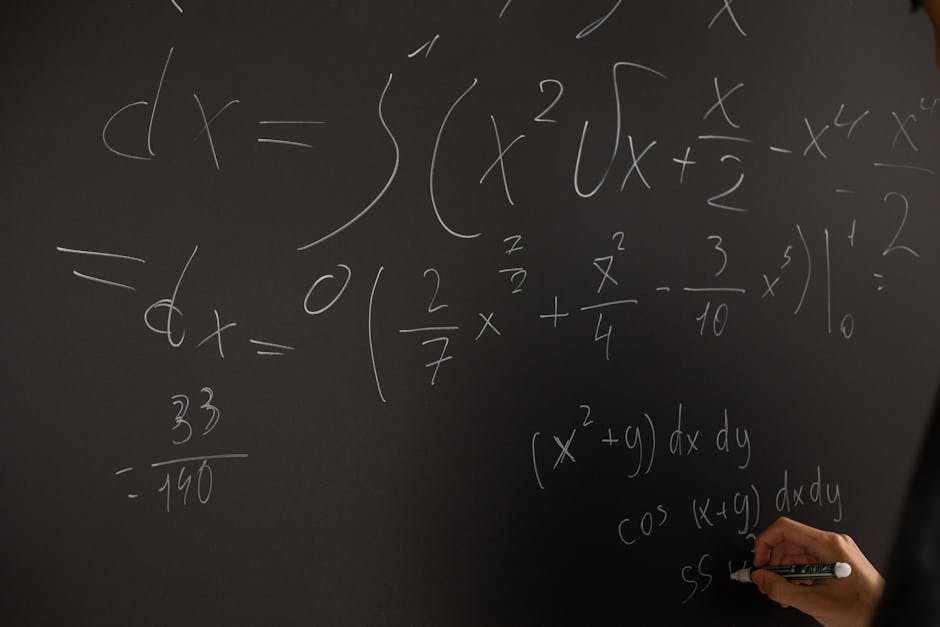
Photo by Monstera Production on Pexels
Once you've identified $f(x)$ and $g(x)$, the next step is to find their individual derivatives, $f'(x)$ and $g'(x)$. This might involve using other differentiation rules you've learned, like the Power Rule or derivatives of trigonometric functions.
Assembling the Product Rule Formula

Photo by cottonbro studio on Pexels
Finally, you plug $f(x)$, $g(x)$, $f'(x)$, and $g'(x)$ into the Product Rule formula: $f(x)g'(x) + g(x)f'(x)$.
Here's a simple flow to visualize the process:
graph TD
    A["Start with h(x) = f(x) * g(x)"] --> B["Identify f(x)"]
    A --> C["Identify g(x)"]
    B --> D["Find f'(x)"]
    C --> E["Find g'(x)"]
    D & E --> F["Apply Product Rule: f(x)g'(x) + g(x)f'(x)"]
    F --> G["Simplify Result"]
Why it's not just $f'(x)g'(x)$

Photo by Brett Jordan on Pexels
It's tempting to think that the derivative of a product is just the product of the derivatives. However, this isn't true. Consider if you're calculating the area of a rectangle whose length is $x$ and width is $x$, so area $A(x) = x \cdot x = x^2$. The derivative is $A'(x) = 2x$. If you incorrectly applied $f'(x)g'(x)$ here, where $f(x)=x$ and $g(x)=x$, then $f'(x)=1$ and $g'(x)=1$. Their product would be $1 \cdot 1 = 1$, which is wrong.
The Product Rule accounts for the fact that both functions are changing simultaneously. The term $f(x)g'(x)$ considers how the product changes due to $g(x)$ changing while $f(x)$ stays put for an instant, and $g(x)f'(x)$ considers how the product changes due to $f(x)$ changing while $g(x)$ stays put. Adding them together gives you the total rate of change.
3. Worked Example
Let's find the derivative of $h(x) = (x^2 + 3)(e^x)$.
-
Identify $f(x)$ and $g(x)$:
Let $f(x) = x^2 + 3$
Let $g(x) = e^x$ -
Find the derivatives $f'(x)$ and $g'(x)$:
Using the Power Rule for $f(x)$: $f'(x) = 2x + 0 = 2x$
The derivative of $e^x$ is itself: $g'(x) = e^x$ -
Apply the Product Rule formula:
$h'(x) = f(x)g'(x) + g(x)f'(x)$
Substitute the functions and their derivatives:
$h'(x) = (x^2 + 3)(e^x) + (e^x)(2x)$ -
Simplify the result (optional but good practice):
You can factor out $e^x$:
$h'(x) = e^x(x^2 + 3 + 2x)$
$h'(x) = e^x(x^2 + 2x + 3)$
So, the derivative of $(x^2 + 3)(e^x)$ is $e^x(x^2 + 2x + 3)$.
4. Key Takeaways
- The Product Rule is essential for differentiating functions that are the product of two other functions.
- The formula is $h'(x) = f(x)g'(x) + g(x)f'(x)$.
- Always identify $f(x)$, $g(x)$, $f'(x)$, and $g'(x)$ before plugging them into the formula.
- The order of the two terms in the sum doesn't matter, as addition is commutative.
- Don't forget to simplify your final answer if possible, often by factoring.
Common Mistakes to Avoid:
- Don't multiply the derivatives directly: $h'(x) \neq f'(x)g'(x)$. This is the most common error.
- Forgetting to take the derivative of one of the functions: Make sure you find both $f'(x)$ and $g'(x)$.
- Mixing up which function goes with which derivative: It's $f(x)g'(x)$ and $g(x)f'(x)$, not $f(x)f'(x)$ or $g(x)g'(x)$.
- Making algebraic errors during simplification: Pay attention to distribution and combining like terms.
5. Now Try It
Find the derivative of the function $y = x^3 \sin(x)$.
What to do:
1. Identify $f(x)$ and $g(x)$.
2. Find their respective derivatives, $f'(x)$ and $g'(x)$.
3. Apply the Product Rule formula.
4. Simplify your answer.
What success looks like:
Your final answer should be in a simplified form, likely with a common factor pulled out, and should correctly apply all parts of the Product Rule formula without any terms missing or misplaced.
Frequently asked about Product Rule
More from calculus
Get the full calculus curriculum
Clone the complete plan to your dashboard for unlimited AI-generated notes, practice quizzes, and a personalised revision schedule.
Save this course free