Differentiation of Exponential Functions
From the calculus curriculum
TL;DR
Differentiating exponential functions is straightforward: the derivative of $e^x$ is $e^x$, and for $a^x$, it's $a^x \ln(a)$. The chain rule is essential when the exponent is a function other than just $x$. Master these rules, and you'll easily handle most exponential derivative problems.
1. The Mental Model
Think of exponential functions like a special kind of growth or decay. When you differentiate them, you're essentially finding the rate of that growth or decay. The neat trick is that for $e^x$, its rate of change is always equal to its current value.
2. The Core Material
When we talk about exponential functions, we usually mean functions where the variable is in the exponent, like $e^x$ or $2^x$. Differentiating these has specific, powerful rules.
The Natural Exponential Function: $e^x$
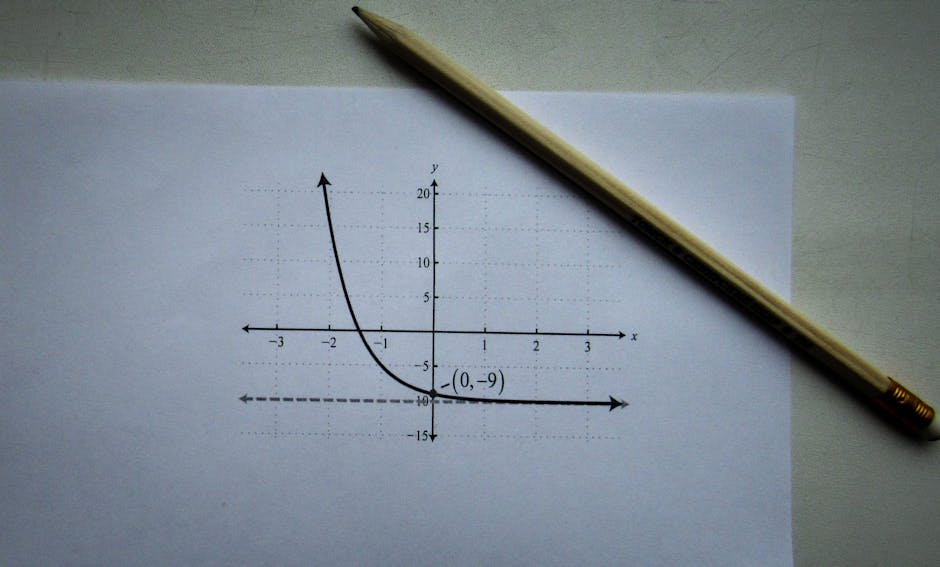
Photo by Sergey Meshkov on Pexels
The most fundamental exponential function is $f(x) = e^x$, where $e$ is Euler's number (approximately 2.71828). This function is incredibly special because its derivative is itself!
If $f(x) = e^x$, then $f'(x) = e^x$.
This means the slope of the tangent line to $e^x$ at any point $(x, e^x)$ is exactly $e^x$.
The Chain Rule with $e^u$
Photo by Sergey Meshkov on Pexels
Often, the exponent isn't just $x$. It's a function of $x$, like $e^{2x}$ or $e^{\sin(x)}$. This is where the chain rule comes in.
If $f(x) = e^{u(x)}$, where $u(x)$ is some function of $x$, then the derivative is:
$f'(x) = e^{u(x)} \cdot u'(x)$
You differentiate the $e^{u(x)}$ part (which stays $e^{u(x)}$) and then multiply by the derivative of the exponent $u'(x)$.
Let's look at an example:
If $f(x) = e^{3x}$, then $u(x) = 3x$.
So, $u'(x) = 3$.
Therefore, $f'(x) = e^{3x} \cdot 3 = 3e^{3x}$.
General Exponential Functions: $a^x$
Photo by Shubham Dhage on Pexels
What if the base isn't $e$, but some other positive constant $a$ (where $a \neq 1$)?
For $f(x) = a^x$, the derivative is:
$f'(x) = a^x \ln(a)$
Here, $\ln(a)$ is the natural logarithm of $a$. Remember that $\ln(e) = 1$, which is why the rule for $e^x$ simplifies nicely to $e^x \cdot 1 = e^x$.
The Chain Rule with $a^u$

Photo by William Hadley on Pexels
Just like with $e^u$, if the exponent of $a$ is a function $u(x)$, we apply the chain rule.
If $f(x) = a^{u(x)}$, then the derivative is:
$f'(x) = a^{u(x)} \cdot \ln(a) \cdot u'(x)$
Again, you differentiate the $a^{u(x)}$ part, multiply by $\ln(a)$, and then multiply by the derivative of the exponent $u'(x)$.
Here's how you can think about the process:
flowchart TD
    A["Start with an exponential function f(x)"] --> B{{"Is the base 'e'?"}};
    B -- Yes --> C{{"Is the exponent 'x'?"}};
    B -- No --> D{"Base is 'a' (constant)"};
    C -- Yes --> E["Derivative is e^x"];
    C -- No --> F{"Exponent is u(x)"};
    F --> G["Derivative is e^u(x) * u'(x)"];
    D --> H{{"Is the exponent 'x'?"}};
    H -- Yes --> I["Derivative is a^x * ln(a)"];
    H -- No --> J{"Exponent is u(x)"};
    J --> K["Derivative is a^u(x) * ln(a) * u'(x)"];
3. Worked Example
Let's differentiate $f(x) = 7^{x^2 - 5x}$.
- Identify the form: This is a general exponential function $a^{u(x)}$, where $a=7$ and $u(x) = x^2 - 5x$.
- Find $u'(x)$: The derivative of $u(x) = x^2 - 5x$ is $u'(x) = 2x - 5$.
- Apply the formula: The formula for $a^{u(x)}$ is $a^{u(x)} \cdot \ln(a) \cdot u'(x)$.
- Substitute the parts:
$f'(x) = 7^{(x^2 - 5x)} \cdot \ln(7) \cdot (2x - 5)$ - Clean it up (optional, but good practice):
$f'(x) = (2x - 5) \ln(7) \cdot 7^{(x^2 - 5x)}$
4. Key Takeaways
- The derivative of $e^x$ is simply $e^x$. It's its own rate of change!
- For $e^{u(x)}$, use the chain rule: $e^{u(x)} \cdot u'(x)$. Don't forget to multiply by the derivative of the exponent.
- The derivative of $a^x$ (where $a$ is a constant base) is $a^x \ln(a)$.
- For $a^{u(x)}$, combine both rules: $a^{u(x)} \cdot \ln(a) \cdot u'(x)$.
- Always identify the "inner" function (the exponent) before applying the chain rule.
- Remember $\ln(e) = 1$, which explains why $\ln(e)$ disappears for $e^x$ derivatives.
Common Mistakes to Avoid:
- Forgetting the chain rule when the exponent is more complex than just $x$.
- Omitting $\ln(a)$ when the base is not $e$. This is a very common error.
- Confusing $x^n$ (power rule: $nx^{n-1}$) with $a^x$ (exponential rule: $a^x \ln a$). They look similar but are fundamentally different.
- Miscalculating $u'(x)$, especially if it involves multiple terms or other rules.
5. Now Try It
Differentiate the following function: $g(x) = 5 \cdot e^{\cos(x)}$.
Think about the constant multiple rule first, then identify the $u(x)$ part for the exponential. What is $u'(x)$? Put all the pieces together using the chain rule for $e^{u(x)}$.
Success looks like a final derivative expression that clearly shows the application of the constant multiple rule and the chain rule for an exponential function with a trigonometric exponent.
Frequently asked about Differentiation of Exponential Functions
More from calculus
Get the full calculus curriculum
Clone the complete plan to your dashboard for unlimited AI-generated notes, practice quizzes, and a personalised revision schedule.
Save this course free