Cells: The Basic Units of Life
From the Grade 10 life science curriculum
TL;DR
Cells are the smallest units of life, acting as tiny factories performing all essential functions. There are two main types: prokaryotic cells, which are simpler and lack a true nucleus, and eukaryotic cells, which are more complex with a nucleus and other specialized compartments called organelles. Understanding cells is key to understanding how all living things work, from bacteria to plants and animals.
1. The Mental Model
Think of cells like the tiny, individual bricks that build any house. Just as a house needs many bricks working together, all living things—whether a tree, a dog, or you—are built from countless cells, each performing a specific job to keep the whole organism alive and functioning.
2. The Core Material
Cells are truly amazing! They're the fundamental building blocks of all known life. Every single living thing, from the smallest bacteria to the largest whale, is made of cells. Some organisms are just one cell (like bacteria!), while others are made of trillions (like us!).
Even though cells are tiny, they do everything necessary for life: they take in nutrients, convert them into energy, carry out specialized functions, and even reproduce.
Two Main Types of Cells
Photo by Terrance Barksdale on Pexels
There are two major categories of cells:
-
Prokaryotic Cells: These are the older, simpler type of cell. Think of them as basic studios.
- They don't have a true nucleus. Instead, their genetic material (DNA) just floats around in a region called the nucleoid.
- They also don't have many other membrane-bound organelles (specialized structures inside cells).
- Bacteria and Archaea are examples of organisms made of prokaryotic cells.
- They are generally much smaller than eukaryotic cells.
-
Eukaryotic Cells: These are more complex and evolved. Think of them as fully equipped houses with many rooms.
- They have a true nucleus, which is a membrane-bound "control center" that houses their genetic material (DNA).
- They have many different organelles, each with a specific job, like mitochondria (energy production), endoplasmic reticulum (protein and lipid synthesis), and Golgi apparatus (packaging and transport).
- Plants, animals, fungi, and protists are all made of eukaryotic cells.
- They are generally much larger than prokaryotic cells.
Key Parts of a Cell (General)

Photo by Monstera Production on Pexels
Even with their differences, most cells share some common features:
- Cell Membrane: This is the outer boundary of the cell. It's like a gatekeeper, controlling what goes in and out.
- Cytoplasm: This is the jelly-like substance that fills the cell and surrounds the organelles. It's where many chemical reactions happen.
- Genetic Material (DNA): This is the cell's "instruction manual," containing all the information needed to build and operate the cell.
- Ribosomes: These tiny structures are responsible for making proteins, following the instructions from the DNA.
Here's a simple way to visualize the relationship between these cell types:
graph TD
    A["All Cells"] --> B["Prokaryotic Cells"]
    A --> C["Eukaryotic Cells"]
    B --> D["No True Nucleus"]
    B --> E["Few Organelles"]
    B --> F["Bacteria, Archaea"]
    C --> G["True Nucleus"]
    C --> H["Many Organelles"]
    C --> I["Plants, Animals, Fungi, Protists"]
Animal vs. Plant Cells (Both Eukaryotic)
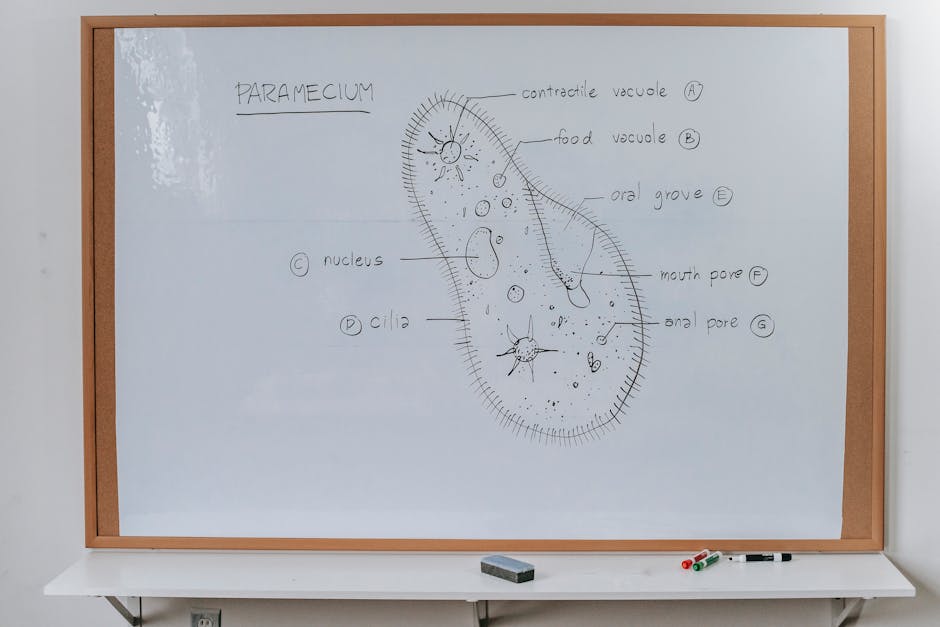
Photo by Katerina Holmes on Pexels
Within eukaryotic cells, there are some key differences between animal and plant cells:
Animal Cells Have:
* A cell membrane.
* Mitochondria (for energy).
* Small vacuoles (for storage).
* No cell wall.
* No chloroplasts.
Plant Cells Have:
* Cell Wall: A rigid outer layer outside the cell membrane, providing support and protection.
* Chloroplasts: Organelles that perform photosynthesis (converting sunlight into energy). This is why plants are green!
* Large Central Vacuole: A big sac that stores water, nutrients, and waste, helping maintain cell shape.
* Also have a cell membrane, mitochondria, and a nucleus, just like animal cells.
3. Worked Example
Let's imagine you're looking at two different organisms under a microscope: a tiny bit of pond scum (which contains single-celled algae, a type of protist) and some bacteria from yogurt.
-
Observing the Bacteria: You see very small, simple cells. You can tell they have an outer boundary and some genetic material floating around, but you don't see any clear "rooms" or compartments inside. There's no distinct nucleus. Based on these observations, you'd identify these as prokaryotic cells.
-
Observing the Algae: Now you look at the pond scum. You see much larger cells. You notice a clear, defined structure in the center (the nucleus). You also see many green, oval-shaped structures floating around inside, and a thick, rigid outer layer. You'd correctly identify these as eukaryotic cells, and specifically plant-like eukaryotic cells because of the presence of chloroplasts (the green structures for photosynthesis) and a cell wall (the rigid outer layer).
4. Key Takeaways
- Cells are the fundamental building blocks of all living organisms.
- Prokaryotic cells are simpler, lack a true nucleus, and have few organelles (e.g., bacteria).
- Eukaryotic cells are more complex, have a true nucleus, and many specialized organelles (e.g., plant, animal, fungi cells).
- The cell membrane controls what enters and leaves all cells.
- DNA is the genetic instruction manual found in all cells.
- Plant cells have a cell wall, chloroplasts, and a large central vacuole, which animal cells lack.
Common Mistakes to Avoid:
- Don't confuse the cell membrane with the cell wall; only plant (and fungi/bacteria) cells have a cell wall.
- Don't think that only complex organisms have cells; single-celled organisms are also made of cells.
- Don't forget that both plant and animal cells are eukaryotic and both have mitochondria for energy.
- Don't assume all cells are the same; they vary greatly in size, shape, and internal structures depending on their function.
5. Now Try It
Imagine you've discovered a new single-celled organism. You observe it under a powerful microscope and note the following: it's quite small, has genetic material concentrated in a region but not enclosed by a membrane, and lacks any large, organized internal structures like chloroplasts or mitochondria. It also doesn't have a rigid outer cell wall, only a flexible outer boundary.
Based on these observations, write down what type of cell you think it is (prokaryotic or eukaryotic) and explain why using two specific pieces of evidence from your observations.
Success looks like clearly stating the cell type and providing two distinct reasons, directly linked to your observations, that support your classification.
Frequently asked about Cells: The Basic Units of Life
Study this next
Get the full Grade 10 life science curriculum
Clone the complete plan to your dashboard for unlimited AI-generated notes, practice quizzes, and a personalised revision schedule.
Save this course free