Introduction to Networks
From the Core maths year 10 curriculum
TL;DR
Networks are collections of points (vertices) connected by lines (edges), used to model relationships in many real-world situations. We use networks to understand connections like roads, friendships, or computer systems. Key concepts include identifying vertices, edges, paths, and understanding connectivity.
1. The Mental Model
Imagine a map where cities are dots and roads are lines connecting them. That's essentially a network! It helps us visualise how different things are linked and how you can get from one point to another.
2. The Core Material
Networks, sometimes called graphs, are a powerful way to represent connections. Let's break down the main parts:
Vertices (or Nodes)
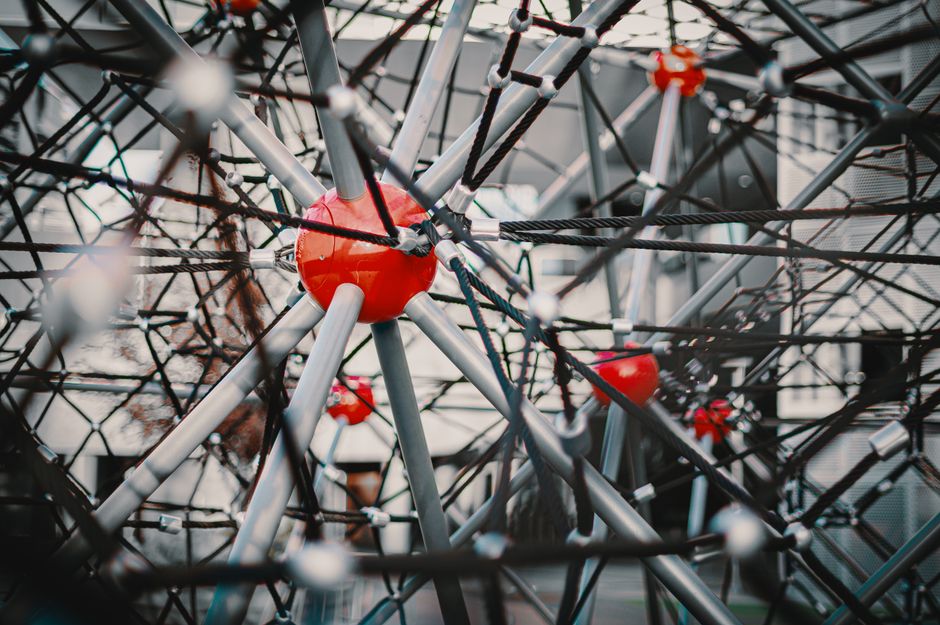
Photo by Brett Sayles on Pexels
These are the individual points in your network. Think of them as the 'things' you're connecting.
* In a road network, cities or intersections are vertices.
* In a social network, people are vertices.
* In a computer network, individual computers or servers are vertices.
Edges (or Links)

Photo by wal_ 172619 on Pexels
These are the connections between the vertices. They show how the 'things' are related.
* A road between two cities is an edge.
* A friendship between two people is an edge.
* A cable connecting two computers is an edge.
Edges can be:
* Directed: Meaning the connection only goes one way (e.g., a one-way street). We show this with an arrow on the edge.
* Undirected: Meaning the connection goes both ways (e.g., a two-way street). We show this with a simple line.
* Weighted: Meaning the edge has a value or cost associated with it (e.g., distance of a road, time taken, cost of a flight).
Paths and Cycles

Photo by indra projects on Pexels
- A path is a sequence of edges that connects one vertex to another.
- A cycle is a path that starts and ends at the same vertex, visiting other vertices in between.
Connectivity
- A network is connected if there's a path between any two vertices. If you can get from anywhere to anywhere else, it's connected.
- If a network isn't connected, it means it has separate components (groups of connected vertices).
Here's a simple example:
graph LR
    A["Vertex A"] --> B["Vertex B"]
    B --> C["Vertex C"]
    A --> C
    D["Vertex D"]
    C -- "Weighted (10km)" --> D
In this diagram:
* A, B, C, D are the vertices.
* A --> B is a directed edge.
* B --> C is another directed edge.
* A --> C is a directed edge.
* C -- "Weighted (10km)" --> D is an undirected, weighted edge.
* A path from A to D could be A -> C -> D.
* A cycle could be A -> B -> C -> A.
Degree of a Vertex

Photo by https://kaboompics.com/ on Pexels
The degree of a vertex is simply the number of edges connected to it. If an edge is directed, we talk about in-degree (edges coming into the vertex) and out-degree (edges going out of the vertex).
3. Worked Example
Let's look at a simple network representing bus routes between four towns: Alton (A), Bude (B), Caster (C), and Durn (D).
Imagine the following routes:
1. Bus from Alton to Bude (and back)
2. Bus from Alton to Caster (one-way only)
3. Bus from Bude to Durn (and back)
4. Bus from Caster to Durn (and back), taking 30 minutes.
Let's identify the network components:
- Vertices: A, B, C, D (the four towns).
-
Edges:
- (A, B) - Undirected (bus goes both ways)
- (A, C) - Directed (bus goes A to C only)
- (B, D) - Undirected (bus goes both ways)
- (C, D) - Undirected and Weighted (bus goes both ways, takes 30 minutes)
-
Degree of each vertex:
- Vertex A: 2 (connected to B and C)
- Vertex B: 2 (connected to A and D)
- Vertex C: 2 (connected from A, and to/from D)
- Vertex D: 2 (connected to B and C)
-
Paths:
- Path from A to D: A -> B -> D.
- Another path from A to D: A -> C -> D.
This network is connected because you can get from any town to any other town using the bus routes. For example, to get from Bude to Caster, you could go B -> A -> C or B -> D -> C.
4. Key Takeaways
- Networks use vertices (points) and edges (lines) to represent relationships between things.
- Vertices are the individual items, and edges are the connections between them.
- Edges can be directed (one-way), undirected (two-way), or weighted (have a value like distance or time).
- A path is a sequence of edges from one vertex to another; a cycle is a path that returns to its starting point.
- A network is connected if you can find a path between any two vertices.
- The degree of a vertex is the number of edges connected to it.
Common Mistakes to Avoid:
- Mixing up vertices and edges; remember, vertices are the things, edges are the connections.
- Forgetting that an edge can be directed, meaning you can't always travel in both directions.
- Not noticing if a network is disconnected, meaning some parts aren't reachable from others.
- Confusing a path with a cycle; a cycle always ends where it started.
5. Now Try It
Draw a network representing your immediate family (parents, siblings, grandparents).
1. Identify the vertices: Each family member is a vertex.
2. Identify the edges: Draw an edge between two people if they are directly related (e.g., parent-child, sibling-sibling, spouse-spouse). You don't need to use directed edges here, but you can if you want to show parent-child direction.
3. Calculate the degree: For each family member, count how many direct connections they have.
4. Identify a path: Can you find a path from yourself to a grandparent?
5. Identify a cycle (if any): Is there any path that starts and ends with the same person, going through others?
Success looks like a clear diagram with labels for family members and lines showing their relationships, and your written answers to the questions above.
Frequently asked about Introduction to Networks
Study this next
Get the full Core maths year 10 curriculum
Clone the complete plan to your dashboard for unlimited AI-generated notes, practice quizzes, and a personalised revision schedule.
Save this course free