Technology, Brains, and Future Possibilities
From the ingles B10 curriculum
TL;DR
Technology is rapidly advancing, giving us new ways to understand and potentially enhance the human brain. This interaction opens up incredible future possibilities, from treating diseases to creating new forms of intelligence. However, it also brings important ethical questions we need to consider carefully.
1. The Mental Model
Think of your brain as an incredibly complex, biological computer, and technology as a set of tools we're developing to interact with it, understand its code, and maybe even upgrade its hardware or software.
2. The Core Material
The relationship between technology and the brain is evolving quickly, touching on several key areas. We're not just talking about smartphones; we're talking about direct interfaces and advanced ways to study the brain's inner workings.
Understanding the Brain with Technology
Photo by SHVETS production on Pexels
Modern technology gives us unprecedented ways to look inside the living brain without surgery.
* Neuroimaging: Techniques like fMRI (functional Magnetic Resonance Imaging) and PET (Positron Emission Tomography) allow scientists to see which parts of the brain are active when we think, feel, or move. This helps us map brain functions.
* Electrophysiology: EEG (Electroencephalography) records the electrical activity of the brain from the scalp. It's great for understanding brain states like sleep, alertness, or detecting seizures.
Brain-Computer Interfaces (BCIs)
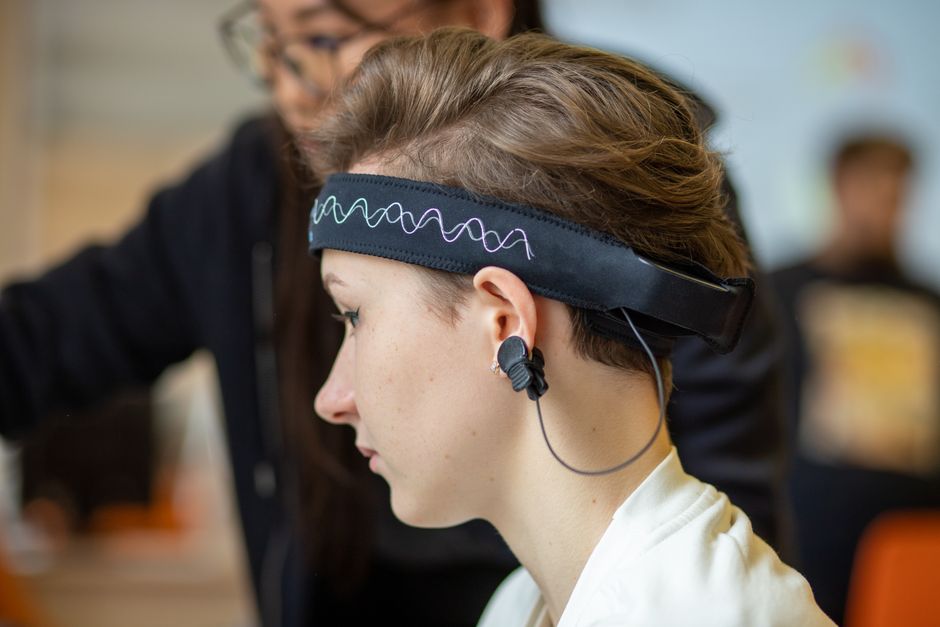
Photo by Михаил Крамор on Pexels
BCIs are systems that allow direct communication pathways between an enhanced or wired brain and an external device.
* Input BCIs: These allow technology to send signals into the brain, for example, cochlear implants restoring hearing or retinal implants restoring sight.
* Output BCIs: These allow the brain to control external devices directly using thought. Imagine a paralyzed person moving a robotic arm just by thinking about it.
Neuroprosthetics
These are devices that replace or augment a damaged part of the nervous system. The most famous examples are cochlear implants for hearing loss and deep brain stimulation (DBS) for Parkinson's disease, which uses electrical impulses to regulate abnormal brain activity.
AI and the Brain
Photo by Google DeepMind on Pexels
Artificial Intelligence (AI) plays a huge role in both understanding the brain and creating brain-like systems.
* Modeling: AI can help build complex models of brain networks, simulating how neurons connect and communicate.
* Mimicking: Neural networks, a core part of AI, are inspired by the brain's structure. They "learn" in ways that are somewhat similar to how our brains learn.
Future Possibilities and Ethical Considerations

Photo by Markus Winkler on Pexels
As technology advances, we're facing truly mind-bending possibilities:
* Cognitive Enhancement: Could we use technology to improve memory, focus, or learning abilities in healthy individuals?
* Treating Neurological Disorders: BCIs and neuroprosthetics offer immense hope for people with conditions like paralysis, epilepsy, or severe depression.
* Digital Immortality/Mind Uploading: This is highly speculative but explores the idea of transferring human consciousness to a digital substrate.
* Privacy and Security: If our brains can interface directly with technology, what about the privacy of our thoughts? Who controls this data?
* Equity and Access: Will these powerful technologies only be available to a select few, widening the gap between people?
Here's a diagram illustrating the flow from understanding the brain to future possibilities:
graph TD
    A["Observación y Estudio del Cerebro (fMRI, EEG)"] --> B["Desarrollo de Tecnologías de Interfaz"]
    B --> C1["Implantes Cocleares/Retinales (Entrada BCI)"]
    B --> C2["Control de Prótesis Robóticas (Salida BCI)"]
    C1 --> D["Restauración de Funciones"]
    C2 --> D["Mejora de Calidad de Vida"]
    D --> E["Potencial de Mejora Cognitiva"]
    E --> F["Dilemas Éticos y Sociales"]
    B --> G["Investigación con IA (Modelos Cerebrales)"]
    G --> E
3. Worked Example
Imagine someone who has lost the ability to speak due to a stroke. Current BCI technology is being developed to help them communicate. A patient could have a small chip implanted in their brain that detects the neural signals associated with their intent to speak certain words or letters. This chip translates these brain signals into commands that control an external device, such as a speech synthesizer or a computer screen that displays typed words. So, by merely thinking "hello," the system could generate the word "hello" vocally or display it on a screen, restoring a vital form of communication.
4. Key Takeaways
- Technology helps us visualize and analyze brain activity, from broad patterns to specific electrical signals.
- Brain-Computer Interfaces (BCIs) enable direct communication between the brain and external devices, offering two-way interaction.
- Neuroprosthetics can restore lost functions (like hearing or movement) by replacing damaged nervous system parts.
- Artificial intelligence is crucial for both modeling how the brain works and creating systems inspired by its structure.
- Future possibilities include cognitive enhancement and advanced medical treatments, but also bring significant ethical challenges regarding privacy, equity, and the definition of humanity.
- We must consider the societal impact of brain-related technologies as they become more powerful.
5. Now Try It
Think about a specific neurological condition (e.g., paralysis, severe depression, blindness). In 150 words or less, describe how you imagine a future technology, combining elements of AI and BCIs, could realistically alleviate or cure this condition. What would be the biggest ethical concern you'd have about that specific solution? Success looks like proposing a plausible technological solution and identifying a relevant ethical dilemma.
Frequently asked about Technology, Brains, and Future Possibilities
Study this next
Get the full ingles B10 curriculum
Clone the complete plan to your dashboard for unlimited AI-generated notes, practice quizzes, and a personalised revision schedule.
Save this course free