Introduction to Forces and Newton's Laws
From the distance and time graph, simple machines, calculating acceleration, stopping distance, calculation forces, how wings cause lift, forces, balanced forces, flight, speeding cars curriculum
TL;DR
Forces are pushes or pulls that can change an object's motion. Newton's three laws explain how forces, mass, and acceleration are related. Understanding these laws helps us predict how things move, or why they stay still.
1. The Mental Model
Think of forces as invisible hands pushing or pulling objects. These "hands" are always acting, even if you don't see things moving, and their combined effect determines what happens next.
2. The Core Material
When we talk about forces, we're describing a push or a pull on an object. Forces have both a magnitude (how strong they are) and a direction. For example, pushing a door open requires a force in a specific direction.
Balanced and Unbalanced Forces
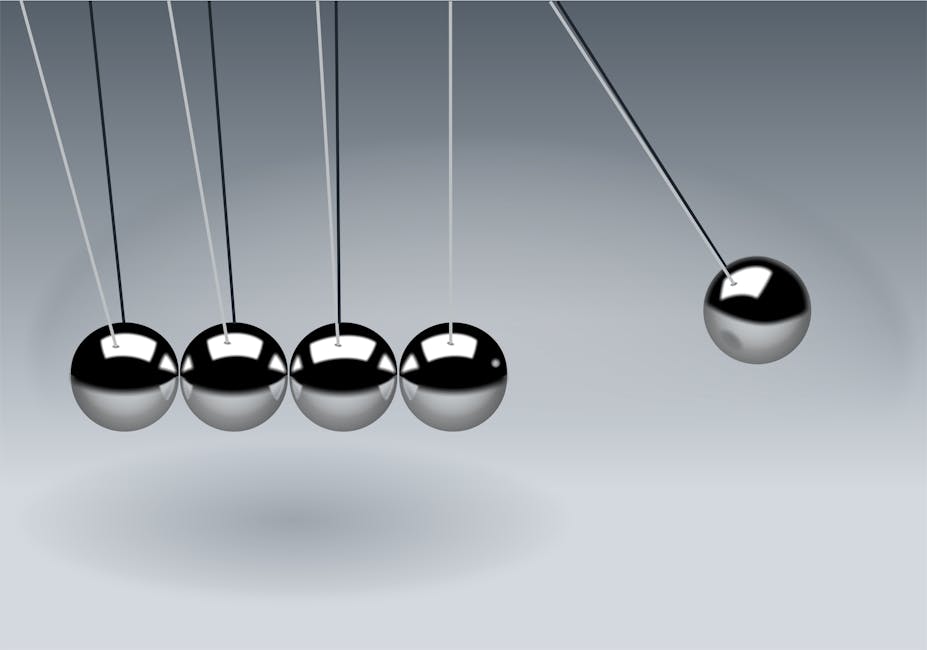
Photo by Pixabay on Pexels
Forces can be balanced or unbalanced.
* Balanced forces mean all the pushes and pulls on an object cancel each other out. If an object has balanced forces, it will either stay still or keep moving at a constant speed in a straight line. Think of a book sitting on a table – gravity pulls it down, and the table pushes it up, creating balanced forces.
* Unbalanced forces mean there's a net (overall) force acting on the object. If forces are unbalanced, the object's motion will change. It might speed up, slow down, or change direction. Kicking a soccer ball is an example of an unbalanced force causing it to accelerate.
Newton's Three Laws of Motion

Photo by Jose Manuel Gonzalez Lupiañez Photography on Pexels
Isaac Newton described how forces affect motion with three fundamental laws:
Newton's First Law: The Law of Inertia
An object at rest stays at rest, and an object in motion stays in motion with the same speed and in the same direction unless acted upon by an unbalanced force.
This law means objects are "lazy" – they resist changes to their current state of motion. If something isn't moving, it won't start moving unless pushed or pulled. If something is moving, it won't stop or change direction unless a force acts on it (like friction or air resistance). Inertia is this resistance to change in motion; objects with more mass have more inertia.
Newton's Second Law: Force, Mass, and Acceleration
The acceleration of an object is directly proportional to the net force acting on it and inversely proportional to its mass. This is often written as:
F = m × a
Where:
* F is the net force (measured in Newtons, N)
* m is the mass of the object (measured in kilograms, kg)
* a is the acceleration of the object (measured in meters per second squared, m/s²)
This law tells us that a larger force will cause a larger acceleration, and a more massive object will require a larger force to achieve the same acceleration.
Newton's Third Law: Action-Reaction
For every action, there is an equal and opposite reaction.
This means forces always come in pairs. When you push on something, that something pushes back on you with the same amount of force, but in the opposite direction. For example:
* When you jump, your feet push down on the ground (action), and the ground pushes up on your feet (reaction), launching you into the air.
* A rocket pushes exhaust gases downwards (action), and the gases push the rocket upwards (reaction).
graph TD
    A["Object is at Rest"] --> B{Are forces Balanced?};
    A --> C{Are forces Unbalanced?};
    B --> D["Object stays at rest (1st Law)"];
    C --> E["Object accelerates (2nd Law)"];

    F["Object is in Motion"] --> G{Are forces Balanced?};
    F --> H{Are forces Unbalanced?};
    G --> I["Object continues at constant velocity (1st Law)"];
    H --> J["Object accelerates/decelerates/changes direction (2nd Law)"];

    K["Every Action Force"] --> L["Has an Equal & Opposite Reaction Force (3rd Law)"];
3. Worked Example
Let's say you're pushing a shopping cart with a mass of 20 kg. If you apply a net force of 40 N to the cart, what will its acceleration be?
Using Newton's Second Law:
F = m × a
We know:
F = 40 N
m = 20 kg
We want to find 'a'. So, rearrange the formula:
a = F / m
a = 40 N / 20 kg
a = 2 m/s²
So, the shopping cart will accelerate at 2 meters per second squared.
4. Key Takeaways
- Forces are pushes or pulls with a magnitude and direction, measured in Newtons.
- Balanced forces result in no change in motion (object stays still or moves at constant velocity).
- Unbalanced forces cause an object to accelerate (speed up, slow down, or change direction).
- Newton's First Law (Inertia) states objects resist changes to their motion.
- Newton's Second Law (F=ma) quantifies how force, mass, and acceleration are related.
- Newton's Third Law states that forces always occur in equal and opposite action-reaction pairs.
- Mass is a measure of an object's inertia, not its weight.
Common mistakes to avoid:
- Confusing mass with weight; weight is a force (due to gravity), mass is a measure of inertia.
- Thinking that an object needs a constant force to keep moving at a constant velocity (it only needs a net force to change its velocity).
- Forgetting that action-reaction forces always act on different objects.
- Assuming balanced forces mean there are no forces acting; it means the forces cancel out.
5. Now Try It
Imagine you're pushing a heavier cart, with a mass of 50 kg, and you want it to accelerate at 1.5 m/s². What net force would you need to apply? Once you calculate the force, think about what Newton's Third Law tells you about the force the cart exerts back on you while you're pushing it. What would success look like? You'd have a specific force value in Newtons and a clear statement about the reaction force.
Frequently asked about Introduction to Forces and Newton's Laws
Study this next
Get the full distance and time graph, simple machines, calculating acceleration, stopping distance, calculation forces, how wings cause lift, forces, balanced forces, flight, speeding cars curriculum
Clone the complete plan to your dashboard for unlimited AI-generated notes, practice quizzes, and a personalised revision schedule.
Save this course free