ICSE/ISC: Mathematics — Algebra and Equations
From the ICSE & ISC Prep curriculum
TL;DR
Algebra uses letters (variables) to represent unknown numbers, helping you solve problems where quantities are related but not fully known. Equations are mathematical statements showing two expressions are equal, which you solve by isolating the variable. Mastering algebraic manipulation is key to solving these equations effectively.
1. The Mental Model
Think of algebra as a language for patterns and relationships between numbers. Variables are like placeholders for numbers you haven't found yet, and equations are like balanced scales: whatever you do to one side, you must do to the other to keep it balanced.
2. The Core Material
Algebra is essentially generalized arithmetic. Instead of working with just numbers, you work with symbols (like x, y, a, b) that can represent any number. This allows you to write formulas, model real-world situations, and solve problems where values are unknown.
Variables, Constants, and Terms

Photo by Markus Spiske on Pexels
- Variables: Letters representing unknown values (e.g.,
x,y). - Constants: Fixed numerical values (e.g., 5, -2, 1/3).
- Terms: Parts of an algebraic expression separated by
+or-signs. A term can be a number, a variable, or a product of numbers and variables (e.g.,3x,7,4xy). - Coefficients: The numerical part of a term that multiplies a variable (e.g., in
3x,3is the coefficient).
Algebraic Expressions vs. Equations
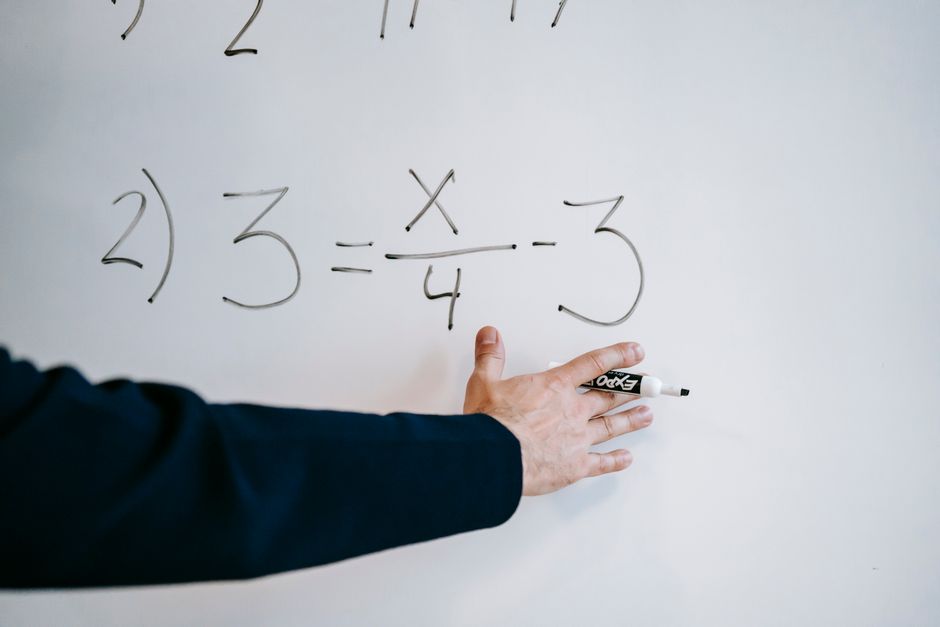
Photo by Vanessa Garcia on Pexels
- Expression: A combination of variables, constants, and mathematical operations (e.g.,
2x + 5,y^2 - 3y + 1). An expression doesn't have an equality sign. - Equation: A statement that two expressions are equal, shown with an equality sign (
=) (e.g.,2x + 5 = 11,y^2 - 3y + 1 = 0). The goal with an equation is usually to find the value(s) of the variable(s) that make the statement true.
Solving Linear Equations (One Variable)
Photo by Vanessa Garcia on Pexels
Linear equations are those where the highest power of the variable is 1 (e.g., 2x + 5 = 11). To solve them, you use inverse operations to isolate the variable.
Basic Principles:
- Addition/Subtraction Property of Equality: You can add or subtract the same number from both sides of an equation, and the equation remains balanced.
- Example:
x - 3 = 7→x - 3 + 3 = 7 + 3→x = 10
- Example:
- Multiplication/Division Property of Equality: You can multiply or divide both sides of an equation by the same non-zero number, and the equation remains balanced.
- Example:
4x = 20→4x / 4 = 20 / 4→x = 5
- Example:
Steps for Solving:
- Simplify: Combine like terms on each side if possible. Use the distributive property if there are parentheses.
- Isolate Variable Terms: Move all terms containing the variable to one side of the equation (usually the left) and all constant terms to the other side. Do this by adding or subtracting terms from both sides.
- Isolate the Variable: Divide or multiply to get the variable by itself.
graph TD
    A["Start with Equation"] --> B{"Simplify Both Sides?"}
    B -- Yes --> C["Apply Distributive Property, Combine Like Terms"]
    B -- No --> D["Move Variable Terms to One Side"]
    C --> D
    D --> E["Move Constant Terms to Other Side"]
    E --> F{"Variable Isolated?"}
    F -- No (coefficient != 1) --> G["Divide/Multiply by Coefficient"]
    F -- Yes --> H["Solution Found"]
    G --> H
Solving Quadratic Equations (One Variable)
Photo by Vanessa Garcia on Pexels
Quadratic equations are those where the highest power of the variable is 2 (e.g., ax^2 + bx + c = 0, where a ≠ 0). They often have two solutions.
Methods:
- Factoring:
- Set the equation to
0. - Factor the quadratic expression into two linear factors.
- Set each factor to
0and solve forx. - Example:
x^2 - 5x + 6 = 0→(x - 2)(x - 3) = 0→x - 2 = 0orx - 3 = 0→x = 2orx = 3.
- Set the equation to
- Using the Quadratic Formula: This always works, even when factoring is difficult or impossible.
- For an equation in the form
ax^2 + bx + c = 0, the solutions are:
x = [-b ± sqrt(b^2 - 4ac)] / 2a - The
b^2 - 4acpart is called the discriminant. It tells you about the nature of the roots:- If
> 0: Two distinct real roots. - If
= 0: One real root (a repeated root). - If
< 0: No real roots (two complex roots).
- If
- For an equation in the form
Systems of Linear Equations (Two Variables)
These involve two or more linear equations with the same set of variables (e.g., x and y). You're looking for values of x and y that satisfy all equations simultaneously.
Methods:
- Substitution Method:
- Solve one equation for one variable (e.g.,
yin terms ofx). - Substitute this expression into the other equation.
- Solve the resulting single-variable equation.
- Substitute the value back into one of the original equations to find the second variable.
- Solve one equation for one variable (e.g.,
- Elimination Method:
- Multiply one or both equations by a constant so that the coefficients of one variable become opposites.
- Add the two equations together to eliminate that variable.
- Solve the resulting single-variable equation.
- Substitute the value back to find the second variable.
3. Worked Example
Let's solve a quadratic equation using factoring and then the quadratic formula to see both in action.
Problem: Solve 2x^2 + 7x + 3 = 0
Method 1: Factoring
- We need two numbers that multiply to
2 * 3 = 6(product of 'a' and 'c') and add up to7('b'). These numbers are1and6. - Rewrite the middle term (
7x) using these numbers:
2x^2 + 1x + 6x + 3 = 0 - Group terms and factor by grouping:
x(2x + 1) + 3(2x + 1) = 0 - Factor out the common binomial:
(2x + 1)(x + 3) = 0 - Set each factor to zero and solve:
2x + 1 = 0→2x = -1→x = -1/2
x + 3 = 0→x = -3
The solutions are x = -1/2 and x = -3.
Method 2: Quadratic Formula
For 2x^2 + 7x + 3 = 0, we have a = 2, b = 7, c = 3.
x = [-b ± sqrt(b^2 - 4ac)] / 2a
x = [-7 ± sqrt(7^2 - 4 * 2 * 3)] / (2 * 2)
x = [-7 ± sqrt(49 - 24)] / 4
x = [-7 ± sqrt(25)] / 4
x = [-7 ± 5] / 4
Now, find the two solutions:
x1 = (-7 + 5) / 4 = -2 / 4 = -1/2
x2 = (-7 - 5) / 4 = -12 / 4 = -3
Both methods give the same solutions!
4. Key Takeaways
- Algebra uses variables to represent unknowns, making it a powerful tool for solving general problems.
- Equations are balanced statements; whatever operation you perform on one side, you must do on the other.
- Linear equations have one solution and are solved by isolating the variable using inverse operations.
- Quadratic equations can have up to two solutions and are typically solved by factoring or using the quadratic formula.
- Systems of equations involve multiple equations and variables, requiring methods like substitution or elimination.
- Always check your solutions by plugging them back into the original equation(s).
Common Mistakes to Avoid:
- Forgetting to do the same operation on both sides of an equation. This is the most common error.
- Sign errors: Be very careful with positive and negative signs, especially when distributing or moving terms across the equality.
- Incorrectly combining like terms: You can only add or subtract terms that have the exact same variable parts and powers (e.g.,
3x + 2ycannot be combined). - Dividing by zero: Never divide by an expression that could be zero, especially when solving for a variable.
- Not fully simplifying: Always reduce fractions and combine all like terms at the end.
5. Now Try It
You've got a word problem: "The sum of two numbers is 15. One number is 3 more than twice the other number. Find the two numbers."
- Define variables for the two numbers (e.g.,
xandy). - Set up a system of two linear equations based on the information given.
- Solve the system using either the substitution or elimination method.
- State your two numbers clearly.
Success looks like: You correctly identify both numbers, and when you plug them back into the original statements, they both hold true. You should get two numbers whose sum is 15, and one of them is correctly 3 more than twice the other.
Frequently asked about ICSE/ISC: Mathematics — Algebra and Equations
Study this next
Get the full ICSE & ISC Prep curriculum
Clone the complete plan to your dashboard for unlimited AI-generated notes, practice quizzes, and a personalised revision schedule.
Save this course free