Inverse Proportion: Fundamentals and Applications
From the Chapter 7: Direct and Inverse Proportion Chapter 8: Polygons and Geometrical Constructions Chapter 9: Congruence and Similarity ( sec 2 g2 math) in singapore curriculum
TL;DR
Inverse proportion describes a relationship where an increase in one quantity leads to a decrease in another, and vice-versa, at a constant product. We'll explore how to identify these relationships and use the constant of proportionality to solve problems. This concept is useful for understanding real-world scenarios like work rates and travel times.
1. The Mental Model
Think of a seesaw: if one side goes up, the other must go down. That's the core idea of inverse proportion – as one thing gets bigger, the other gets smaller, but in a predictable, linked way.
2. The Core Material
When two quantities, let's say x and y, are in inverse proportion, it means their product is always a constant value. We write this as:
x * y = k
where k is the constant of proportionality.
Alternatively, we can express y as being inversely proportional to x:
y = k / x
This equation tells us that if x increases, y must decrease for k to remain constant.
Identifying Inverse Proportion

Photo by Magda Ehlers on Pexels
How do you know if two quantities are inversely proportional?
- Look for "opposite" effects: Does increasing one quantity naturally cause the other to decrease?
- Check the product: If you have pairs of values, multiply them. If their products are roughly the same, they're likely inversely proportional.
Example:
Imagine you have a fixed amount of work to do.
- If you have more workers, the time to complete the job will be less.
- If you have fewer workers, the time to complete the job will be more.
Here, Number of Workers * Time Taken = Constant (Total Work)
Calculating the Constant of Proportionality (k)

Photo by RDNE Stock project on Pexels
Once you have one pair of values (x1, y1) that are inversely proportional, you can find k:
k = x1 * y1
Then, you can use this k to find unknown values. If you have another pair (x2, y2), then:
x2 * y2 = k
This means x1 * y1 = x2 * y2. This is a very handy relationship!
Graphing Inverse Proportion
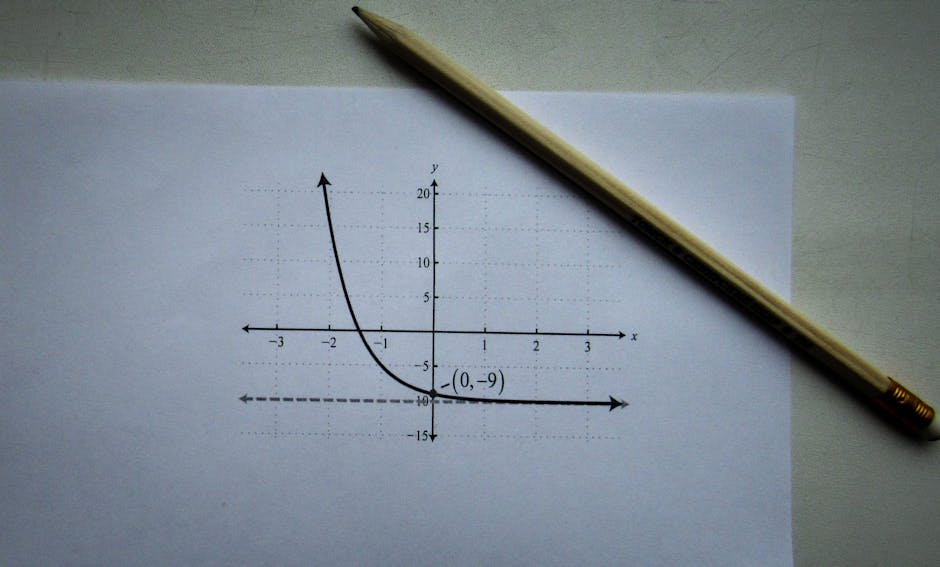
Photo by Sergey Meshkov on Pexels
The graph of an inverse proportion (y = k/x) is a curve called a hyperbola. It never touches the x-axis or the y-axis, as x can't be zero (you can't divide by zero) and y can't be zero (unless k is zero, which means there's no relationship).
graph TD
    A["Identify two quantities (e.g., A and B)"] --> B{"Do they 'move' in opposite directions?"};
    B -- "Yes, if A increases, B decreases" --> C{"Can you express their product as a constant?"};
    C -- "Yes, A * B = k" --> D["They are inversely proportional!"];
    B -- "No, they move together or differently" --> E["Not inversely proportional"];
    D --> F["Use k to find unknown values (A1*B1 = A2*B2)"];
3. Worked Example
Let's say it takes 3 workers 8 days to paint a house. How many days would it take 4 workers to paint the same house, assuming they work at the same rate?
- Identify quantities: Number of workers (W) and Time taken (T).
- Determine relationship: More workers mean less time. This is inverse proportion.
- Find the constant k: Using the first scenario:
W1 * T1 = k
3 workers * 8 days = 24
So,k = 24. Thiskrepresents the total "worker-days" needed for the job. - Use k to find the unknown: Now we have 4 workers (W2 = 4) and we want to find the new time (T2).
W2 * T2 = k
4 * T2 = 24
T2 = 24 / 4
T2 = 6 days
So, it would take 4 workers 6 days to paint the house.
4. Key Takeaways
- Inverse proportion means that as one quantity increases, the other decreases proportionally.
- The product of the two inversely proportional quantities is always a constant (
x * y = k). - This constant k is called the constant of proportionality and represents the total "amount" or "work."
- You can use the relationship
x1 * y1 = x2 * y2to solve for unknown values. - The graph of an inverse proportion is a hyperbola that approaches but never touches the axes.
Common Mistakes to Avoid:
- Confusing with Direct Proportion: Don't assume y = kx (direct proportion) when the problem describes an inverse relationship. Always check if quantities move in opposite directions.
- Incorrectly Calculating k: Remember it's x * y = k, not x / y = k.
- Dividing instead of Multiplying: When solving for an unknown, make sure you're using the correct operation based on x * y = k.
- Forgetting Units: Always include units in your final answer (e.g., days, hours, people).
5. Now Try It
A bus travels at an average speed of 60 km/h and takes 4 hours to complete a journey. How long would the same journey take if the bus traveled at an average speed of 80 km/h?
What to do:
1. Identify the two quantities involved and determine if they are in inverse proportion.
2. Calculate the constant of proportionality (k) using the given speed and time.
3. Use this k to find the new time for the journey at the higher speed.
What success looks like:
You'll get a sensible time (in hours) that is less than 4 hours, which makes sense because the bus is travelling faster.
Frequently asked about Inverse Proportion: Fundamentals and Applications
Study this next
Get the full Chapter 7: Direct and Inverse Proportion Chapter 8: Polygons and Geometrical Constructions Chapter 9: Congruence and Similarity ( sec 2 g2 math) in singapore curriculum
Clone the complete plan to your dashboard for unlimited AI-generated notes, practice quizzes, and a personalised revision schedule.
Save this course free