Applications of Definite Integrals: Areas
From the maths 105 curriculum
TL;DR
Definite integrals are super useful for calculating the exact area under a curve or between curves. You'll essentially sum up tiny rectangles to get the precise area. Remember to set up your integral correctly based on whether you're integrating with respect to $x$ or $y$.
1. The Mental Model
Think of finding an area as adding up an infinite number of incredibly thin slices. Each slice is like a tiny rectangle, and the definite integral is the tool that sums all these slices to give you the total area. It's much more precise than just counting squares on a graph.
2. The Core Material
Definite integrals are fantastic for finding the area of irregular shapes that can be bounded by functions. The core idea is to find the function that describes the "top" boundary and the "bottom" boundary (or "right" and "left"), and then integrate the difference between them over the desired interval.
2.1 Area Under a Single Curve (and above the x-axis)

Photo by Sergey Meshkov on Pexels
If you have a function $f(x)$ that's always positive over an interval $[a, b]$, the area between the curve, the x-axis, and the vertical lines $x=a$ and $x=b$ is given by:
$\int_a^b f(x) \, dx$
This is your basic area calculation.
2.2 Area Between Two Curves

Photo by Steve A Johnson on Pexels
This is where it gets really powerful. To find the area between two functions, say $f(x)$ and $g(x)$, over an interval $[a, b]$, you need to identify which function is "on top." If $f(x) \ge g(x)$ for all $x$ in $[a, b]$, then the area is:
$\int_a^b (f(x) - g(x)) \, dx$
The crucial part here is always subtracting the "lower" function from the "upper" function. If the functions cross, you might need to split your integral into multiple parts.
2.3 Area with Respect to $y$ (Integrating Horizontally)
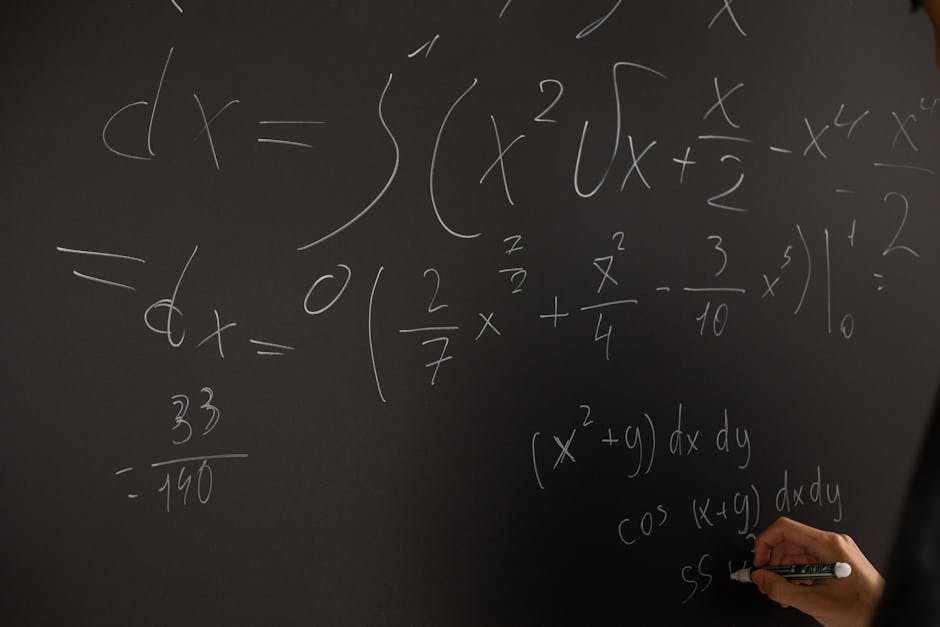
Photo by Monstera Production on Pexels
Sometimes it's easier to find the area by integrating with respect to $y$. This happens when your functions are defined as $x = f(y)$ and $x = g(y)$, or when a region is better described by "right" and "left" boundaries.
In this case, if $f(y) \ge g(y)$ (meaning $f(y)$ is to the right of $g(y)$) over an interval $[c, d]$ on the y-axis, the area is:
$\int_c^d (f(y) - g(y)) \, dy$
Here, you're subtracting the "leftmost" function from the "rightmost" function.
graph TD
    A["Identify Region for Area"] --> B{"Functions in terms of x or y?"}
    B -- "x (y = f(x))" --> C["Find Intersection Points (if needed)"]
    C --> D{"Which function is 'Upper'?"}
    D -- "y_upper = f(x)" --> E["Set up Integral: $\int (f(x) - g(x)) dx$"]
    D -- "y_upper = g(x)" --> F["Set up Integral: $\int (g(x) - f(x)) dx$"]
    E --> G["Evaluate Definite Integral"]
    F --> G
    B -- "y (x = f(y))" --> H["Find Intersection Points (if needed)"]
    H --> I{"Which function is 'Right'?"}
    I -- "x_right = f(y)" --> J["Set up Integral: $\int (f(y) - g(y)) dy$"]
    I -- "x_right = g(y)" --> K["Set up Integral: $\int (g(y) - f(y)) dy$"]
    J --> G
    K --> G
    G --> L["Result: Area Value"]
3. Worked Example
Let's find the area bounded by the curves $y = x^2$ and $y = x + 2$.
Step 1: Find the intersection points.
Set the equations equal to each other:
$x^2 = x + 2$
$x^2 - x - 2 = 0$
$(x - 2)(x + 1) = 0$
So, $x = 2$ and $x = -1$. These are your limits of integration.
Step 2: Determine which function is "upper" in the interval $[-1, 2]$.
Pick a test point, say $x=0$ (which is between -1 and 2).
For $y = x^2$, $y(0) = 0^2 = 0$.
For $y = x + 2$, $y(0) = 0 + 2 = 2$.
Since $2 > 0$, $y = x + 2$ is the upper function.
Step 3: Set up the integral.
Area $= \int_{-1}^{2} ((x + 2) - x^2) \, dx$
Step 4: Evaluate the integral.
Area $= \int_{-1}^{2} (-x^2 + x + 2) \, dx$
Area $= \left[ -\frac{x^3}{3} + \frac{x^2}{2} + 2x \right]_{-1}^{2}$
Now, plug in the limits:
At $x=2$: $(-\frac{2^3}{3} + \frac{2^2}{2} + 2(2)) = (-\frac{8}{3} + \frac{4}{2} + 4) = (-\frac{8}{3} + 2 + 4) = (-\frac{8}{3} + 6) = -\frac{8}{3} + \frac{18}{3} = \frac{10}{3}$
At $x=-1$: $(-\frac{(-1)^3}{3} + \frac{(-1)^2}{2} + 2(-1)) = (-\frac{-1}{3} + \frac{1}{2} - 2) = (\frac{1}{3} + \frac{1}{2} - 2) = \frac{2}{6} + \frac{3}{6} - \frac{12}{6} = -\frac{7}{6}$
Subtract the lower limit value from the upper limit value:
Area $= \frac{10}{3} - (-\frac{7}{6}) = \frac{10}{3} + \frac{7}{6} = \frac{20}{6} + \frac{7}{6} = \frac{27}{6} = \frac{9}{2}$
The area between the curves is $\frac{9}{2}$ or 4.5 square units.
4. Key Takeaways
- The definite integral $\int_a^b f(x) \, dx$ calculates the net signed area between $f(x)$ and the x-axis.
- For area between two curves, always subtract the lower function from the upper function, or the left function from the right function.
- If functions cross within your desired interval, you must split the integral into multiple parts, taking the absolute value of each part if only total area is desired.
- Integrating with respect to $y$ can simplify problems where curves are better defined as $x = f(y)$.
- Intersection points are often the limits of integration when finding the area bounded by the curves themselves.
- A negative result for area means you likely subtracted in the wrong order; absolute value gives the true area.
Common Mistakes to Avoid:
- Forgetting to find intersection points when the bounds aren't explicitly given.
- Incorrectly identifying which function is "upper" or "right" over the entire interval.
- Making sign errors when evaluating the antiderivative at the limits of integration.
- Not splitting the integral if the "upper" or "right" function changes within the region.
5. Now Try It
Find the area bounded by the curves $y = \sqrt{x}$ and $y = x$.
First, find their intersection points. Then, determine which function is above the other between those points. Finally, set up and evaluate the definite integral. You should get an area of $\frac{1}{6}$ square units.
Frequently asked about Applications of Definite Integrals: Areas
Study this next
Get the full maths 105 curriculum
Clone the complete plan to your dashboard for unlimited AI-generated notes, practice quizzes, and a personalised revision schedule.
Save this course free