Quadratic Functions and Equations
From the alg 2 curriculum
TL;DR
Quadratic functions create parabolas, which are U-shaped graphs, and you'll learn to work with their equations. These equations often have two solutions, which are where the parabola crosses the x-axis. We'll cover different methods to solve them, like factoring, using the quadratic formula, and completing the square.
1. The Mental Model
Think of quadratic functions as describing paths or shapes that curve smoothly, like a ball thrown in the air or the arch of a bridge. They're all about how one quantity changes based on the square of another, leading to these distinctive U-shapes.
2. The Core Material
A quadratic function is any function that can be written in the form:
f(x) = ax² + bx + c
where 'a', 'b', and 'c' are real numbers, and a ≠ 0. The highest power of 'x' is 2.
When you set f(x) = 0, you get a quadratic equation:
ax² + bx + c = 0
The solutions to this equation are called the roots or zeros of the function, and they represent the x-intercepts of the parabola.
Graphing Parabolas
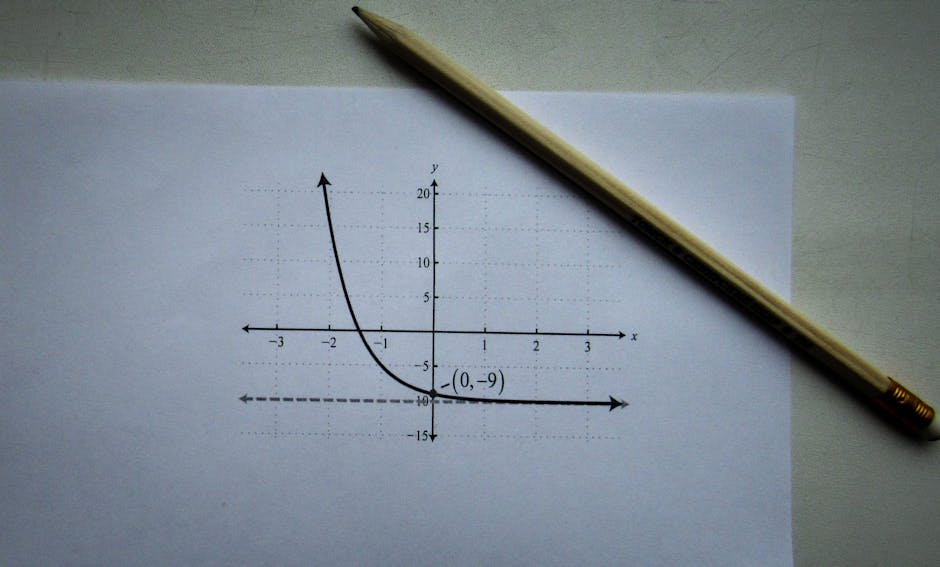
Photo by Sergey Meshkov on Pexels
The graph of a quadratic function is a parabola.
* If a > 0 (positive), the parabola opens upwards (like a smile).
* If a < 0 (negative), the parabola opens downwards (like a frown).
* The vertex is the highest or lowest point of the parabola. Its x-coordinate can be found using x = -b / (2a).
* The axis of symmetry is a vertical line that passes through the vertex, dividing the parabola into two mirror images. Its equation is x = -b / (2a).
Solving Quadratic Equations
Photo by Sergey Meshkov on Pexels
There are several key methods to find the roots of a quadratic equation:
1. Factoring
This method works well when the quadratic expression can be easily factored into two binomials.
* Set the equation to 0.
* Factor the quadratic expression.
* Set each factor equal to 0 and solve for x.
2. Using Square Roots
This is useful when the quadratic equation is in the form ax² + c = 0 (no 'bx' term).
* Isolate the x² term.
* Take the square root of both sides, remembering to include both positive and negative roots.
3. Completing the Square
This method transforms the quadratic expression into a perfect square trinomial. It's especially useful for rewriting the function into vertex form f(x) = a(x - h)² + k, where (h, k) is the vertex.
* Move the constant term 'c' to the right side of the equation.
* Divide all terms by 'a' (if a ≠ 1).
* Take half of the 'b' term (now the coefficient of x), square it, and add it to both sides of the equation.
* Factor the left side as a perfect square and solve.
4. The Quadratic Formula
This is the most universal method; it always works, even when factoring or completing the square are difficult or yield complex numbers.
The solutions for ax² + bx + c = 0 are given by:
x = [-b ± sqrt(b² - 4ac)] / (2a)
The discriminant, Δ = b² - 4ac, tells you about the nature of the roots:
* If Δ > 0: Two distinct real roots (parabola crosses x-axis twice).
* If Δ = 0: One real root (a double root, parabola touches x-axis at one point).
* If Δ < 0: Two complex (non-real) roots (parabola does not cross the x-axis).
Here's a flowchart to help you decide which solving method to use:
graph TD
    A["Start: Quadratic Equation ax² + bx + c = 0"] --> B{"Is there a 'bx' term?"}
    B -- No (bx = 0) --> C{"Isolate x²"}
    C --> D["Take ± square root of both sides"]
    D --> E["Solution: x = ± sqrt(...)"]
    B -- Yes (bx ≠ 0) --> F{"Can it be factored easily?"}
    F -- Yes --> G["Factor the quadratic expression"]
    G --> H["Set each factor to 0 & solve"]
    F -- No --> I{"Is 'a' equal to 1?"}
    I -- Yes --> J["Consider Completing the Square"]
    I -- No or "Completing the Square" is tricky --> K["Use the Quadratic Formula"]
    K --> L["x = [-b ± sqrt(b² - 4ac)] / (2a)"]
    J --> M["Complete the Square and solve"]
3. Worked Example
Let's solve the equation 2x² + 5x - 3 = 0 using the quadratic formula.
-
Identify a, b, and c:
In2x² + 5x - 3 = 0, we have:
a = 2
b = 5
c = -3 -
Plug values into the quadratic formula:
x = [-b ± sqrt(b² - 4ac)] / (2a)
x = [-5 ± sqrt(5² - 4 * 2 * -3)] / (2 * 2) -
Simplify inside the square root (the discriminant):
x = [-5 ± sqrt(25 - (-24))] / 4
x = [-5 ± sqrt(25 + 24)] / 4
x = [-5 ± sqrt(49)] / 4 -
Calculate the square root:
x = [-5 ± 7] / 4 -
Find the two solutions:
- For the
+case:
x1 = (-5 + 7) / 4
x1 = 2 / 4
x1 = 1/2 - For the
-case:
x2 = (-5 - 7) / 4
x2 = -12 / 4
x2 = -3
- For the
So, the solutions to the equation 2x² + 5x - 3 = 0 are x = 1/2 and x = -3.
4. Key Takeaways
- Quadratic functions
f(x) = ax² + bx + cgraph as parabolas, opening up ifa > 0and down ifa < 0. - The vertex of a parabola is its highest or lowest point, found at
x = -b / (2a). - Solving quadratic equations means finding the x-intercepts or roots, where the parabola crosses the x-axis.
- Factoring is a quick method when the expression can be broken into simple binomials.
- The quadratic formula
x = [-b ± sqrt(b² - 4ac)] / (2a)is a universal tool for solving any quadratic equation. - The discriminant
b² - 4actells you if you'll have two real, one real, or two complex solutions. - Completing the square is useful for converting to vertex form and understanding the structure of the parabola.
Common mistakes to avoid:
- Forgetting the
±when taking square roots, which means you miss half the solutions. - Incorrectly calculating the discriminant, especially with negative numbers.
- Not setting the quadratic equation to
0before attempting to factor or use the formula. - Dividing by 'a' only on one side of the equation when completing the square.
5. Now Try It
Given the quadratic function g(x) = x² - 6x + 8:
- Find the coordinates of the vertex.
- Determine if the parabola opens upwards or downwards.
- Find the x-intercepts (the roots) by factoring.
- Find the x-intercepts again using the quadratic formula.
Success looks like: You should find the same x-intercepts using both factoring and the quadratic formula, and correctly identify the vertex and direction of opening.
Frequently asked about Quadratic Functions and Equations
Study this next
Get the full alg 2 curriculum
Clone the complete plan to your dashboard for unlimited AI-generated notes, practice quizzes, and a personalised revision schedule.
Save this course free