Chemical Sciences: Chemical Reactions and States of Matter
From the TERM 4 Science test plan curriculum
TL;DR
Chemical reactions involve rearranging atoms to form new substances, while states of matter describe how particles are arranged and move. Energy changes are key to understanding both, as matter can change state by gaining or losing energy, and reactions either release or absorb energy. Understanding these concepts helps explain everyday phenomena from cooking to rust.
1. The Mental Model
Think of matter as Lego bricks. Chemical reactions are like taking apart existing Lego creations and building entirely new ones with the same bricks. States of matter are just different ways you can arrange and connect those same Lego bricks – tightly packed and still, loosely connected and moving, or completely separate and zooming around.
2. The Core Material
You're going to dive into how matter behaves and changes. This topic covers two big ideas: chemical reactions, where new substances are formed, and states of matter, which describe how particles are arranged.
Chemical Reactions

Photo by Ron Lach on Pexels
A chemical reaction is a process that involves rearrangement of the atomic structure of a substance, creating new substances. You start with reactants and end up with products. It's not just a change in appearance; the actual chemical identity changes.
You can often spot a chemical reaction by looking for signs like:
* Gas production: bubbles forming.
* Color change: a new color appears.
* Temperature change: the container gets hotter (exothermic) or colder (endothermic).
* Precipitate formation: a solid forms in a liquid solution.
* Light emission: light is given off.
Reactions can be:
* Exothermic: They release energy, usually as heat. Think burning wood.
* Endothermic: They absorb energy, usually as heat. Think an instant cold pack.
States of Matter
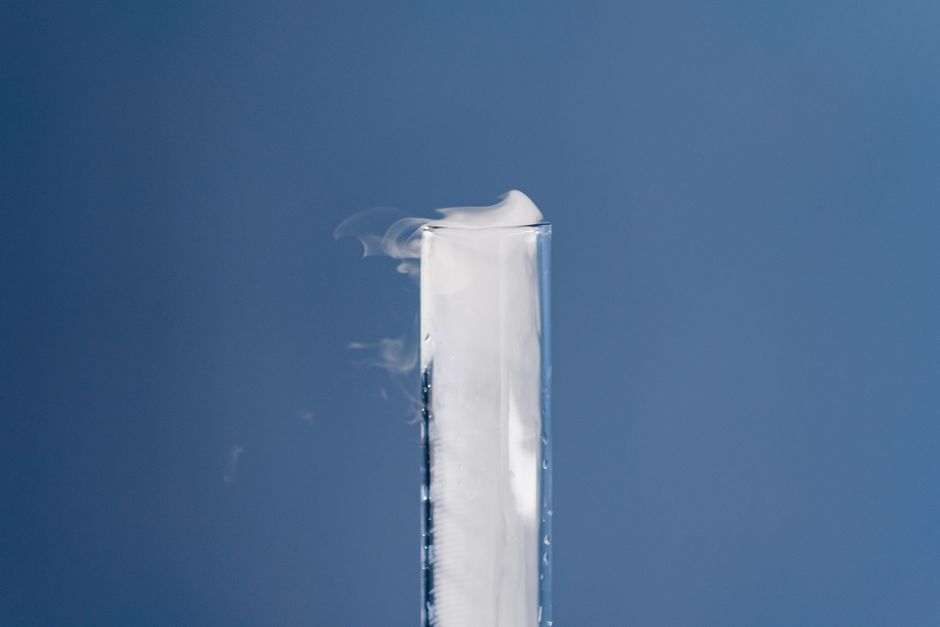
Photo by Ron Lach on Pexels
Matter exists in different states depending on how its particles (atoms or molecules) are arranged and how much energy they have. The three main states you'll focus on are solid, liquid, and gas. There's also plasma, but you typically won't cover that in as much depth.
Here’s a quick breakdown:
- Solid: Particles are tightly packed in a fixed pattern, vibrating in place. They have a definite shape and volume.
- Liquid: Particles are close together but can slide past each other. They have a definite volume but take the shape of their container.
- Gas: Particles are far apart, moving randomly and rapidly. They have no definite shape or volume, filling any container.
Changes of state (like melting, freezing, boiling, condensing, subliming, and depositing) are physical changes, not chemical reactions. The substance itself doesn't change chemically, just its physical form. These changes are driven by the addition or removal of energy (usually heat).
graph TD
    A["Solid (Low Energy)"] --> B["Liquid (Medium Energy)"]
    B --> C["Gas (High Energy)"]

    A -- Melt (Add Heat) --> B
    B -- Freeze (Remove Heat) --> A

    B -- Boil/Evaporate (Add Heat) --> C
    C -- Condense (Remove Heat) --> B

    A -- Sublimate (Add Heat) --> C
    C -- Deposit (Remove Heat) --> A
Understanding Energy in Changes

Photo by Thắng-Nhật Trần on Pexels
Both chemical reactions and changes of state involve energy.
- Chemical reactions: Breaking bonds requires energy, and forming bonds releases energy. The overall energy change determines if a reaction is exothermic (net energy released) or endothermic (net energy absorbed).
- Changes of state: Adding energy increases particle movement, leading to transitions from solid to liquid to gas. Removing energy slows particles down, causing transitions in the opposite direction.
3. Worked Example
Let's look at what happens when you light a candle.
- Melting Wax (Physical Change): The heat from the flame causes the solid wax near the wick to turn into liquid wax. This is a change of state from solid to liquid. The wax molecules are still wax molecules; they're just arranged differently and moving more. This process absorbs heat from the flame.
- Vaporizing Wax (Physical Change): The liquid wax is drawn up the wick, where the heat from the flame turns it into a gas (wax vapor). Again, this is a change of state from liquid to gas. The wax molecules are still wax, but now they're far apart and moving rapidly. This also absorbs heat.
- Burning Wax (Chemical Reaction): The wax vapor mixes with oxygen in the air. When ignited by the flame, the wax (hydrocarbons) reacts with oxygen to produce carbon dioxide and water. This is a chemical reaction. You're forming new substances (CO2 and H2O) from the original wax and oxygen. This reaction is highly exothermic, releasing significant heat and light, which sustains the flame and causes more wax to melt and vaporize.
So, lighting a candle involves both physical changes (melting, vaporizing) and a chemical reaction (burning).
4. Key Takeaways
- Chemical reactions form entirely new substances by rearranging atoms, while changes of state only alter the physical form of a substance.
- Energy is always involved: reactions either release (exothermic) or absorb (endothermic) energy; changes of state absorb or release energy to alter particle movement.
- Solids have fixed shapes and volumes, liquids have fixed volumes but take container shape, and gases have no fixed shape or volume.
- Temperature and pressure are key factors that influence both reaction rates and the state of matter.
- Signs like gas production, color change, or temperature change can indicate a chemical reaction is occurring.
- Melting, boiling, and sublimation require energy input; freezing, condensing, and deposition release energy.
Common Mistakes to Avoid:
* Confusing a physical change (like melting ice) with a chemical reaction (like burning wood). Remember, if the substance's chemical identity doesn't change, it's physical.
* Assuming all reactions that feel cold are endothermic. A cold feeling might just be rapid evaporation, which is a physical change.
* Forgetting that mass is conserved in chemical reactions. Atoms are rearranged, not created or destroyed.
* Mixing up the terms for different state changes (e.g., calling boiling "evaporation" at any temperature, or confusing freezing with condensation).
5. Now Try It
Take a moment to identify examples of chemical reactions and changes of state in your daily life. Over the next 15 minutes, look around your kitchen or bathroom. Write down three examples of changes you observe and classify each one as either a chemical reaction or a change of state. For each one, briefly explain why you classified it that way (e.g., "new substance formed" or "only physical form changed").
What success looks like: You'll have a list of three everyday phenomena, correctly identified as either chemical reactions or changes of state, with a clear and concise reason for your classification.
Frequently asked about Chemical Sciences: Chemical Reactions and States of Matter
Study this next
Get the full TERM 4 Science test plan curriculum
Clone the complete plan to your dashboard for unlimited AI-generated notes, practice quizzes, and a personalised revision schedule.
Save this course free