"course_name": "Matrices, Equations, Similarities and Congruency, Statistics, Algebra, Sets, Probability",
From the matrices, equetions, similarities and congruency , Statistics,Algebra,sets,Probability, curriculum
TL;DR
This course covers fundamental mathematical concepts from different areas, including how to organize data, solve for unknowns, compare shapes, analyze data, and understand chance. You'll learn essential tools for problem-solving in various contexts, preparing you for more advanced topics.
1. The Mental Model
Think of this course as building a mathematical toolkit. Each topic gives you a new tool for understanding patterns, solving problems, and making predictions in different real-world situations.
2. The Core Material
Matrices: Organizing Numbers

Photo by Black ice on Pexels
Matrices are just rectangular grids of numbers. They're super useful for organizing data or solving systems of equations. You can add, subtract, and multiply them following specific rules.
Equations: Finding the Unknown
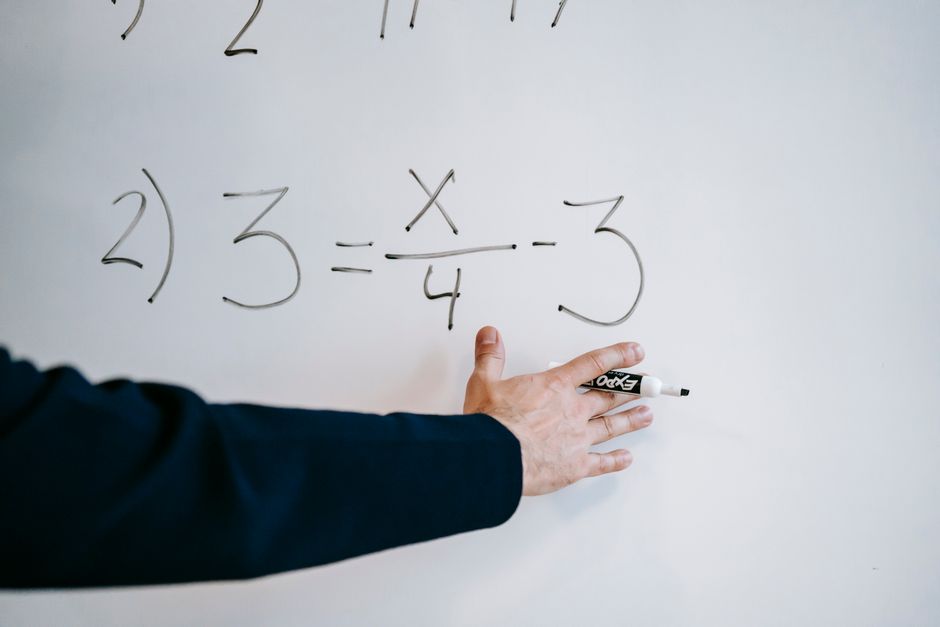
Photo by Vanessa Garcia on Pexels
An equation shows that two expressions are equal. Your goal is usually to find the value(s) of the unknown variable(s) that make the equation true. This often involves isolating the variable using inverse operations.
Similarities and Congruency: Comparing Shapes

Photo by Towfiqu barbhuiya on Pexels
- Congruent shapes are identical in every way – same size, same shape. Think of two identical cookies.
- Similar shapes have the same shape but different sizes. One is a scaled version of the other. All their corresponding angles are equal, and corresponding sides are proportional.
graph TD
    A["Shapes"] --> B["Congruent?"]
    B -- "Yes (Same Size & Shape)" --> C["All corresponding angles are equal"]
    C --> D["All corresponding sides are equal"]
    B -- "No (Different Size or Shape)" --> E["Similar?"]
    E -- "Yes (Same Shape, Different Size)" --> F["All corresponding angles are equal"]
    F --> G["Corresponding sides are proportional"]
    E -- "No (Different Shape)" --> H["Neither Congruent nor Similar"]
Statistics: Making Sense of Data

Photo by ANTONI SHKRABA production on Pexels
Statistics is all about collecting, organizing, analyzing, interpreting, and presenting data. You'll learn about measures of central tendency (like mean, median, mode) and measures of spread (like range) to describe data sets.
Algebra: Generalizing Math
Algebra uses letters (variables) to represent unknown numbers. This lets you write general rules and solve problems that apply to many different situations, not just specific numbers. You'll work with expressions, equations, and inequalities.
Sets: Grouping Things
A set is a well-defined collection of distinct objects. You'll learn about different ways to describe sets, operations like union (combining sets) and intersection (finding common elements), and how to use Venn diagrams to visualize them.
Probability: Predicting Chance
Probability is the measure of how likely an event is to happen. It's usually expressed as a fraction, decimal, or percentage between 0 (impossible) and 1 (certain). You'll calculate probabilities for simple and compound events.
3. Worked Example
Let's look at similar triangles.
Problem: Triangle ABC has angles A=90°, B=30°, C=60°. Its sides are AB=5 cm, BC=10 cm, AC≈8.66 cm. Triangle DEF has angles D=90°, E=30°, F=60°. Its side DE=10 cm. Are these triangles similar or congruent? Find the length of EF.
Solution:
1. Check angles: Both triangles have angles 90°, 30°, 60°. Since all corresponding angles are equal, the triangles are similar. They are not necessarily congruent because we don't know if their sides are the same length yet.
2. Find the scale factor: Since they are similar, the ratio of corresponding sides is constant.
* Side AB corresponds to DE.
* Ratio = DE / AB = 10 cm / 5 cm = 2.
* The scale factor from triangle ABC to triangle DEF is 2.
3. Calculate EF: Side BC corresponds to EF.
* EF = BC * scale factor
* EF = 10 cm * 2 = 20 cm.
So, Triangle ABC and Triangle DEF are similar, and the length of EF is 20 cm.
4. Key Takeaways
- Matrices organize data efficiently and are used in solving systems of equations.
- Equations help you find unknown values by balancing expressions.
- Congruent shapes are identical; similar shapes have the same form but different sizes, with proportional sides.
- Statistics provides tools to describe and interpret data sets.
- Algebra uses variables to generalize mathematical relationships and solve a wide range of problems.
- Sets define collections of items, allowing for operations like union and intersection.
- Probability quantifies the likelihood of events occurring.
- Understanding these concepts builds a strong foundation for advanced math and problem-solving.
Common Mistakes to Avoid
- Confusing similarity with congruency; remember similarity means same shape, congruency means same shape and same size.
- Forgetting to perform the same operation on both sides of an equation, which invalidates the equality.
- Incorrectly identifying corresponding sides or angles when working with similar figures.
- Misinterpreting mean, median, and mode – know when to use each for data analysis.
5. Now Try It
Spend 15 minutes reviewing how to solve a simple linear equation like 3x + 7 = 19, and then try calculating the mean, median, and mode for the following data set: {12, 15, 11, 18, 15, 13, 16}.
Success looks like correctly finding the value of x and all three statistical measures for the data set.
Frequently asked about "course_name": "Matrices, Equations, Similarities and Congruency, Statistics, Algebra, Sets, Probability",
More from matrices, equetions, similarities and congruency , Statistics,Algebra,sets,Probability,
Get the full matrices, equetions, similarities and congruency , Statistics,Algebra,sets,Probability, curriculum
Clone the complete plan to your dashboard for unlimited AI-generated notes, practice quizzes, and a personalised revision schedule.
Save this course free