"description": "Establish a strong understanding of fundamental algebraic concepts, operations, and the principles of set theory as a basis for subsequent topics.",
From the matrices, equetions, similarities and congruency , Statistics,Algebra,sets,Probability, curriculum
TL;DR
You'll learn the basic building blocks of algebra, like variables and operations, which are essential for solving math problems. We'll also cover set theory, a way to group items, that helps organize mathematical ideas. Mastering these concepts will give you a strong foundation for future topics.
1. The Mental Model
Think of algebra as a language for describing relationships using symbols instead of just numbers. Set theory is like creating well-defined collections of things, helping us categorize and understand mathematical objects more clearly. Together, they give you powerful tools for problem-solving.
2. The Core Material
Understanding Variables and Expressions
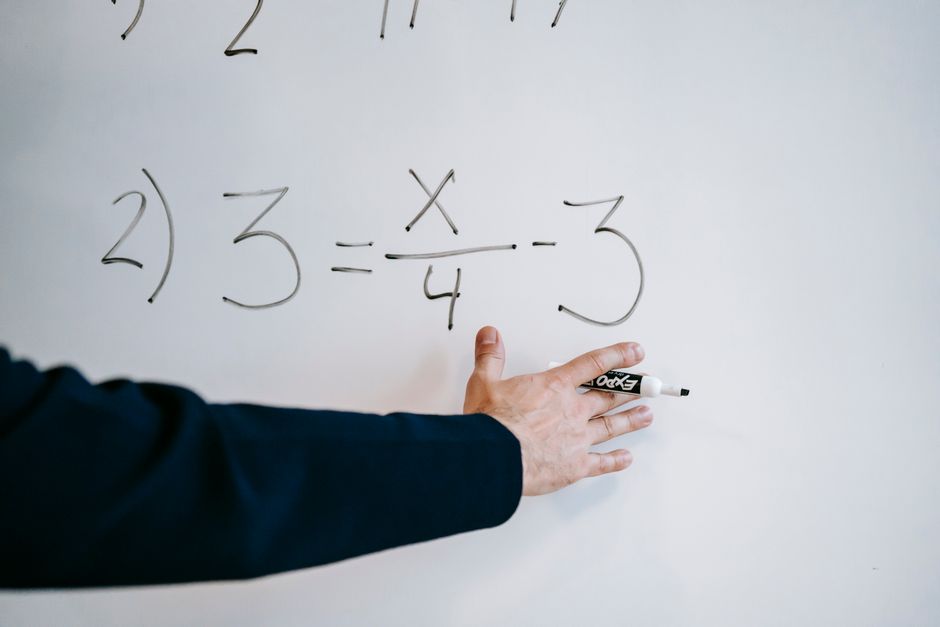
Photo by Vanessa Garcia on Pexels
In algebra, we use variables (usually letters like x, y, a, b) to represent unknown numbers or values that can change. An algebraic expression is a combination of variables, numbers, and operation symbols (+, -, *, /). It doesn't have an equals sign.
For example:
* x + 5 is an expression. Here, 'x' is a variable, '5' is a constant, and '+' is an operation.
* 3y - 2 is another expression. '3' is a coefficient (a number multiplying a variable).
Algebraic Operations

Photo by Lum3n on Pexels
The basic operations you know apply:
* Addition (+): a + b
* Subtraction (-): a - b
* Multiplication (* or juxtaposition): a * b or ab or 3x
* Division (/ or fraction bar): a / b or a/b
Equations vs. Expressions
Photo by Vanessa Garcia on Pexels
- An expression is a mathematical phrase (e.g.,
2x + 7). - An equation shows that two expressions are equal (e.g.,
2x + 7 = 15). Solving an equation means finding the value(s) of the variable(s) that make the equation true.
Introduction to Set Theory

Photo by Ann H on Pexels
A set is a well-defined collection of distinct objects, called elements or members. The order of elements doesn't matter, and each element is unique.
Sets are usually represented in one of two ways:
1. Roster Method (Listing): List all elements inside curly braces {}.
* Example: A = {1, 2, 3, 4} (Set A contains the numbers 1, 2, 3, 4)
* Example: B = {red, blue, green}
2. Set-Builder Notation: Describe the property that all elements in the set share.
* Example: C = {x | x is an even number less than 10} (Read as "C is the set of all x such that x is an even number less than 10"). This would be {2, 4, 6, 8}.
Key Set Concepts:
- Element of a set:
∈symbol.2 ∈ Ameans "2 is an element of set A". - Not an element of a set:
∉symbol.5 ∉ Ameans "5 is not an element of set A". - Empty Set (Null Set): A set with no elements. Represented by
{}or∅. - Subset: If every element of set A is also an element of set B, then A is a subset of B (
A ⊆ B). If A is a subset of B but not equal to B, it's a proper subset (A ⊂ B).
Here's a diagram to visualize set relationships:
graph TD
    A["Universe of Numbers"] --> B["Whole Numbers"]
    B --> C["Integers"]
    C --> D["Rational Numbers"]
    D --> E["Real Numbers"]
    E --> F["Complex Numbers"]
    subgraph Natural Numbers
        G["Counting Numbers (1, 2, 3...)"]
    end
    B --> G
    C["Integers"] --> H["Negative Integers (...-3, -2, -1)"]
    C --> I["Zero (0)"]
    D --> J["Fractions and Decimals (e.g., 1/2, 0.75)"]
3. Worked Example
Let's work with an algebraic expression and a set.
Problem: Evaluate the expression 3x + 2y - 1 when x = 4 and y = -2. Then, list the elements of set P = {z | z is an integer, and -3 < z ≤ 1}.
Solution:
-
Evaluate the expression:
- Substitute
x = 4andy = -2into the expression3x + 2y - 1. 3(4) + 2(-2) - 112 + (-4) - 112 - 4 - 18 - 17
- Substitute
-
List the elements of set P:
- The set
Pcontains integers (z) such thatzis greater than -3 but less than or equal to 1. - Integers greater than -3 are -2, -1, 0, 1, 2, ...
- Integers less than or equal to 1 are ..., -1, 0, 1.
- Combining these conditions, the integers that fit are -2, -1, 0, and 1.
- So,
P = {-2, -1, 0, 1}.
- The set
4. Key Takeaways
- Variables are symbols that represent unknown or changing values in algebra.
- An algebraic expression combines variables, numbers, and operations without an equals sign.
- An equation states that two expressions are equal, and you solve it to find variable values.
- A set is a well-defined collection of distinct objects called elements.
- Sets can be described by listing their elements (roster method) or by a rule (set-builder notation).
- The empty set contains no elements, and subsets are sets contained within larger sets.
- Understanding these basics helps you build more complex mathematical ideas.
Common Mistakes to Avoid:
- Confusing expressions with equations; remember, equations have an equals sign.
- Forgetting the order of operations (PEMDAS/BODMAS) when evaluating expressions.
- Not paying attention to whether elements in a set must be unique or ordered (they must be unique, order doesn't matter).
- Misinterpreting inequalities in set-builder notation (e.g., < vs. ≤).
5. Now Try It
Exercise: Given the expression 5a - 3b + 10, evaluate it when a = -3 and b = 2. Then, write the set Q = {x | x is a natural number, and 5 < x < 10} using the roster method.
What success looks like: You'll have a single number as the result of your expression evaluation and a clearly listed set of numbers for set Q.
Frequently asked about "description": "Establish a strong understanding of fundamental algebraic concepts, operations, and the principles of set theory as a basis for subsequent topics.",
More from matrices, equetions, similarities and congruency , Statistics,Algebra,sets,Probability,
Get the full matrices, equetions, similarities and congruency , Statistics,Algebra,sets,Probability, curriculum
Clone the complete plan to your dashboard for unlimited AI-generated notes, practice quizzes, and a personalised revision schedule.
Save this course free