Past Year Paper Analysis and Exam Technique
From the FLUID MECHANIC curriculum
TL;DR
Analyzing past year papers is crucial for understanding exam patterns and identifying frequently tested concepts. It helps you prioritize your study efforts and develop effective time management strategies for the actual exam. By practicing with these papers, you'll build confidence and improve your problem-solving speed.
1. The Mental Model
Think of past year papers as a treasure map leading to exam success. Each question is a clue, revealing what concepts are important, how they're tested, and what kind of solutions are expected. By deciphering these clues, you can predict what's coming and prepare strategically.
2. The Core Material
Analyzing past year papers isn't just about doing practice questions; it's a systematic approach to understanding your exam. Here's how to do it effectively for Fluid Mechanics:
2.1 Understand the Exam Structure
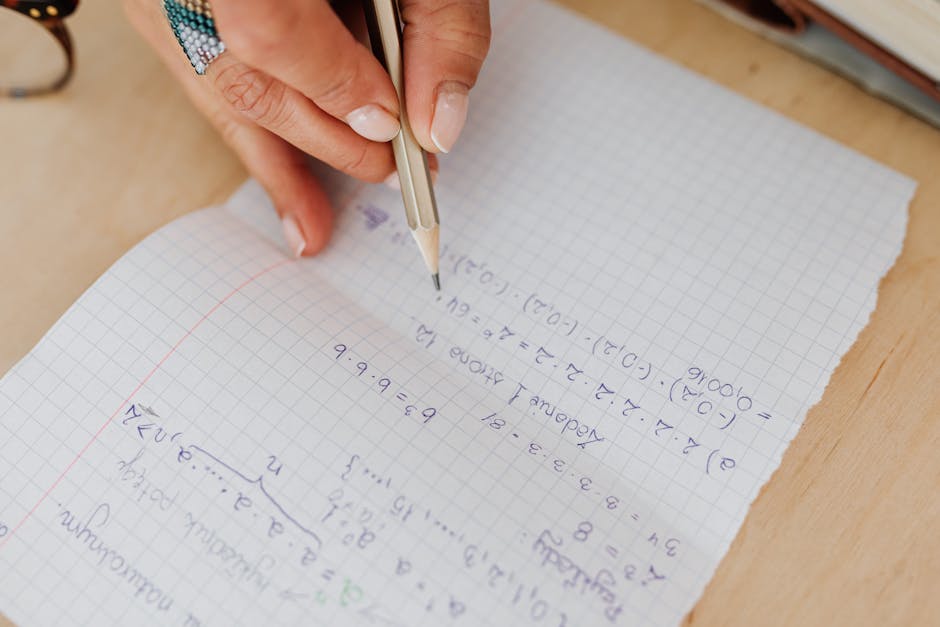
Photo by https://kaboompics.com/ on Pexels
Before diving into questions, get a feel for the exam's layout. How many sections are there? What's the distribution of marks? Are there compulsory questions? Knowing this helps you allocate your study time and plan your approach during the exam.
2.2 Identify Key Topics and Question Types

Photo by Ann H on Pexels
Go through several past papers and make a list of the topics that appear repeatedly. Are there always questions on Bernoulli's equation, continuity, or boundary layers? Also, note the type of questions: Are they conceptual, problem-solving, or derivation-based? This helps you focus your revision.
2.3 Analyze Mark Schemes and Expected Answers

Photo by Andy Barbour on Pexels
Don't just look at whether your answer is right or wrong. Study the mark schemes (if available). They show you how marks are allocated for different steps in a solution. This is vital for understanding what details you need to include and how to present your work to maximize marks, even if your final answer isn't perfect.
2.4 Time Management and Pacing

Photo by Gustavo Fring on Pexels
Practice completing papers under timed conditions. This helps you understand how much time you can realistically spend on each question. Many students know the material but run out of time. Simulate exam conditions to refine your pacing.
graph TD
    A["Get Past Papers (Last 3-5 Years)"] --> B["First Pass: Read Through (No Solving)"];
    B --> C["Identify Recurring Topics/Concepts"];
    C --> D["Note Question Styles (Conceptual, Problem, Derivation)"];
    D --> E["Attempt Questions (Under Timed Conditions)"];
    E --> F{"Compare with Solutions/Mark Schemes"};
    F -- "Yes" --> G["Understand Marking Criteria & Common Pitfalls"];
    F -- "No" --> H["Review Relevant Lecture Notes/Textbook"];
    G --> I["Identify Weak Areas"];
    H --> I;
    I --> J["Targeted Revision & Practice"];
    J --> E;
2.5 Develop an Exam Day Strategy
Based on your analysis, plan how you'll approach the actual exam. Which questions will you tackle first? How much time will you allocate to each section? What's your strategy for questions you find difficult? Having a plan reduces anxiety and helps you perform better.
3. Worked Example
Let's say you're analyzing a Fluid Mechanics past paper and come across this question:
Question:
A horizontal pipe of 15 cm diameter carries water at a velocity of 2 m/s. It then gradually tapers down to a 7.5 cm diameter. If the pressure at the larger diameter section is 150 kPa, calculate the pressure at the smaller diameter section, assuming no energy loss. (Density of water = 1000 kg/m³)
Analysis Process:
- Identify Core Concepts: This question immediately screams "Continuity Equation" and "Bernoulli's Equation." The phrase "no energy loss" confirms Bernoulli's applicability.
- Required Information: You're given two diameters, one velocity, and one pressure. You need to find the other pressure.
- Formulas Needed:
- Continuity: $A_1 V_1 = A_2 V_2$ (or $\frac{\pi D_1^2}{4} V_1 = \frac{\pi D_2^2}{4} V_2$)
- Bernoulli: $\frac{P_1}{\rho g} + \frac{V_1^2}{2g} + z_1 = \frac{P_2}{\rho g} + \frac{V_2^2}{2g} + z_2$
- Step-by-Step Solution (as you'd do it in the exam):
- Step 1: Calculate areas and diameters (D1 = 0.15 m, D2 = 0.075 m).
- $A_1 = \frac{\pi}{4} (0.15)^2 = 0.01767 m^2$
- $A_2 = \frac{\pi}{4} (0.075)^2 = 0.004418 m^2$
- Step 2: Use Continuity Equation to find $V_2$.
- $A_1 V_1 = A_2 V_2$
- $0.01767 m^2 \times 2 m/s = 0.004418 m^2 \times V_2$
- $V_2 = \frac{0.01767 \times 2}{0.004418} \approx 8 m/s$
- Step 3: Apply Bernoulli's Equation.
- Since the pipe is horizontal, $z_1 = z_2$. So, $\frac{P_1}{\rho g} + \frac{V_1^2}{2g} = \frac{P_2}{\rho g} + \frac{V_2^2}{2g}$
- Rearranging for $P_2$: $P_2 = P_1 + \frac{1}{2}\rho (V_1^2 - V_2^2)$ (Multiply by $\rho$ to get pressure terms, then isolate $P_2$)
- $P_2 = 150 \times 10^3 Pa + \frac{1}{2} \times 1000 kg/m^3 \times ((2 m/s)^2 - (8 m/s)^2)$
- $P_2 = 150000 + 500 \times (4 - 64)$
- $P_2 = 150000 + 500 \times (-60)$
- $P_2 = 150000 - 30000$
- $P_2 = 120000 Pa = 120 kPa$
- Step 1: Calculate areas and diameters (D1 = 0.15 m, D2 = 0.075 m).
Exam Technique Notes:
* Clearly state your assumptions (e.g., "horizontal pipe, so $z_1=z_2$").
* Show all steps, especially variable substitution.
* Include units at each major step or in the final answer.
* Make sure your final answer has the correct units and appropriate significant figures.
4. Key Takeaways
- Start analyzing past papers early in your revision process to guide your studies.
- Always attempt questions under timed conditions to improve speed and manage exam anxiety.
- Pay close attention to mark schemes to understand how marks are allocated for steps, not just the final answer.
- Identify your recurring weak areas from past paper practice and dedicate extra study time to them.
- Develop a clear exam-day strategy based on your strengths and the paper's structure.
- Don't just solve; analyze the questions, recurring themes, and expected answer formats.
- Understand the context of the problem and the underlying fluid mechanics principles.
Common Mistakes to Avoid:
- Not attempting past papers under strict exam conditions.
- Focusing only on getting the right answer, ignoring the steps and presentation.
- Overlooking the recurring nature of certain topics and question types.
- Failing to review your mistakes and understand why you got something wrong.
- Memorizing solutions instead of understanding the concepts.
5. Now Try It
Take a full past year paper for Fluid Mechanics, and for the first 30 minutes, don't answer any questions. Instead, identify and list the top 5 most frequently tested concepts/equations in that paper. Then, pick one multi-part problem that involves both conceptual understanding and calculation, and write down a detailed step-by-step plan (without solving it yet) for how you would approach solving it to maximize marks, including which formulas you'd use and what assumptions you'd state. Success looks like a clear, logical plan that addresses all parts of the question, demonstrates understanding of the concepts, and outlines proper presentation.
Frequently asked about Past Year Paper Analysis and Exam Technique
More from FLUID MECHANIC
Get the full FLUID MECHANIC curriculum
Clone the complete plan to your dashboard for unlimited AI-generated notes, practice quizzes, and a personalised revision schedule.
Save this course free