Fluid Pressure and its Measurement
From the FLUID MECHANIC curriculum
TL;DR
Fluid pressure is the force a fluid exerts perpendicularly on a surface, crucial for understanding how fluids behave. You'll often encounter gauge, absolute, and vacuum pressures in exam questions, differing by their reference point. Measuring devices like manometers and pressure transducers are used to quantify these pressures.
1. The Mental Model
Imagine you're underwater: the deeper you go, the more the water pushes on you. That pushing force, spread over your body's surface, is pressure. Different ways of talking about this "push" depend on whether you're comparing it to a perfect vacuum, the atmosphere, or just a specific point.
2. The Core Material
Fluid pressure is defined as the force exerted perpendicularly per unit area by a fluid. This concept is fundamental in fluid mechanics.
$$P = \frac{F}{A}$$
Where:
* $P$ is pressure (Pascals, Pa, or N/m²)
* $F$ is force (Newtons, N)
* $A$ is area (m²)
Types of Pressure
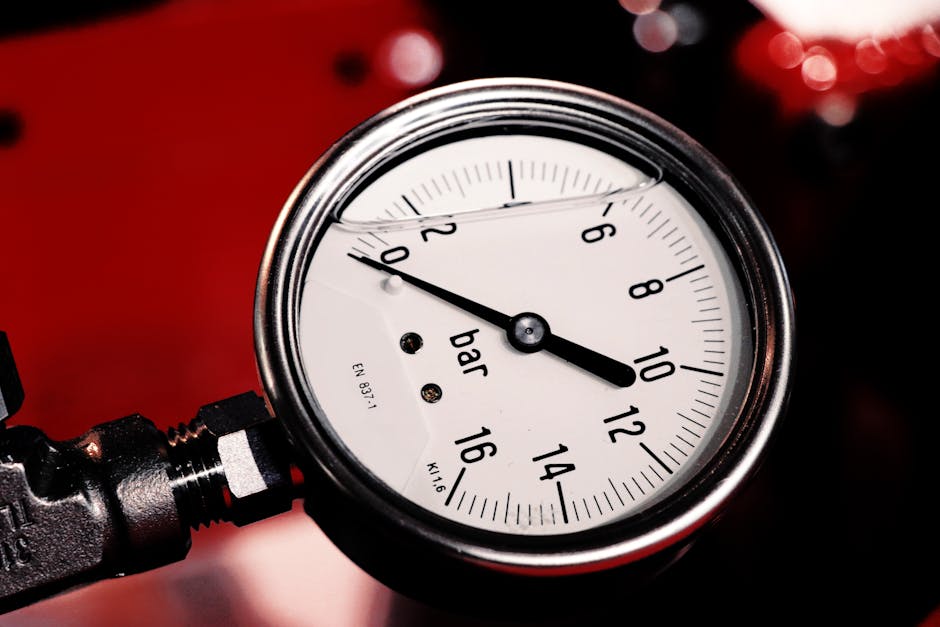
Photo by Amir Ghoorchiani on Pexels
You'll primarily deal with three types of pressure in exams:
- Absolute Pressure ($P_{abs}$): This is the pressure measured relative to a perfect vacuum (zero pressure). It's always positive.
- Gauge Pressure ($P_{gauge}$): This is the pressure measured relative to the local atmospheric pressure. A positive gauge pressure means it's above atmospheric, while a negative gauge pressure (also called vacuum pressure) means it's below atmospheric.
- Atmospheric Pressure ($P_{atm}$): This is the pressure exerted by the weight of the air column above a specific point. It varies with altitude and weather conditions.
The relationship between these is key:
$$P_{abs} = P_{gauge} + P_{atm}$$
If a pressure is below atmospheric, it's often expressed as Vacuum Pressure ($P_{vac}$).
$$P_{abs} = P_{atm} - P_{vac}$$
Pressure Variation in a Static Fluid
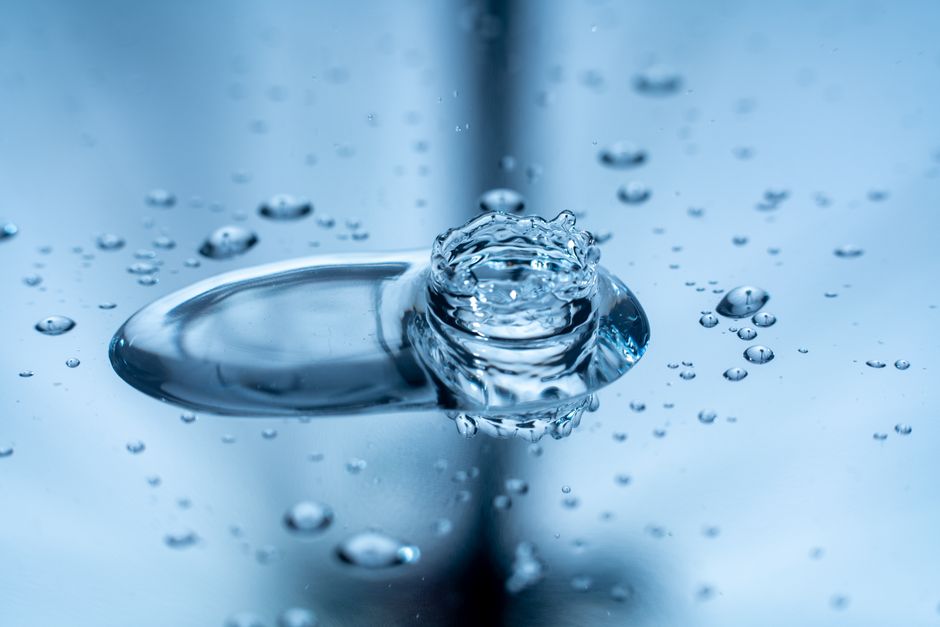
Photo by Vilnis Husko on Pexels
For a static fluid (a fluid at rest), the pressure increases with depth. This is described by:
$$P_2 - P_1 = \rho g h$$
Or, if considering pressure at a depth 'h' from a free surface open to atmosphere:
$$P = P_{atm} + \rho g h$$
Where:
* $P$ is pressure
* $\rho$ is the fluid density (kg/m³)
* $g$ is the acceleration due to gravity (approx. 9.81 m/s²)
* $h$ is the depth (m)
This formula shows that pressure acts equally in all directions at a given depth within a static fluid.
Pressure Measurement Devices
Photo by Amir Ghoorchiani on Pexels
You should be familiar with common devices used to measure pressure:
- Manometers: These use a fluid column to measure pressure differences.
- U-tube manometer: Measures gauge pressure or differential pressure. The height difference of the fluid column directly relates to the pressure.
- Inclined manometer: Used for measuring small pressure differences with greater accuracy.
- Barometer: Measures atmospheric pressure. A common type is the mercury barometer.
- Bourdon Gauge: A mechanical device that uses a coiled tube that straightens under pressure. It's often used for industrial pressure measurements and typically measures gauge pressure.
- Pressure Transducers: Electronic devices that convert pressure into an electrical signal. They are versatile and can measure absolute, gauge, or differential pressure.
Here's a simple flow of how pressure is conceptualized and measured:
graph LR
    A["Fluid Exerts Force (F)"] --> B["Over an Area (A)"]
    B --> C{"What's the reference point?"}
    C -- "Relative to vacuum" --> D["Absolute Pressure (P_abs)"]
    C -- "Relative to atmosphere" --> E["Gauge Pressure (P_gauge)"]
    C -- "Atmospheric itself" --> F["Atmospheric Pressure (P_atm)"]
    D -.-> H["Measured by: Manometer, Transducer"]
    E -.-> H
    F -.-> I["Measured by: Barometer"]
    H --> J["P = F/A"]
    I --> J
3. Worked Example
A submarine is submerged to a depth of 150 meters in seawater with a density of 1030 kg/m³. If the atmospheric pressure at the surface is 101.3 kPa, calculate the absolute pressure acting on the submarine.
-
Identify knowns:
- Depth, $h = 150$ m
- Fluid density, $\rho = 1030$ kg/m³
- Atmospheric pressure, $P_{atm} = 101.3$ kPa $= 101300$ Pa
- Acceleration due to gravity, $g = 9.81$ m/s²
-
Calculate gauge pressure at depth:
The gauge pressure due to the water column is $P_{gauge} = \rho g h$.
$P_{gauge} = (1030 \text{ kg/m³}) \times (9.81 \text{ m/s²}) \times (150 \text{ m})$
$P_{gauge} = 1,515,645 \text{ Pa}$
$P_{gauge} = 1515.645 \text{ kPa}$ (approximately) -
Calculate absolute pressure:
$P_{abs} = P_{gauge} + P_{atm}$
$P_{abs} = 1,515,645 \text{ Pa} + 101,300 \text{ Pa}$
$P_{abs} = 1,616,945 \text{ Pa}$
$P_{abs} = 1616.945 \text{ kPa}$ (approximately)
So, the absolute pressure acting on the submarine is approximately 1617 kPa.
4. Key Takeaways
- Pressure is force per unit area, and in static fluids, it increases with depth.
- Absolute pressure is measured from a perfect vacuum and is always positive.
- Gauge pressure is measured relative to atmospheric pressure; it can be positive or negative.
- Atmospheric pressure is the weight of the air column above you, varying with altitude.
- Manometers use fluid height differences to measure pressure, often gauge or differential.
- Barometers specifically measure atmospheric pressure.
- Pressure transducers convert pressure into electrical signals for electronic measurement.
Common mistakes to avoid:
- Confusing gauge pressure with absolute pressure; always know your reference point.
- Forgetting to add atmospheric pressure when calculating absolute pressure from gauge pressure.
- Not converting units consistently (e.g., kPa to Pa, or cm to m) before calculation.
- Incorrectly applying $\rho g h$ for dynamic fluid situations – it's for static fluids.
- Assuming atmospheric pressure is always a standard value (e.g., 101.3 kPa) without checking if it's given or needs to be calculated.
5. Now Try It
A U-tube manometer containing mercury (density 13,600 kg/m³) is connected to a pipe carrying oil (density 850 kg/m³). The oil-mercury interface on the pipe side is 0.25 m below the pipe centerline. The free surface of the mercury on the other side is 0.15 m above the pipe centerline. The pressure at the pipe centerline is 20 kPa gauge. Calculate the height difference of the mercury column that would correspond to this gauge pressure.
What success looks like: You should be able to clearly identify the different fluid columns and their heights, set up the pressure balance equation for the manometer, and correctly solve for the unknown height difference in the mercury column. You'll need to work through pressure calculations for each fluid section.
Frequently asked about Fluid Pressure and its Measurement
Study this next
Get the full FLUID MECHANIC curriculum
Clone the complete plan to your dashboard for unlimited AI-generated notes, practice quizzes, and a personalised revision schedule.
Save this course free