Viscosity: Dynamic and Kinematic
From the FLUID MECHANIC curriculum
TL;DR
Viscosity is a fluid's resistance to flow; dynamic viscosity measures this resistance directly, while kinematic viscosity considers both this resistance and the fluid's density. Both are crucial for understanding how fluids move and interact, especially in exam questions involving shear stress or fluid motion through pipes. Dynamic viscosity helps calculate shear forces, whereas kinematic viscosity is key for dimensionless numbers like the Reynolds number, which predicts flow patterns.
1. The Mental Model
Imagine stirring honey versus stirring water: honey resists more because it's more viscous. Viscosity quantifies this "thickness" or internal friction. Dynamic viscosity is the absolute stickiness, and kinematic viscosity is how easily it flows when gravity is involved, adjusting for its heaviness.
2. The Core Material
Viscosity is a fundamental property of fluids that describes their resistance to shear deformation or flow. Think of it as internal friction within the fluid.
Dynamic Viscosity (Absolute Viscosity)
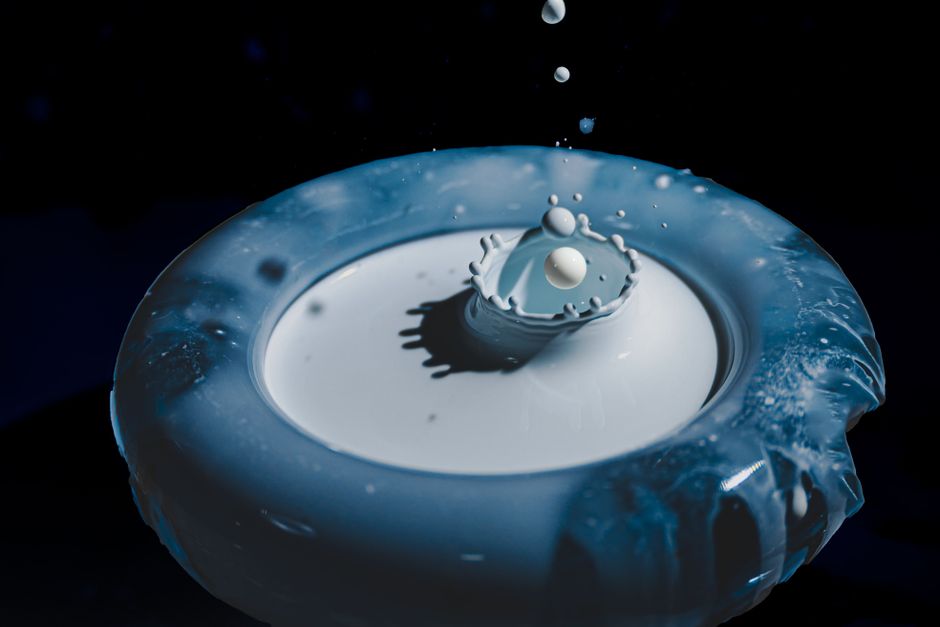
Photo by omar william david williams on Pexels
Dynamic viscosity, denoted by the Greek letter $\mu$ (mu), quantifies a fluid's internal resistance to flow when subjected to an external force. It's the proportionality constant between the shear stress applied to a fluid and the resulting shear rate.
The formula relating shear stress ($\tau$) to dynamic viscosity ($\mu$) and velocity gradient (du/dy) is:
$\tau = \mu \frac{du}{dy}$
Where:
* $\tau$ is the shear stress (force per unit area, typically in Pascals, Pa, or N/m$^2$).
* $\mu$ is the dynamic viscosity (Pa·s, or N·s/m$^2$, or poise in cgs units).
* $\frac{du}{dy}$ is the velocity gradient or shear rate (per second, s$^{-1}$). This represents how quickly the fluid's velocity changes across its thickness.
A higher dynamic viscosity means a fluid requires more force to make it flow at a given rate. Common units include the Pascal-second (Pa·s) in SI, or the Poise (P) and Centipoise (cP) in cgs, where 1 Pa·s = 10 Poise = 1000 cP.
Kinematic Viscosity

Photo by Landiva Weber on Pexels
Kinematic viscosity, denoted by the Greek letter $\nu$ (nu), is the ratio of dynamic viscosity to the fluid's density ($\rho$). It describes a fluid's inherent resistance to flow under the influence of gravity, without considering the external force causing the flow. It's particularly useful when gravity is the primary driving force for fluid motion, as it directly relates to how quickly momentum diffuses through the fluid.
The formula is:
$\nu = \frac{\mu}{\rho}$
Where:
* $\nu$ is the kinematic viscosity (m$^2$/s in SI, or Stokes in cgs).
* $\mu$ is the dynamic viscosity (Pa·s).
* $\rho$ is the fluid density (kg/m$^3$).
A fluid with high kinematic viscosity would "feel" thick and flow slowly under gravity, even if its dynamic viscosity isn't extremely high, simply because it's less dense. Common units include square meters per second (m$^2$/s) in SI, or the Stokes (St) and Centistokes (cSt) in cgs, where 1 m$^2$/s = 10$^4$ Stokes = 10$^6$ cSt.
graph TD
    A["Fluid Property: Resistance to Flow"] --> B["Viscosity"]
    B --> C["Dynamic Viscosity (μ)"]
    B --> D["Kinematic Viscosity (ν)"]
    C --> E["Measures internal friction / absolute stickiness"]
    C --> F["Units: Pa·s, N·s/m², Poise"]
    D --> G["Measures momentum diffusivity / flow under gravity"]
    D --> H["Units: m²/s, Stokes"]
    C --> I["Used in Shear Stress calculations"]
    D --> J["Used in Reynolds Number calculations"]
    C -- "Divided by Density (ρ)" --> D
Why are both important for exams?

Photo by Andy Barbour on Pexels
Exam questions often test your understanding of when to use each:
* Dynamic viscosity is usually needed when calculating shear stress or force exerted by a moving fluid on a surface, or vice versa (e.g., flow between plates).
* Kinematic viscosity is frequently used in problems involving fluid flow patterns (e.g., laminar vs. turbulent flow, determined by the Reynolds number), or when analyzing fluid motion where inertia and gravity are key factors. You'll often see density given separately, requiring you to convert between dynamic and kinematic viscosity.
3. Worked Example
Let's say you have an oil with a dynamic viscosity of 0.8 Pa·s and a density of 900 kg/m$^3$. A past exam question might ask you to calculate its kinematic viscosity and then consider a scenario.
Scenario: A flat plate is moving at 2 m/s over a large stationary plate, and the gap between them is filled with this oil. The gap is 5 mm. Assuming a linear velocity profile, what is the shear stress on the moving plate?
-
Calculate Kinematic Viscosity ($\nu$):
$\nu = \frac{\mu}{\rho} = \frac{0.8 \text{ Pa·s}}{900 \text{ kg/m}^3}$
$\nu = 0.000888... \text{ m}^2\text{/s}$
$\nu \approx 8.89 \times 10^{-4} \text{ m}^2\text{/s}$ -
Calculate Shear Stress ($\tau$):
First, determine the velocity gradient ($\frac{du}{dy}$).
The velocity changes from 0 m/s (at the stationary plate) to 2 m/s (at the moving plate) over a distance of 5 mm (0.005 m).
$\frac{du}{dy} = \frac{\Delta u}{\Delta y} = \frac{2 \text{ m/s} - 0 \text{ m/s}}{0.005 \text{ m}} = \frac{2}{0.005} \text{ s}^{-1} = 400 \text{ s}^{-1}$Now, use the dynamic viscosity to find the shear stress:
$\tau = \mu \frac{du}{dy} = 0.8 \text{ Pa·s} \times 400 \text{ s}^{-1}$
$\tau = 320 \text{ N/m}^2$ (or 320 Pa)
So, the kinematic viscosity is approximately $8.89 \times 10^{-4} \text{ m}^2\text{/s}$, and the shear stress on the moving plate is 320 Pa.
4. Key Takeaways
- Dynamic viscosity ($\mu$) is a fluid's absolute resistance to shear or flow, measured in Pa·s.
- Kinematic viscosity ($\nu$) is dynamic viscosity divided by density, representing how easily a fluid flows under gravity, measured in m$^2$/s.
- You'll use dynamic viscosity for calculations involving shear stress or force.
- You'll use kinematic viscosity often with the Reynolds number to determine flow type (laminar/turbulent).
- Always pay attention to the units given in the problem and convert them to a consistent system (usually SI).
- Temperature significantly affects viscosity; usually, liquids get less viscous when heated, and gases get more viscous.
Common Mistakes to Avoid:
* Mixing up the symbols for dynamic ($\mu$) and kinematic ($\nu$) viscosity.
* Forgetting to convert units (e.g., mm to meters, Poise to Pa·s, Stokes to m$^2$/s).
* Using dynamic viscosity when kinematic is required for dimensionless numbers, or vice versa.
* Not correctly identifying when a linear velocity profile can be assumed (often stated in simplified exam problems, but not always true in real-world scenarios).
5. Now Try It
Take a problem from a past paper involving fluid flow in a pipe or between two plates. If it gives you dynamic viscosity and density, calculate the kinematic viscosity. If it gives you kinematic viscosity and asks for shear stress, remember you'll need the density to find dynamic viscosity first. Then, try to calculate the shear stress or Reynolds number depending on the problem's requirements. Compare your answers with the solutions to ensure you correctly distinguished between and applied dynamic and kinematic viscosity.
Frequently asked about Viscosity: Dynamic and Kinematic
More from FLUID MECHANIC
Get the full FLUID MECHANIC curriculum
Clone the complete plan to your dashboard for unlimited AI-generated notes, practice quizzes, and a personalised revision schedule.
Save this course free