Introduction to Passive Elements and Energy Storage
From the ELECTRIC CIRCUIT 2 BEJ104033 S3 curriculum
TL;DR
This topic introduces you to the fundamental passive circuit components: resistors, inductors, and capacitors. You'll learn how these elements behave in a circuit and how inductors and capacitors specifically store energy. Understanding these components is crucial for analyzing and designing almost any electrical circuit.
1. The Mental Model
Think of passive elements as the basic building blocks of any circuit that don't generate power themselves. Resistors control current flow, while inductors and capacitors are like temporary energy banks, storing energy in magnetic and electric fields, respectively.
2. The Core Material
In electric circuits, passive elements are components that consume or store energy, rather than generate it. They don't require an external power source to operate.
Resistors (R)
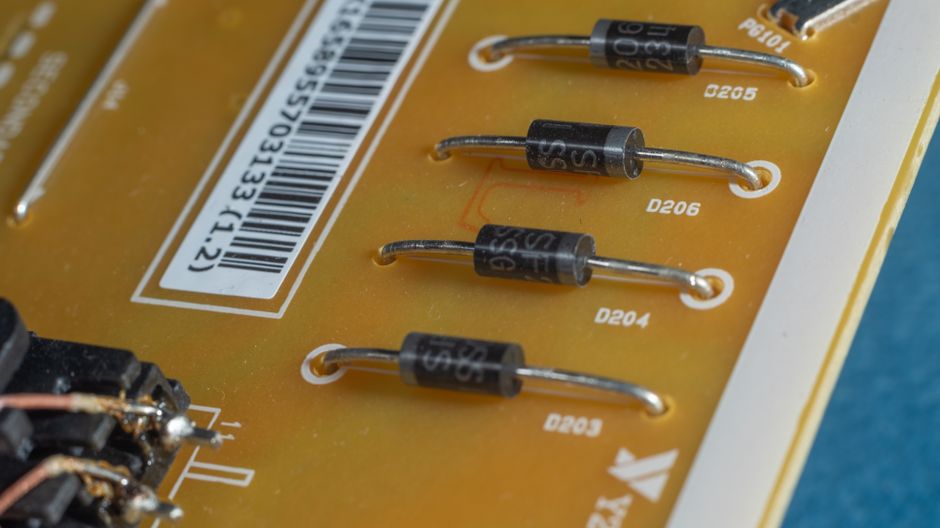
Photo by Ivan Chumak on Pexels
Resistors are components designed to oppose the flow of electric current. This opposition causes electrical energy to be dissipated as heat. The relationship between voltage (V), current (I), and resistance (R) is given by Ohm's Law:
$V = IR$
The unit for resistance is the Ohm ($\Omega$). Resistors are fundamental for controlling current and voltage levels in a circuit.
Inductors (L)

Photo by Nothing Ahead on Pexels
Inductors are components that store energy in a magnetic field when current flows through them. They are typically coils of wire. The voltage across an inductor is proportional to the rate of change of current flowing through it:
$V_L = L \frac{dI}{dt}$
Here, $L$ is the inductance, measured in Henries (H). Inductors resist changes in current. If the current tries to change rapidly, the inductor will generate a large voltage to oppose that change.
Energy Stored in an Inductor:
The energy ($W_L$) stored in an inductor's magnetic field is given by:
$W_L = \frac{1}{2} L I^2$
This means an inductor can store energy as long as there's current flowing through it.
Capacitors (C)
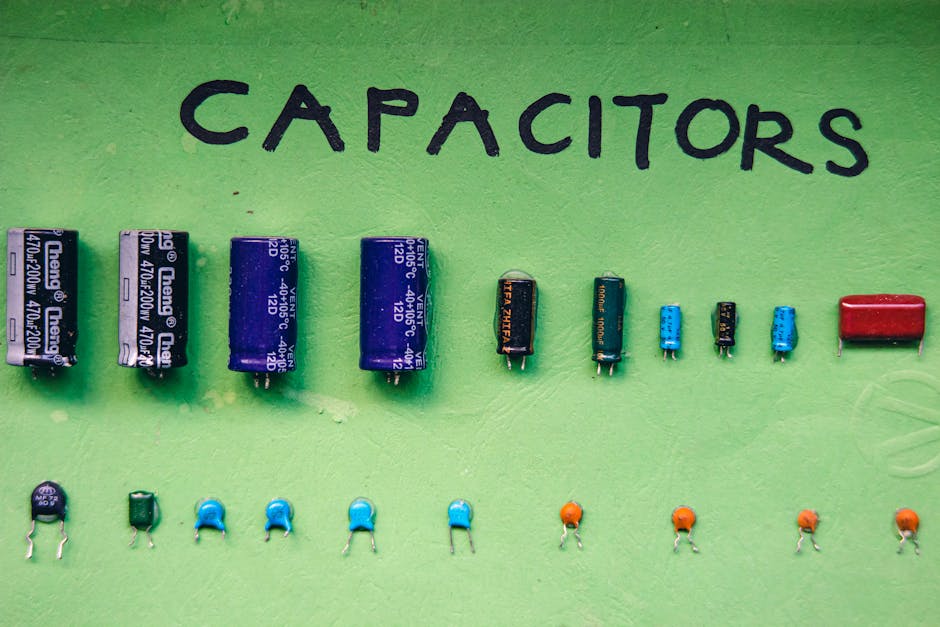
Photo by Nothing Ahead on Pexels
Capacitors are components that store energy in an electric field. They typically consist of two conductive plates separated by an insulating material (dielectric). The current through a capacitor is proportional to the rate of change of voltage across it:
$I_C = C \frac{dV}{dt}$
Here, $C$ is the capacitance, measured in Farads (F). Capacitors resist changes in voltage. If the voltage tries to change rapidly, the capacitor will draw or supply a large current to oppose that change.
Energy Stored in a Capacitor:
The energy ($W_C$) stored in a capacitor's electric field is given by:
$W_C = \frac{1}{2} C V^2$
This means a capacitor can store energy as long as there's a voltage across it.
Comparing Inductors and Capacitors

Photo by Sergei Starostin on Pexels
It's helpful to see how these two energy storage elements relate:
graph TD
    A["Energy Storage Elements"] --> B["Inductor (L)"];
    A --> C["Capacitor (C)"];
    B --> D["Stores energy in Magnetic Field"];
    B --> E["Opposes change in Current"];
    B --> F["Voltage proportional to dI/dt"];
    C --> G["Stores energy in Electric Field"];
    C --> H["Opposes change in Voltage"];
    C --> I["Current proportional to dV/dt"];
3. Worked Example
Let's say you have a 10 mH (milliHenry) inductor and a 470 $\mu$F (microFarad) capacitor.
-
If a current of 2 A flows through the inductor, how much energy is stored?
- $L = 10 \text{ mH} = 10 \times 10^{-3} \text{ H}$
- $I = 2 \text{ A}$
- $W_L = \frac{1}{2} L I^2 = \frac{1}{2} \times (10 \times 10^{-3} \text{ H}) \times (2 \text{ A})^2$
- $W_L = \frac{1}{2} \times 0.01 \times 4 = 0.02 \text{ Joules}$
-
If the capacitor is charged to 12 V, how much energy is stored?
- $C = 470 \text{ } \mu\text{F} = 470 \times 10^{-6} \text{ F}$
- $V = 12 \text{ V}$
- $W_C = \frac{1}{2} C V^2 = \frac{1}{2} \times (470 \times 10^{-6} \text{ F}) \times (12 \text{ V})^2$
- $W_C = \frac{1}{2} \times 470 \times 10^{-6} \times 144 = 0.03384 \text{ Joules}$
4. Key Takeaways
- Passive elements (resistors, inductors, capacitors) consume or store energy, they don't generate it.
- Resistors dissipate energy as heat and follow Ohm's Law ($V=IR$).
- Inductors store energy in a magnetic field and oppose changes in current ($V_L = L \frac{dI}{dt}$).
- Capacitors store energy in an electric field and oppose changes in voltage ($I_C = C \frac{dV}{dt}$).
- The energy stored in an inductor is $W_L = \frac{1}{2} L I^2$.
- The energy stored in a capacitor is $W_C = \frac{1}{2} C V^2$.
Common Mistakes to Avoid:
- Mixing up which component opposes changes in current (inductor) versus voltage (capacitor).
- Forgetting to convert units (like mH to H, or $\mu$F to F) before calculations.
- Using the wrong formula for energy storage; remember $I^2$ for inductors and $V^2$ for capacitors.
- Assuming inductors or capacitors immediately change their current or voltage – they resist instantaneous changes.
5. Now Try It
You have a 220 $\Omega$ resistor, a 50 mH inductor, and a 100 $\mu$F capacitor.
1. Calculate the voltage across the resistor if 50 mA of current flows through it.
2. If the inductor has a current of 1.5 A flowing through it, how much energy is stored?
3. If the capacitor is charged to 5 V, how much energy is stored?
What success looks like: You can correctly apply Ohm's Law and the energy storage formulas for inductors and capacitors, providing answers with correct units.
Frequently asked about Introduction to Passive Elements and Energy Storage
Study this next
Get the full ELECTRIC CIRCUIT 2 BEJ104033 S3 curriculum
Clone the complete plan to your dashboard for unlimited AI-generated notes, practice quizzes, and a personalised revision schedule.
Save this course free