Active Learning and Engagement
From the eeyg;p curriculum
TL;DR
Active learning means you're doing something with the material, not just passively receiving it. Engaging with content helps you understand and remember it much better than just reading or listening. By actively participating, you'll build stronger connections and see how concepts really work.
1. The Mental Model
Think of your brain like a muscle. Just passively watching someone lift weights won't make you stronger; you have to do the lifting yourself. Similarly, active learning is about "exercising" your brain by applying, analyzing, and creating with the information you're trying to learn.
2. The Core Material
Active learning isn't just one thing; it's a whole approach to studying where you're constantly interacting with the material. It's about moving beyond simply absorbing information to actually processing it deeply.
Why Active Learning Works

Photo by Ann H on Pexels
When you actively engage, your brain creates more connections between new information and what you already know. This makes the information easier to retrieve later and helps you understand it at a deeper level. Passive learning, like just listening to a lecture or rereading notes, often results in superficial understanding because you're not challenging your brain to work with the material.
Common Active Learning Techniques
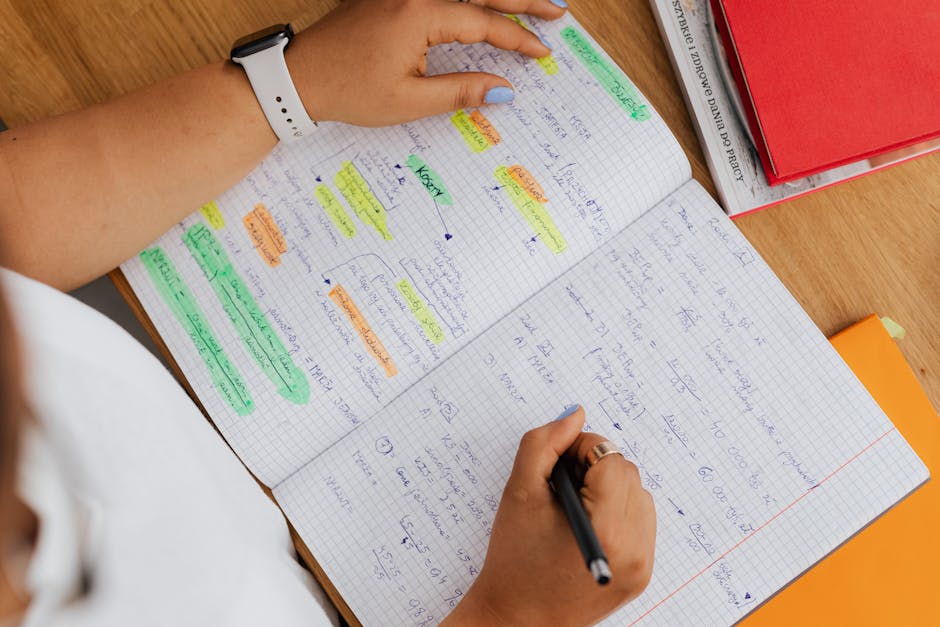
Photo by https://kaboompics.com/ on Pexels
There are many ways to be active in your learning. Here are a few effective ones:
- Summarizing in your own words: After reading a section or listening to a part of a lecture, try to explain it out loud or write down the main points without looking at your notes. This forces you to process and articulate the information.
- Asking questions: Don't just accept information. Ask "why" or "how" it works. If you're in a class, ask the instructor. If you're studying alone, try to answer your own questions or research them.
- Teaching someone else: If you can explain a concept clearly to someone else, you truly understand it. This exposes gaps in your knowledge and solidifies what you know.
- Practicing with problems/exercises: This is especially crucial for subjects like math, science, or programming. Doing practice problems isn't just about getting the right answer; it's about applying principles and understanding the steps.
- Creating visual aids: Drawing diagrams, flowcharts, or mind maps helps organize information spatially and visually, engaging different parts of your brain.
- Self-quizzing: Instead of just reviewing notes, create your own questions or use flashcards to test your recall.
The Cycle of Active Engagement

Photo by Stephen Leonardi on Pexels
graph LR
    A["Receive Information (Read, Listen)"] --> B["Process Actively (Summarize, Question, Connect)"];
    B --> C["Apply/Practice (Solve Problems, Create)"];
    C --> D["Reflect/Assess (Self-Quiz, Identify Gaps)"];
    D --> A;
This diagram shows that active learning is a continuous loop. You receive information, then you actively work with it, then you apply it, and finally, you check your understanding before going back to refine or learn more.
3. Worked Example
Let's say you're learning about the water cycle.
Passive Approach: You read the chapter in your textbook and highlight key terms like "evaporation," "condensation," and "precipitation." You might even reread the chapter a few times.
Active Approach:
1. Read and Summarize: You read a section on evaporation. You then close the book and try to explain what evaporation is in your own words to an imaginary friend. You'd likely say something like, "Evaporation is when water turns into a gas and goes up into the air, usually because of heat from the sun."
2. Ask Questions: You might wonder, "Why does water evaporate faster on a hot, windy day?" and then you'd look for the answer or think about it.
3. Create a Diagram: You draw a simple diagram of the water cycle, labeling each stage and adding short descriptions of what happens at each step (e.g., "Clouds form here" next to condensation). You might even include arrows to show the direction of water movement.
4. Self-Quiz: You create flashcards with terms like "transpiration" on one side and its definition on the other, testing yourself periodically.
5. Teach Someone: You try to explain the entire water cycle to a younger sibling or a pet, making sure you can describe each stage clearly and in order.
Notice how much more you're doing in the active approach. Each action reinforces your understanding.
4. Key Takeaways
- Active learning involves doing something with the material, not just consuming it.
- Techniques like summarizing, questioning, and teaching help you process information deeply.
- Engaging actively creates stronger memory pathways and a more thorough understanding.
- It's a cyclical process of receiving, processing, applying, and reflecting.
- The more senses and mental processes you involve, the better you'll learn.
Common mistakes you should avoid:
- Highlighting without understanding: Just coloring text doesn't mean you've learned it.
- Rereading notes repeatedly: This gives a false sense of familiarity without deep comprehension.
- Procrastinating practice problems: Delaying application means you're not testing your understanding.
- Studying in isolation without testing yourself: You need to check if you actually know the material.
5. Now Try It
Choose a concept or topic you're currently studying. Spend 15 minutes applying at least three different active learning techniques to it. For example, you could read a section, summarize it out loud, then draw a diagram explaining the core idea, and finally, write down 2-3 questions you'd ask someone about it.
What success looks like: After 15 minutes, you should be able to explain the concept in your own words without looking at your notes, and you should feel like you have a clearer, more connected understanding of it than if you had just passively read it.
Frequently asked about Active Learning and Engagement
Study this next
Get the full eeyg;p curriculum
Clone the complete plan to your dashboard for unlimited AI-generated notes, practice quizzes, and a personalised revision schedule.
Save this course free