Applications and Review
From the Algebra 1 curriculum
Applications and Review
TL;DR
Algebra's not just about 'x's and 'y's; it's a powerful tool to solve real-world problems by translating situations into equations. You'll review key concepts like solving equations and inequalities, working with functions, and understanding graphs to tackle practical scenarios. The goal is to build confidence in applying everything you've learned throughout Algebra 1.
1. The Mental Model
Think of algebra as a translator. You take a problem described in words, translate it into math symbols, solve the math, and then translate the answer back into what it means for the original problem. It's like having a secret decoder ring for everyday challenges.
2. The Core Material
You've learned a lot of tools in Algebra 1: solving equations, working with inequalities, understanding functions, and interpreting graphs. Now, it's time to put those tools to work together.
2.1 Translating Word Problems

Photo by Ann H on Pexels
The first step is always to understand the problem and identify what you need to find. Then, assign variables to unknown quantities. Look for keywords that indicate mathematical operations:
- Addition: "sum," "total," "increased by," "more than"
- Subtraction: "difference," "less than," "decreased by," "subtracted from"
- Multiplication: "product," "times," "of," "twice," "per"
- Division: "quotient," "divided by," "per," "ratio"
- Equals: "is," "was," "will be," "results in"
For example, "Three less than twice a number is seven" translates to $2x - 3 = 7$.
2.2 Solving Equations and Inequalities

Photo by Vanessa Garcia on Pexels
Once you have an equation or inequality, you use the inverse operations to isolate the variable. Remember, whatever you do to one side, you must do to the other. For inequalities, don't forget to flip the inequality sign if you multiply or divide by a negative number.
2.3 Working with Functions

Photo by Marc Mueller on Pexels
Many real-world relationships can be modeled with functions. You might encounter linear functions ($y = mx + b$) to model constant rates of change, or quadratic functions ($y = ax^2 + bx + c$) for situations involving acceleration or projectile motion. Understanding domain and range helps you define sensible inputs and outputs for your models.
2.4 Interpreting Graphs
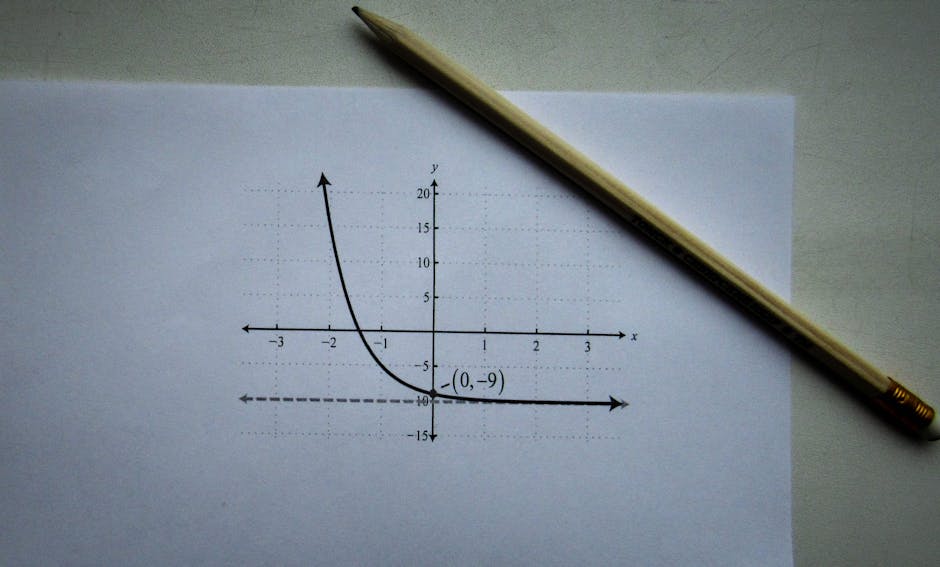
Photo by Sergey Meshkov on Pexels
Graphs provide a visual representation of relationships.
* Slope: Represents the rate of change.
* Intercepts: Show starting points or where one quantity is zero.
* Turning points: Indicate maximums or minimums.
Here's how you can approach an application problem:
graph TD
    A["Read and Understand Problem"] --> B["Identify Unknowns and Given Info"];
    B --> C["Assign Variables"];
    C --> D{"Choose Appropriate Math Concept?"};
    D -- "Linear Equation" --> E["Formulate Linear Equation"];
    D -- "Inequality" --> F["Formulate Inequality"];
    D -- "Function" --> G["Define Function/Equation"];
    E --> H["Solve Equation"];
    F --> I["Solve Inequality"];
    G --> J["Solve Function/Interpret Graph"];
    H --> K["Check Solution & State Answer"];
    I --> K;
    J --> K;
    K --> Z["Problem Solved!"];
3. Worked Example
Problem: A cell phone plan costs \$30 per month plus \$0.05 per text message. If your bill for one month was \$42.50, how many text messages did you send?
- Understand the problem: We need to find the number of text messages sent.
- Identify unknowns/givens:
- Monthly cost: \$30
- Cost per text: \$0.05
- Total bill: \$42.50
- Unknown: number of text messages
- Assign variables: Let $t$ be the number of text messages.
- Formulate equation: The total cost is the monthly cost plus the cost per text message times the number of texts.
$30 + 0.05t = 42.50$ - Solve the equation:
$30 + 0.05t = 42.50$
Subtract 30 from both sides:
$0.05t = 42.50 - 30$
$0.05t = 12.50$
Divide by 0.05:
$t = \frac{12.50}{0.05}$
$t = 250$ - Check and state answer: If you sent 250 texts, the cost would be $30 + (0.05 \times 250) = 30 + 12.50 = 42.50$. This matches the total bill.
Answer: You sent 250 text messages.
4. Key Takeaways
- Always read the problem carefully to understand what's being asked and what information you're given.
- Assign variables to the unknown quantities before trying to write an equation.
- Look for keywords that help you translate words into mathematical operations and relationships.
- Solve the resulting equation, inequality, or function using the algebraic skills you've learned.
- Always check your answer to see if it makes sense in the context of the original problem.
Common Mistakes to Avoid:
- Not defining your variables clearly at the start.
- Confusing keywords (e.g., "less than" means subtraction in reverse order).
- Forgetting to label units in your final answer (e.g., "250 texts," not just "250").
- Not checking if your solution is reasonable for the real-world scenario.
5. Now Try It
You're buying movie tickets. Child tickets cost \$8 each, and adult tickets cost \$12 each. You bought a total of 10 tickets and spent \$100. How many child tickets and how many adult tickets did you buy?
What to do:
1. Define variables for the number of child tickets and adult tickets.
2. Set up a system of two equations based on the total number of tickets and the total cost.
3. Solve the system of equations.
What success looks like: You'll have two numbers, one for child tickets and one for adult tickets, that add up to 10 tickets and whose combined cost totals \$100.
Frequently asked about Applications and Review
Study this next
Get the full Algebra 1 curriculum
Clone the complete plan to your dashboard for unlimited AI-generated notes, practice quizzes, and a personalised revision schedule.
Create Free Account