Foundations of Chemistry: Matter, Measurement, and Fundamentals
From the chemistry curriculum
Foundations of Chemistry: Matter, Measurement, and Fundamentals
TL;DR
Chemistry is the study of matter – its composition, structure, properties, and changes it undergoes. Accurate measurements are crucial in chemistry, requiring precision and understanding of units. These foundational concepts are essential for all further study in chemistry.
1. The Mental Model
Think of chemistry as trying to understand all the "stuff" around you. You're exploring what it's made of, how it behaves, and how it can change, using careful observation and measurement as your tools.
2. The Core Material
Chemistry starts with matter, which is anything that has mass and takes up space. We classify matter in several ways.
2.1 Classifying Matter
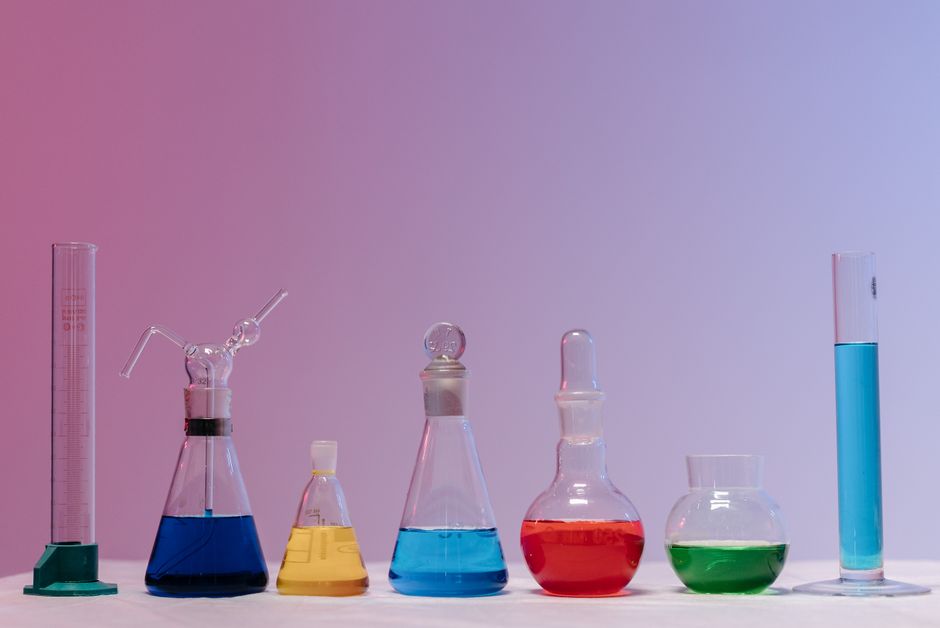
Photo by Pavel Danilyuk on Pexels
First, matter can be either a pure substance or a mixture.
- Pure Substances: These have a fixed composition and distinct properties. They can be elements or compounds.
- Elements: The simplest form of matter that can't be broken down into simpler substances by chemical means (e.g., Oxygen, Gold). You'll find them on the periodic table.
- Compounds: Formed when two or more different elements are chemically combined in a fixed ratio (e.g., Water H₂O, Carbon Dioxide CO₂). They have properties different from their constituent elements.
- Mixtures: These are physical combinations of two or more substances where each substance retains its own identity. Mixtures can be separated by physical means.
- Homogeneous Mixtures (Solutions): Have a uniform composition throughout; you can't see the different parts (e.g., Saltwater, Air).
- Heterogeneous Mixtures: Have a non-uniform composition; you can see distinct parts (e.g., Sand and water, Salad).
graph TD
    A["Matter"] --> B["Pure Substance"]
    A --> C["Mixture"]

    B --> D["Element"]
    B --> E["Compound"]

    C --> F["Homogeneous Mixture (Solution)"]
    C --> G["Heterogeneous Mixture"]

    D["Element"] -- "Examples" --> D1["Oxygen (O)"]
    D -- "Examples" --> D2["Gold (Au)"]

    E["Compound"] -- "Examples" --> E1["Water (H₂O)"]
    E -- "Examples" --> E2["Carbon Dioxide (CO₂)"]

    F["Homogeneous Mixture (Solution)"] -- "Examples" --> F1["Saltwater"]
    F -- "Examples" --> F2["Air"]

    G["Heterogeneous Mixture"] -- "Examples" --> G1["Sand & Water"]
    G -- "Examples" --> G2["Salad"]
2.2 Properties of Matter

Photo by Tara Winstead on Pexels
Matter has physical properties and chemical properties.
- Physical Properties: Can be observed or measured without changing the substance's chemical identity (e.g., color, density, melting point, boiling point). You can see ice melt into water; it's still H₂O.
- Chemical Properties: Describe how a substance reacts or changes into different substances (e.g., flammability, reactivity with acid, ability to rust). Wood burning turns into ash and gases; it's no longer wood.
These properties help us identify and classify different types of matter.
2.3 Changes in Matter

Photo by stelios ΒΚ on Pexels
Matter can undergo physical changes or chemical changes.
- Physical Changes: Alter a substance's appearance but not its chemical composition (e.g., melting ice, dissolving sugar in water, cutting paper). The substance remains chemically the same.
- Chemical Changes (Chemical Reactions): Result in new substances with different chemical properties (e.g., burning wood, rusting iron, cooking an egg). Atoms rearrange to form new molecules.
2.4 Measurement in Chemistry

Photo by Rodolfo Clix on Pexels
Accurate measurement is critical. We use the International System of Units (SI).
- Length: meter (m)
- Mass: kilogram (kg)
- Time: second (s)
- Temperature: Kelvin (K) or Celsius (°C)
- Amount of Substance: mole (mol)
- Volume: liter (L) or cubic meter (m³) – often derived from length (e.g., cm³).
You'll need to understand significant figures (sig figs) to report measurements accurately, reflecting the precision of your instruments. When you add, subtract, multiply, or divide measurements, the answer can't be more precise than the least precise measurement used.
- Multiplication/Division: The answer has the same number of sig figs as the measurement with the fewest sig figs.
- Addition/Subtraction: The answer has the same number of decimal places as the measurement with the fewest decimal places.
3. Worked Example
Let's classify a common item: Sugar water.
First, is it a pure substance or a mixture? You've combined sugar (a compound) and water (a compound). They haven't chemically reacted to form something new; you could evaporate the water and get the sugar back. So, it's a mixture.
Next, is it homogeneous or heterogeneous? Once the sugar is fully dissolved, you can't see individual sugar particles or distinct layers. It looks uniform throughout. Therefore, sugar water is a homogeneous mixture (specifically, a solution).
Now, if you were to boil the sugar water, that's a physical change because the water changes state (liquid to gas) but is still H₂O, and the sugar remains sugar. If you were to caramelize the sugar (heat it strongly until it turns brown), that's a chemical change because new substances with different chemical properties are formed.
4. Key Takeaways
- Matter is anything with mass and volume, classified into pure substances (elements, compounds) or mixtures (homogeneous, heterogeneous).
- Pure substances have fixed compositions; mixtures are physical blends.
- Physical properties can be observed without changing a substance's identity, while chemical properties describe how it reacts.
- Physical changes alter appearance but not chemical makeup; chemical changes create new substances.
- Accurate measurements use SI units, and significant figures reflect the precision of these measurements.
- Always use the correct number of significant figures in your calculations to avoid overstating precision.
Common mistakes to avoid:
- Confusing elements and compounds (elements are simpler, compounds are combinations).
- Mixing up homogeneous and heterogeneous mixtures (uniform vs. non-uniform appearance).
- Not understanding the difference between physical and chemical changes (no new substance vs. new substance formed).
- Ignoring significant figure rules, leading to incorrect precision in answers.
5. Now Try It
You have a glass of iced tea with ice cubes and a lemon slice.
1. Classify the iced tea itself (without the ice or lemon) as a type of matter.
2. Classify the ice cubes as a type of matter, and describe what type of change occurs when they melt.
3. If you were to add more sugar to the tea and stir, what type of change would this be?
What success looks like: You can correctly identify the type of matter (pure substance, homogeneous mixture, heterogeneous mixture) for each component and accurately describe the type of change (physical or chemical) involved.
Frequently asked about Foundations of Chemistry: Matter, Measurement, and Fundamentals
Study this next
Get the full chemistry curriculum
Clone the complete plan to your dashboard for unlimited AI-generated notes, practice quizzes, and a personalised revision schedule.
Create Free Account