Foundations of Chemistry
From the chemistry curriculum
TL;DR
Chemistry is the study of matter and its changes, built on understanding atoms, elements, and how they interact. Everything around you, from the air you breathe to your own body, is made of matter. We'll explore the fundamental concepts that explain why matter behaves the way it does.
1. The Mental Model
Think of chemistry as building with LEGOs. The "LEGO bricks" are atoms, and the different types of bricks are elements. Chemistry explains how these bricks connect to form everything we see and how those connections can break and rearrange.
2. The Core Material
Chemistry starts with understanding what matter is and how we classify it.
Matter and Its Classification
Matter is anything that has mass and takes up space. We can classify matter in a few ways:
- Pure Substances: Have a fixed, uniform composition.
- Elements: The simplest form of matter, cannot be broken down into simpler substances by chemical means (e.g., Oxygen, Gold). Each element is defined by the number of protons in its atoms.
- Compounds: Formed when two or more different elements are chemically combined in a fixed ratio (e.g., Water (H₂O), Carbon Dioxide (CO₂)). Compounds can be broken down into their elements.
- Mixtures: Consist of two or more substances that are physically mixed but not chemically combined. Their composition can vary.
- Homogeneous Mixtures (Solutions): Uniform throughout; you can't see the different components (e.g., saltwater, air).
- Heterogeneous Mixtures: Not uniform; you can see the different components (e.g., sand and water, salad).
graph TD
    A["Matter"] --> B["Pure Substances"]
    A --> C["Mixtures"]
    B --> D["Elements"]
    B --> E["Compounds"]
    C --> F["Homogeneous (Solutions)"]
    C --> G["Heterogeneous"]
    D --> H["(e.g., O, Au)"]
    E --> I["(e.g., H₂O, CO₂)"]
    F --> J["(e.g., Saltwater, Air)"]
    G --> K["(e.g., Sand & Water)"]
States of Matter
Matter commonly exists in three main states, determined by how much energy its particles have and how closely they're packed:
- Solids: Have a definite shape and volume. Particles are tightly packed and vibrate in fixed positions.
- Liquids: Have a definite volume but an indefinite shape (take the shape of their container). Particles are close but can move past each other.
- Gases: Have an indefinite shape and volume (expand to fill their container). Particles are far apart and move randomly and rapidly.
Changes between states (like melting, boiling, freezing) are physical changes, meaning the substance's chemical identity doesn't change.
Physical vs. Chemical Changes
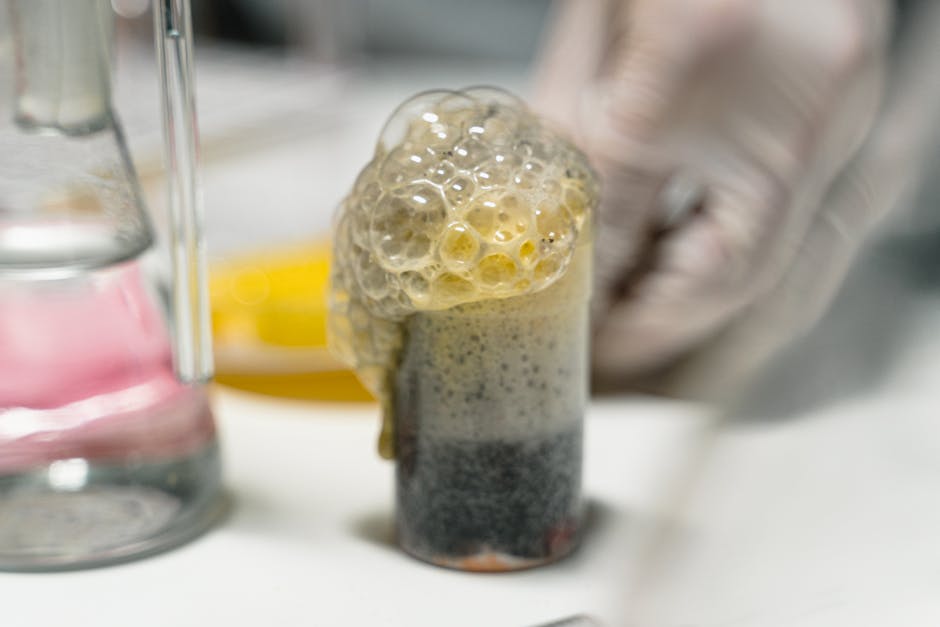
Photo by MART PRODUCTION on Pexels
- Physical Changes: Alter the form of a substance but not its chemical identity (e.g., melting ice, cutting paper, dissolving sugar). The underlying atoms and molecules remain the same.
- Chemical Changes (Chemical Reactions): Result in new substances with different chemical properties (e.g., burning wood, rusting iron, cooking an egg). Atoms rearrange to form new compounds. Signs often include color change, gas production, heat change, or light emission.
Atoms and Atomic Structure

Photo by Diana ✨ on Pexels
The atom is the basic unit of an element. It consists of:
- Nucleus: The dense center containing:
- Protons: Positively charged particles. The number of protons (the atomic number, Z) defines the element.
- Neutrons: Neutrally charged particles.
- Electrons: Negatively charged particles that orbit the nucleus in specific energy levels or shells. They determine an atom's chemical behavior.
In a neutral atom, the number of protons equals the number of electrons. The mass number is the total number of protons and neutrons.
The Periodic Table
This is chemistry's most important tool! It organizes elements by increasing atomic number.
- Periods (Rows): Elements in the same row have the same number of electron shells.
- Groups (Columns): Elements in the same column have similar chemical properties because they have the same number of valence (outermost) electrons.
- Alkali Metals (Group 1): Highly reactive.
- Alkaline Earth Metals (Group 2): Reactive.
- Halogens (Group 17): Highly reactive nonmetals.
- Noble Gases (Group 18): Very unreactive (inert).
- Metals, Nonmetals, Metalloids: The table is broadly divided. Metals are typically shiny, conductive, and malleable. Nonmetals are often brittle, poor conductors. Metalloids have properties of both.
3. Worked Example
Let's classify a few everyday items:
- Air: Air is a mixture of several gases (mainly nitrogen, oxygen, argon). Since its composition can vary slightly and the gases are uniformly mixed, it's a homogeneous mixture (solution). The individual gases (elements/compounds) retain their identities.
- Water (H₂O): Water is formed when hydrogen and oxygen atoms chemically bond in a fixed 2:1 ratio. It has a specific formula and properties distinct from hydrogen and oxygen alone. This makes it a compound, and thus a pure substance.
- Gold (Au): Gold is found on the periodic table as element 79. It cannot be broken down into simpler substances by chemical means. Therefore, it's an element, and thus a pure substance.
- Melting an ice cube: When ice (solid water) melts, it becomes liquid water. Both are still H₂O molecules. The chemical identity hasn't changed, only the state. This is a physical change.
- Baking a cake: Combining flour, eggs, sugar, etc., and heating them causes chemical reactions. New substances are formed; you can't easily separate the original ingredients, and the properties are entirely different. This is a chemical change.
4. Key Takeaways
- Matter is anything with mass and volume, existing as pure substances (elements, compounds) or mixtures (homogeneous, heterogeneous).
- Elements are fundamental, defined by their atomic number (protons).
- Compounds are specific chemical combinations of elements in fixed ratios.
- Physical changes alter form, while chemical changes create new substances.
- Atoms have a nucleus (protons, neutrons) and orbiting electrons.
- The Periodic Table organizes elements by atomic number, showing trends in properties.
- Electron arrangement dictates an atom's chemical behavior.
Common Mistakes to Avoid:
- Confusing elements and compounds – remember compounds combine different elements.
- Mixing up homogeneous and heterogeneous mixtures – uniform appearance is key for homogeneous.
- Assuming all changes involving heat are chemical – boiling water is a physical change.
- Thinking atoms are "solid balls" – they're mostly empty space with a dense nucleus.
5. Now Try It
Take five common items from your kitchen (e.g., salt, sugar, milk, aluminum foil, olive oil). For each item:
1. Classify it as an element, compound, homogeneous mixture, or heterogeneous mixture.
2. Briefly explain your reasoning based on definitions of matter.
3. If you were to boil the item (if applicable), would that be a physical or chemical change? Why?
Success looks like correctly classifying each item and giving a clear, concise reason based on the concepts we've covered, especially distinguishing between pure substances and mixtures, and physical vs. chemical changes.
Frequently asked about Foundations of Chemistry
Study this next
Get the full chemistry curriculum
Clone the complete plan to your dashboard for unlimited AI-generated notes, practice quizzes, and a personalised revision schedule.
Save this course free