Cell Biology
From the biology curriculum
TL;DR
Cells are the fundamental units of life, acting like tiny, self-contained factories that perform all necessary biological functions. They come in two main types, prokaryotic and eukaryotic, differing primarily in their internal organization and complexity. Understanding cellular components and processes is crucial to grasping how all living organisms function.
1. The Mental Model
Think of a cell as a miniature city. It has a boundary (city wall), power plants, waste disposal, communication systems, and a control center, all working together to keep the city alive and thriving.
2. The Core Material
Cells are the smallest structural and functional unit of an organism. They're incredibly diverse but share fundamental characteristics. We broadly classify them into two types: prokaryotic and eukaryotic.
Prokaryotic Cells

Photo by turek on Pexels
These are the simpler, older cell types, like bacteria and archaea.
- No true nucleus: Their genetic material (DNA) floats freely in a region called the nucleoid.
- No membrane-bound organelles: They lack structures like mitochondria or endoplasmic reticulum.
- Smaller in size: Generally 0.1-5.0 µm.
- Simpler internal structure: Their cytoplasm contains ribosomes (for protein synthesis) and often a cell wall outside the plasma membrane for protection.
Eukaryotic Cells
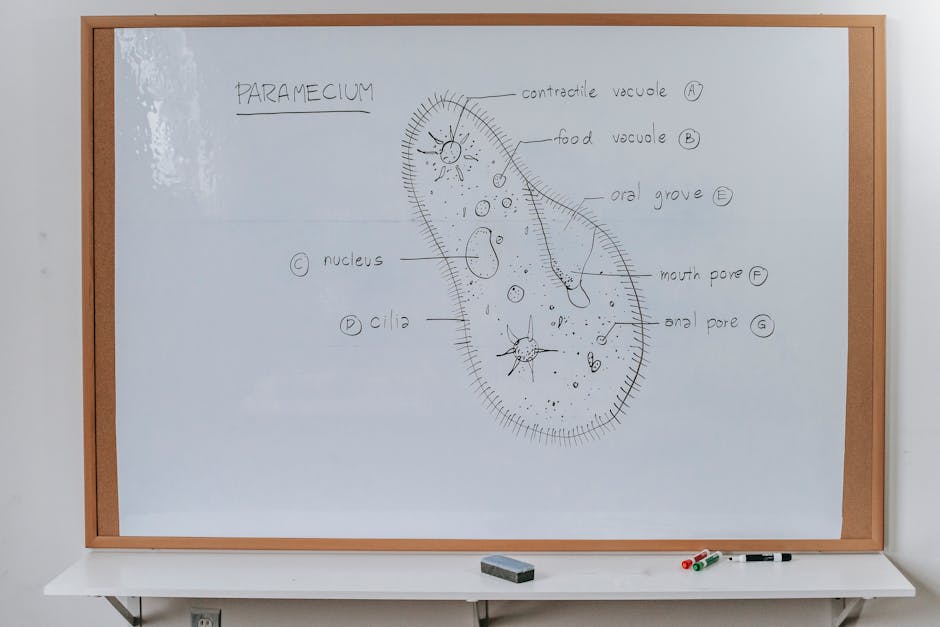
Photo by Katerina Holmes on Pexels
These are more complex, larger, and found in plants, animals, fungi, and protists.
- True nucleus: Their DNA is enclosed within a double membrane, forming the nucleus.
- Membrane-bound organelles: They have specialized internal compartments, each performing specific functions.
- Larger in size: Generally 10-100 µm.
- Complex internal structure: This allows for division of labor and greater specialization.
Key Organelles in Eukaryotic Cells
Photo by Katerina Holmes on Pexels
Let's look at some crucial parts:
- Nucleus: The cell's control center, housing the DNA and directing cell activities.
- Mitochondria: The "powerhouses" of the cell, generating energy (ATP) through cellular respiration.
- Endoplasmic Reticulum (ER): A network of membranes involved in protein and lipid synthesis.
- Rough ER: Has ribosomes; involved in protein synthesis and modification for secretion or insertion into membranes.
- Smooth ER: Lacks ribosomes; involved in lipid synthesis, detoxification, and calcium storage.
- Golgi Apparatus: Modifies, sorts, and packages proteins and lipids from the ER for secretion or delivery to other organelles.
- Ribosomes: Synthesize proteins. Found free in the cytoplasm or attached to the rough ER.
- Lysosomes (Animal Cells): Contain digestive enzymes to break down waste materials and cellular debris.
- Vacuoles (Plant Cells): Large central sac for storage of water, nutrients, and waste. Also maintains turgor pressure.
- Chloroplasts (Plant Cells): Sites of photosynthesis, converting light energy into chemical energy.
- Cell Membrane: A selective barrier surrounding the cell, regulating what enters and exits.
- Cell Wall (Plant & Fungi Cells): Provides structural support and protection outside the cell membrane.
Here's a breakdown of the differences between prokaryotic and eukaryotic cells:
graph TD
    A["Cell Type"] --> B["Prokaryotic Cell"]
    A["Cell Type"] --> C["Eukaryotic Cell"]

    B --> B1["No true nucleus (nucleoid region)"]
    B --> B2["No membrane-bound organelles"]
    B --> B3["Smaller (e.g., bacteria)"]
    B --> B4["Circular DNA"]
    B --> B5["Ribosomes present"]
    B --> B6["Cell wall (peptidoglycan)"]

    C --> C1["True nucleus (DNA enclosed)"]
    C --> C2["Membrane-bound organelles (e.g., mitochondria, ER, Golgi)"]
    C --> C3["Larger (e.g., animal, plant, fungi)"]
    C --> C4["Linear DNA"]
    C --> C5["Ribosomes present"]
    C --> C6["Some have cell wall (cellulose in plants, chitin in fungi)"]
3. Worked Example
Imagine you're examining a cell under a microscope. You observe a distinct, membrane-bound structure containing genetic material. You also notice several small, oval-shaped organelles with internal folds, and a complex network of internal membranes, some studded with tiny dots. Based on these observations, you can confidently classify this as a eukaryotic cell because the presence of a true nucleus and membrane-bound organelles like mitochondria (the oval-shaped ones) and endoplasmic reticulum (the network with dots, which are ribosomes) are hallmarks of eukaryotic cells. If you only saw genetic material floating freely and no internal compartments, you'd suspect a prokaryote.
4. Key Takeaways
- Cells are the fundamental building blocks of all living organisms.
- Prokaryotic cells are simpler, lack a true nucleus and membrane-bound organelles.
- Eukaryotic cells are more complex, possessing a true nucleus and specialized membrane-bound organelles.
- Each organelle in a eukaryotic cell has a specific function, contributing to the overall cell's survival.
- The cell membrane is crucial for regulating cell interaction with its environment.
Common Mistakes to Avoid:
- Confusing prokaryotic cells with eukaryotic cells based on size alone; while generally true, focus on internal complexity.
- Forgetting that all cells, prokaryotic and eukaryotic, have ribosomes.
- Assuming all eukaryotic cells have the same organelles (e.g., animal cells lack cell walls and chloroplasts).
- Thinking that the nucleus is the only place where genetic material is found in eukaryotes (mitochondria and chloroplasts have their own small DNA).
5. Now Try It
Sketch and label a diagram of a generalized plant cell and a generalized animal cell. Focus on accurately representing the key organelles unique to each, and those they share. Your success will be knowing that you can clearly point to and name at least five organelles in each diagram and explain their primary function without looking at your notes.
Frequently asked about Cell Biology
Study this next
Get the full biology curriculum
Clone the complete plan to your dashboard for unlimited AI-generated notes, practice quizzes, and a personalised revision schedule.
Save this course free