Foundations of Scientific Investigation
From the science curriculum
TL;DR
Science is a systematic way of understanding the world, starting with observations and forming testable ideas. You'll learn to ask good questions, design experiments to find answers, and analyze results to build knowledge. It's all about evidence, not just opinions.
1. The Mental Model
Think of science as detective work. You observe something curious, form a hunch (hypothesis), then gather evidence through careful investigation to see if your hunch holds up. It's a continuous cycle of questioning, testing, and refining your understanding.
2. The Core Material
Scientific investigation isn't just a random search for answers; it follows a structured approach. This structure, often called the scientific method, helps ensure that your findings are reliable and can be understood and tested by others. It's a framework, not a rigid set of steps you must always follow in order.
2.1 Observation and Questioning

Photo by Ann H on Pexels
It all starts with observing the world around you and noticing something interesting, puzzling, or unexplained. These observations lead to questions. A good scientific question is specific, measurable, achievable, relevant, and time-bound (SMART, though you won't always explicitly write out "time-bound").
- Bad question: "Why is the sky blue?" (Too broad, complex physics involved).
- Better question: "Does the amount of sugar in a solution affect how quickly yeast produces carbon dioxide?" (Specific, measurable).
2.2 Forming a Hypothesis
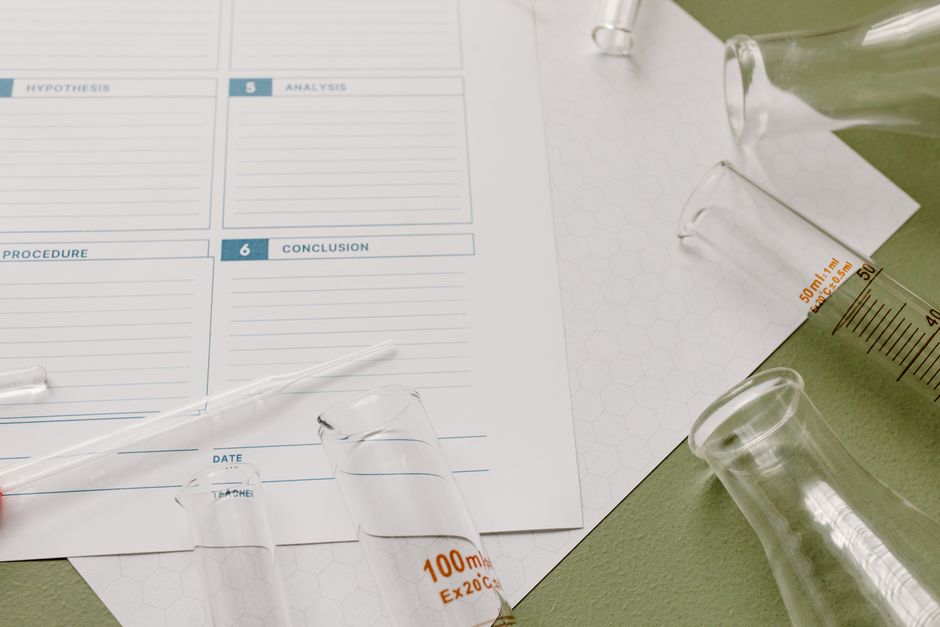
Photo by Tara Winstead on Pexels
Once you have a question, you propose a possible answer – this is your hypothesis. A hypothesis is an educated guess, a testable statement that predicts the relationship between two or more variables. It must be falsifiable, meaning it's possible to prove it wrong.
- Example hypothesis: "If I increase the amount of sugar in a yeast solution, then the rate of carbon dioxide production will also increase."
Notice the "If...then..." structure.
2.3 Designing an Experiment

Photo by picjumbo.com on Pexels
This is where you test your hypothesis. A well-designed experiment will isolate the factor you're testing (the independent variable) and measure its effect on something else (the dependent variable), while keeping everything else constant (controlled variables).
- Independent Variable: What you change or manipulate (e.g., amount of sugar).
- Dependent Variable: What you measure or observe (e.g., rate of CO2 production).
- Controlled Variables: Everything you keep the same to ensure a fair test (e.g., temperature, type of yeast, volume of water).
You'll also need a control group, which is a baseline for comparison. This group doesn't receive the treatment or change in the independent variable.
2.4 Collecting and Analyzing Data

Photo by Lukas Blazek on Pexels
During your experiment, you'll collect data. This data needs to be recorded systematically, often in tables, and then analyzed. Analysis might involve calculating averages, looking for patterns, creating graphs, or performing statistical tests. The goal is to see if your data supports or refutes your hypothesis.
2.5 Drawing Conclusions
Based on your data analysis, you draw a conclusion. Did your experiment support your hypothesis, or did it show your hypothesis was wrong? It's okay if your hypothesis was wrong; that's still valuable scientific knowledge! You also consider any limitations of your experiment and suggest further research.
2.6 Communicating Results
Sharing your findings is crucial. Other scientists need to know what you did, how you did it, and what you found, so they can replicate your work or build on it.
Here's a diagram illustrating the general flow of the scientific method:
graph TD
    A["1. Observe & Ask Question"] --> B["2. Form Hypothesis (Testable Prediction)"]
    B --> C{"3. Design & Conduct Experiment"}
    C --> D["4. Collect & Analyze Data"]
    D --> E{"5. Draw Conclusion"}
    E --> F{("Does data support hypothesis?")}
    F -- "Yes" --> G["6. Communicate Results & Share Findings"]
    F -- "No" --> A
    E --> H["(Refine hypothesis/experiment)"]
    H --> A
3. Worked Example
Let's say you notice that some plants in your garden are growing taller than others, even though they're the same type of plant.
-
Observe & Ask Question: You observe varying plant heights. Your question: "Does the amount of fertilizer affect the height of tomato plants?"
-
Form Hypothesis: "If I give tomato plants more fertilizer, then they will grow taller."
-
Design Experiment:
- Independent Variable: Amount of fertilizer (e.g., 0g, 5g, 10g per plant).
- Dependent Variable: Plant height (measured in cm after 4 weeks).
- Controlled Variables: Same type of tomato seeds, same amount of water, same sunlight exposure, same soil type, same pot size, same temperature.
- Control Group: Plants receiving 0g of fertilizer.
- Procedure: Plant 15 tomato seeds (5 for each fertilizer amount). Measure initial height. Apply fertilizer every week. Measure height weekly for 4 weeks.
-
Collect & Analyze Data: You record heights in a table. After 4 weeks, you calculate the average height for each group.
- 0g fertilizer group: Avg height 25 cm
- 5g fertilizer group: Avg height 40 cm
- 10g fertilizer group: Avg height 35 cm
-
Draw Conclusion: The data suggests that 5g of fertilizer led to the tallest plants, while 10g led to slightly shorter plants than 5g, but still taller than the control. Your initial hypothesis was partially supported (more fertilizer did make them taller up to a point, but too much fertilizer wasn't the best). You might conclude that "moderate amounts of fertilizer increase tomato plant height, but excessive amounts may hinder growth."
4. Key Takeaways
- Scientific investigation starts with observation and leads to specific, testable questions.
- A hypothesis is a testable prediction, often in an "If...then..." format.
- Experiments are designed to test hypotheses by manipulating an independent variable and measuring a dependent variable.
- Controlled variables are crucial for ensuring a fair test by keeping other factors constant.
- Data analysis helps you determine if your evidence supports or refutes your hypothesis.
- Conclusions are based on evidence, and it's okay if your hypothesis is proven wrong.
Common Mistakes to Avoid
- Having a hypothesis that isn't testable or falsifiable.
- Changing more than one independent variable in an experiment, making it impossible to know what caused the results.
- Not having a control group for comparison.
- Ignoring data that doesn't fit your expected outcome; all data is valuable.
- Confusing correlation (two things happening together) with causation (one thing directly causing another).
5. Now Try It
Think about a common household problem or observation. For instance, "Why do some fruits ripen faster than others?" or "Does brand-name soap clean dishes better than generic soap?"
- Formulate a specific, testable question based on your chosen observation.
- Write a clear "If...then..." hypothesis that answers your question.
- List the independent variable, dependent variable, and at least three controlled variables for an experiment to test your hypothesis.
- Briefly describe what your control group would be.
What success looks like: You'll have a clear question and hypothesis, and you'll be able to identify the key components of an experiment to test it, demonstrating an understanding of how to set up a fair investigation.
Frequently asked about Foundations of Scientific Investigation
Study this next
Get the full science curriculum
Clone the complete plan to your dashboard for unlimited AI-generated notes, practice quizzes, and a personalised revision schedule.
Save this course free