Advanced Differentiation Techniques and Applications
From the Calca curriculum
TL;DR
You're going beyond basic derivative rules to handle more complex functions and explore real-world applications. We'll cover implicit differentiation for functions that aren't explicitly y=f(x), related rates to find how quantities change with respect to each other, and optimization to find maximums or minimums.
1. The Mental Model
Think of differentiation as a Swiss Army knife: you have your basic blades, but sometimes you need specialized tools to tackle tougher jobs. Implicit differentiation helps when 'y' is tangled up with 'x', related rates link changing quantities, and optimization finds the "best" outcome.
2. The Core Material
Implicit Differentiation
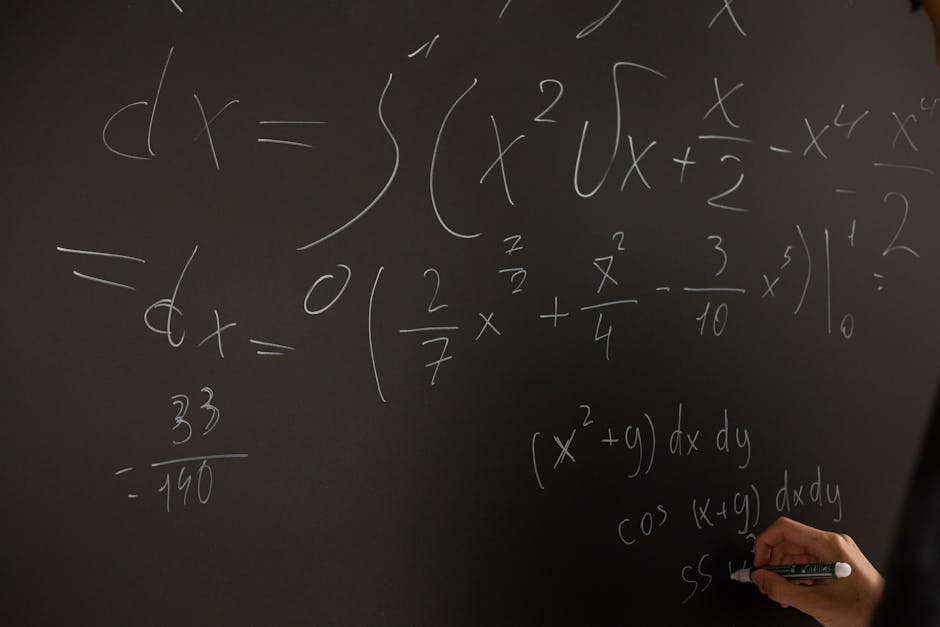
Photo by Monstera Production on Pexels
Sometimes, you can't easily isolate y in terms of x (e.g., x^2 + y^2 = 25). Implicit differentiation lets you find dy/dx by differentiating both sides of the equation with respect to x, treating y as an unknown function of x. Remember the Chain Rule for any term involving y.
Key Idea: When you differentiate a y term, you get its derivative times dy/dx. For example, d/dx(y^2) = 2y * dy/dx.
Related Rates

Photo by Steve A Johnson on Pexels
This technique applies implicit differentiation to real-world scenarios where several quantities are changing over time. You'll typically be given the rate of change of one quantity and asked to find the rate of change of another.
Steps:
1. Identify: What quantities are involved? What rates are given? What rate do you need to find?
2. Formula: Find an equation that relates all the quantities.
3. Differentiate: Differentiate the entire equation with respect to time (t), using implicit differentiation.
4. Substitute & Solve: Plug in all known values and solve for the unknown rate.
graph TD
    A["Identify Quantities & Rates"] --> B["Find Relation (Equation)"];
    B --> C["Differentiate Implicitly (w.r.t. Time)"];
    C --> D["Substitute Known Values"];
    D --> E["Solve for Unknown Rate"];
Optimization
Optimization uses derivatives to find the maximum or minimum value of a function, often in a practical context (e.g., maximizing profit, minimizing cost, finding the largest area).
Steps:
1. Identify: What quantity do you want to maximize or minimize? What are the constraints?
2. Function: Formulate a function of a single variable that represents the quantity to be optimized. This often involves using constraint equations to eliminate variables.
3. Differentiate: Find the first derivative of the function.
4. Critical Points: Set the first derivative equal to zero and solve for the variable. These are your critical points (potential max/min).
5. Test: Use the First Derivative Test (sign changes) or Second Derivative Test (concavity) to confirm if each critical point is a local maximum, minimum, or neither. Also, check endpoints if you're on a closed interval.
6. Interpret: State your answer in the context of the problem.
3. Worked Example
Let's find the dimensions of a rectangular field that has a fixed perimeter of 200 meters and encloses the largest possible area.
-
Identify:
- Maximize: Area (A)
- Constraint: Perimeter (P) = 200m
- Variables: Length (L), Width (W)
-
Function:
- Area:
A = L * W - Perimeter:
2L + 2W = 200 - From the perimeter, we can express
Lin terms ofW:
2L = 200 - 2W
L = 100 - W - Substitute
Linto the Area equation:
A(W) = (100 - W) * W
A(W) = 100W - W^2
- Area:
-
Differentiate:
A'(W) = d/dW (100W - W^2)A'(W) = 100 - 2W
-
Critical Points:
- Set
A'(W) = 0:
100 - 2W = 0
2W = 100
W = 50meters
- Set
-
Test:
- Let's use the Second Derivative Test:
A''(W) = d/dW (100 - 2W) = -2. - Since
A''(50) = -2(which is negative), the critical pointW = 50corresponds to a local maximum.
- Let's use the Second Derivative Test:
-
Interpret:
- If
W = 50meters, thenL = 100 - W = 100 - 50 = 50meters. - The dimensions for the largest possible area are 50m by 50m (a square). The maximum area is
50 * 50 = 2500square meters.
- If
4. Key Takeaways
- Implicit differentiation helps find derivatives when
yisn't explicitly defined as a function ofx. - Remember to apply the Chain Rule to every
yterm when differentiating implicitly with respect toxort. - Related rates problems involve finding an equation relating variables, then differentiating implicitly with respect to time (
t). - Optimization problems require setting up a single-variable function and using its derivative to find critical points.
- Always check critical points with a first or second derivative test to confirm if they are maximums or minimums.
- Don't forget to consider the domain of your function in optimization problems, including potential endpoints.
- Real-world constraints are crucial for setting up the correct optimization function.
5. Now Try It
A 13-foot ladder is leaning against a wall. The bottom of the ladder is sliding away from the wall at a rate of 0.5 feet per second. How fast is the top of the ladder sliding down the wall when the bottom of the ladder is 5 feet from the wall?
Success looks like: Finding dy/dt (where y is the height of the ladder on the wall) and correctly stating its value and units.
Frequently asked about Advanced Differentiation Techniques and Applications
Study this next
Get the full Calca curriculum
Clone the complete plan to your dashboard for unlimited AI-generated notes, practice quizzes, and a personalised revision schedule.
Save this course free