Foundations of Life: Chemistry and Cells
From the Biology curriculum
Foundations of Life: Chemistry and Cells
TL;DR
Life as we know it is built on fundamental chemical principles and organized into tiny, self-contained units called cells. Understanding these basics—from atoms to molecules to cellular structures—is crucial for grasping how living things function. You'll see how chemistry dictates biology, from DNA to metabolism.
1. The Mental Model
Think of life like a complex machine. The "parts list" is chemistry (atoms, molecules), and the "individual machines" are cells. All living things, from bacteria to elephants, are just incredibly elaborate arrangements of these basic chemical building blocks organized into functional cellular units.
2. The Core Material
Atoms, Molecules, and Chemical Bonds

Photo by Steve A Johnson on Pexels
Everything in the universe, including you, is made of atoms. These are the smallest units of matter that retain the identity of a chemical element. Key atoms in biology are Carbon (C), Hydrogen (H), Oxygen (O), Nitrogen (N), Phosphorus (P), and Sulfur (S) – often remembered as CHONPS.
Atoms bond together to form molecules. These bonds involve sharing or transferring electrons.
* Covalent bonds are strong and form when atoms share electrons (like in water, H₂O).
* Ionic bonds form when atoms transfer electrons, creating charged particles (ions) that attract each other (like in table salt, NaCl).
* Hydrogen bonds are weaker attractions between polar molecules (like between water molecules), but they're incredibly important for things like DNA structure and water's properties.
Water is essential for life due to its polarity (uneven charge distribution) and ability to form hydrogen bonds. This gives it unique properties: excellent solvent, high heat capacity, and cohesion (sticks to itself).
Macromolecules: The Building Blocks of Life

Photo by Reinis Brūzītis on Pexels
Living organisms are primarily made of four major types of organic macromolecules (large molecules based on carbon):
- Carbohydrates: Sugars and starches. They're primarily for energy storage (e.g., glucose, glycogen) and structural support (e.g., cellulose in plants).
- Lipids: Fats, oils, and waxes. They're for long-term energy storage, insulation, and forming cell membranes. They are generally hydrophobic (water-fearing).
- Proteins: Incredibly diverse molecules made of amino acids. They perform almost all cellular functions: enzymes (catalyze reactions), structural components, transport, signaling, and defense. Their specific 3D shape is critical for their function.
- Nucleic Acids: DNA (deoxyribonucleic acid) and RNA (ribonucleic acid). These carry and express genetic information. DNA is the blueprint, and RNA helps build proteins from that blueprint. They are made of nucleotides.
The Cell: The Fundamental Unit of Life

Photo by Leo Freire on Pexels
The cell is the smallest structural and functional unit of an organism. All cells share some common features:
* Cell membrane: A lipid bilayer that encloses the cell, regulating what goes in and out.
* Cytoplasm: The jelly-like substance filling the cell, where organelles are suspended.
* Genetic material: DNA, which contains instructions for building and operating the cell.
* Ribosomes: Molecular machines that synthesize proteins.
There are two main types of cells:
- Prokaryotic cells: Simpler, generally smaller, and lack a nucleus and other membrane-bound organelles. Bacteria and Archaea are prokaryotes. Their genetic material floats freely in the cytoplasm.
- Eukaryotic cells: More complex, generally larger, and have a true nucleus (containing DNA) and other specialized, membrane-bound organelles. Animals, plants, fungi, and protists are eukaryotes.
Here's a simplified view of the key differences:
graph TD
    A["Cell Type"] --> B["Prokaryotic"]
    A --> C["Eukaryotic"]

    B --> B1["No Nucleus"]
    B --> B2["DNA in Cytoplasm"]
    B --> B3["No Membrane-bound Organelles"]
    B --> B4["Smaller (e.g., Bacteria)"]

    C --> C1["True Nucleus (DNA inside)"]
    C --> C2["Membrane-bound Organelles"]
    C --> C3["Larger"]
    C --> C4["Plants, Animals, Fungi, Protists"]
    C2 --> C2a["Mitochondria (Energy)"]
    C2 --> C2b["Endoplasmic Reticulum (Protein/Lipid synthesis)"]
    C2 --> C2c["Golgi Apparatus (Modify/package)"]
    C2 --> C2d["Lysosomes (Waste disposal)"]
    C2 --> C2e["Vacuoles (Storage/support - esp. in plants)"]
    C2 --> C2f["Chloroplasts (Photosynthesis - plants/algae)"]
Organelles and Their Functions (Eukaryotic Cells)
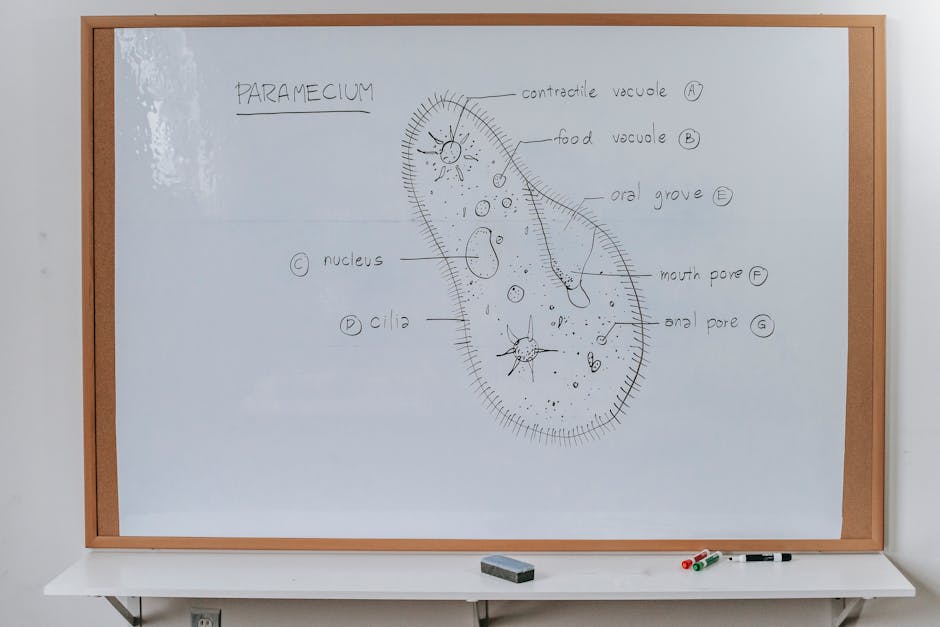
Photo by Katerina Holmes on Pexels
- Nucleus: Contains the cell's genetic material (DNA) organized into chromosomes. It's the control center.
- Mitochondria: The "powerhouses" of the cell; they generate most of the cell's supply of ATP (energy currency) through cellular respiration.
- Endoplasmic Reticulum (ER): A network of membranes involved in protein and lipid synthesis. Rough ER has ribosomes and makes proteins; smooth ER makes lipids and detoxifies.
- Golgi Apparatus: Modifies, sorts, and packages proteins and lipids for secretion or delivery to other organelles.
- Lysosomes: Contain digestive enzymes to break down waste materials and cellular debris.
- Vacuoles: Storage sacs. In plant cells, a large central vacuole maintains turgor pressure and stores water/nutrients.
- Chloroplasts (in plants/algae): Sites of photosynthesis, converting light energy into chemical energy (sugars).
- Cell Wall (in plants, fungi, bacteria): Provides structural support and protection outside the cell membrane.
3. Worked Example
Imagine you're trying to understand how a plant grows. You plant a seed.
First, the seed needs water. Water molecules, due to their polarity and hydrogen bonds, act as a great solvent, helping transport nutrients. The seed's cells, like all cells, are enclosed by a cell membrane, primarily made of lipids, which keeps the cell's internal environment stable.
Inside the plant cells, chloroplasts (organelles) capture sunlight, water, and carbon dioxide to perform photosynthesis, creating glucose (a carbohydrate) for energy. This glucose can be stored as starch (another carbohydrate) or used immediately by mitochondria to produce ATP.
To build the plant's structure (stem, leaves), the cell uses proteins (e.g., enzymes to catalyze reactions, structural proteins) and cellulose (a structural carbohydrate). The instructions for making all these proteins come from the DNA stored in the nucleus of each plant cell. Ribosomes in the cytoplasm (or on the rough ER) read RNA copies of these instructions to build the proteins. The Golgi apparatus then processes and packages these proteins for their final destinations, maybe even sending them to the cell wall for structural support.
4. Key Takeaways
- Life is fundamentally based on chemistry, with specific atoms (CHONPS) forming diverse molecules.
- Water's unique properties, driven by polarity and hydrogen bonds, are essential for all known life.
- Macromolecules (carbohydrates, lipids, proteins, nucleic acids) are the primary building blocks and functional components of cells.
- Cells are the basic units of life, enclosed by a lipid bilayer membrane and containing genetic material and ribosomes.
- Prokaryotic cells are simpler, lacking a nucleus and membrane-bound organelles, while eukaryotic cells are more complex and compartmentalized.
- Organelles within eukaryotic cells perform specialized functions, like mitochondria for energy and the nucleus for genetic control.
- Understanding how these chemical and cellular components interact helps explain all biological processes, from growth to disease.
Common Mistakes to Avoid:
* Confusing prokaryotic and eukaryotic cells; remember eukaryotes have a "true nucleus" (eu- means true).
* Thinking all fats are bad; lipids are vital for cell membranes and energy storage.
* Forgetting that protein shape is directly tied to its function; denaturation (loss of shape) means loss of function.
* Believing cells just "float around"; they have intricate internal structures (organelles) that perform specific jobs.
5. Now Try It
Choose an everyday biological process, like "digestion" or "muscle contraction." For your chosen process, list at least two specific macromolecules (carbohydrates, lipids, proteins, or nucleic acids) and two specific organelles that would be critically involved, and briefly explain their roles.
What success looks like: You correctly identify key players and their functions, demonstrating an understanding of how chemistry and cellular structures contribute to the process. For example, for digestion, you might mention proteins (enzymes breaking down food) and the smooth ER (lipid synthesis for cell repair) and lysosomes (breaking down waste).
Frequently asked about Foundations of Life: Chemistry and Cells
Get the full Biology curriculum
Clone the complete plan to your dashboard for unlimited AI-generated notes, practice quizzes, and a personalised revision schedule.
Create Free Account