Algebra and Functions
From the Maths as level caie curriculum
Algebra and Functions
TL;DR
Algebra and Functions explores manipulating expressions, solving equations, and understanding how one quantity relates to another. You'll master techniques for rearranging formulas, working with different types of functions, and applying these to various mathematical problems. This topic forms the backbone for much of advanced mathematics, so a strong grasp here is essential.
1. The Mental Model
Think of algebra as a language for describing relationships using symbols, and functions as special rules that connect inputs to unique outputs. You're learning to read, write, and manipulate these mathematical sentences and rules to solve puzzles.
2. The Core Material
2.1. Algebraic Manipulation

Photo by Sergey Meshkov on Pexels
This is about rearranging expressions and equations to isolate a variable or simplify things. You'll use basic arithmetic operations (addition, subtraction, multiplication, division) and the order of operations (PEMDAS/BODMAS).
Expanding brackets: Multiply every term inside the bracket by the term outside it.
e.g., 3(x + 2) = 3x + 6
e.g., (x + 1)(x - 2) = x^2 - 2x + x - 2 = x^2 - x - 2
Factorising: The reverse of expanding. Finding common factors to write an expression as a product.
e.g., 4x + 8 = 4(x + 2)
e.g., x^2 - 5x + 6 = (x - 2)(x - 3)
Solving equations: Finding the value(s) of the unknown variable that make the equation true. Do the same operation to both sides to maintain balance.
e.g., 2x + 5 = 11
2x = 6 (subtract 5 from both sides)
x = 3 (divide by 2 from both sides)
2.2. Functions
A function assigns each input (domain) exactly one output (range). You often see them written as f(x), which means "the function of x".
Types of functions you'll encounter:
* Linear: f(x) = mx + c (a straight line)
* Quadratic: f(x) = ax^2 + bx + c (a parabola)
* Cubic: f(x) = ax^3 + bx^2 + cx + d (an S-shape)
* Reciprocal: f(x) = k/x (hyperbola)
* Exponential: f(x) = a^x (rapid growth/decay)
Composite functions: When you apply one function to the result of another. fg(x) means applying g first, then f to the result. gf(x) means apply f first, then g.
e.g., If f(x) = x + 1 and g(x) = x^2, then fg(x) = g(x) + 1 = x^2 + 1.
gf(x) = (f(x))^2 = (x + 1)^2.
Inverse functions: A function f^-1(x) that "undoes" f(x). If f(a) = b, then f^-1(b) = a. Not all functions have inverses unless their domain is restricted. To find f^-1(x):
1. Replace f(x) with y.
2. Swap x and y.
3. Rearrange to make y the subject again.
4. Replace y with f^-1(x).
graph TD
    A["Start with a function f(x)"] --> B["Replace f(x) with y: y = ..."]
    B --> C["Swap x and y: x = ..."]
    C --> D["Rearrange the equation to make y the subject"]
    D --> E["Replace y with f^-1(x)"]
    E --> F["Consider domain/range restrictions (if any)"]
Domain and Range:
* Domain: The set of all possible input values (x) for which the function is defined.
* Range: The set of all possible output values (f(x)) that the function can produce.
2.3. Solving Quadratic Equations
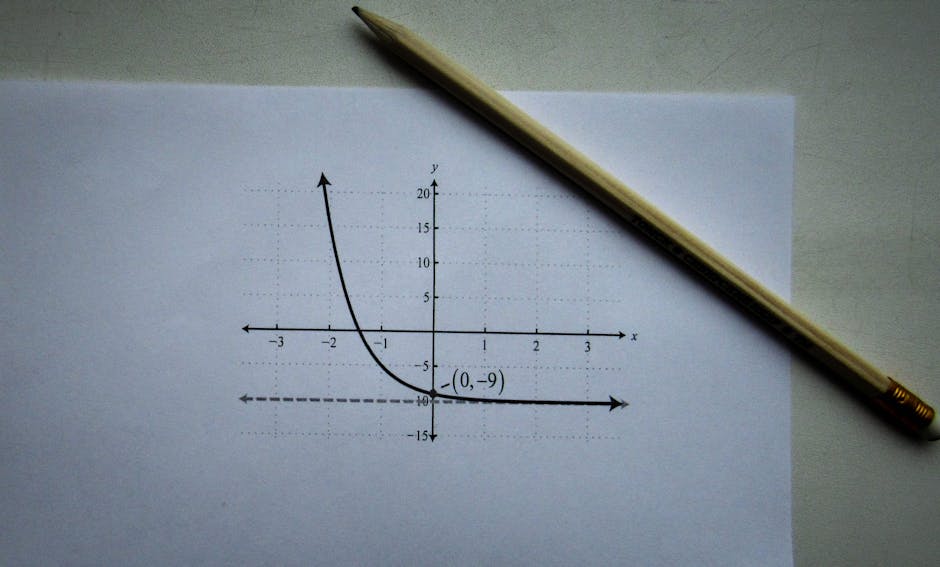
Photo by Sergey Meshkov on Pexels
You have a few methods for ax^2 + bx + c = 0:
* Factorising: If x^2 - 5x + 6 = 0, then (x - 2)(x - 3) = 0, so x = 2 or x = 3.
* Quadratic Formula: x = [-b ± sqrt(b^2 - 4ac)] / 2a. Always works.
* Completing the Square: Useful for finding turning points of parabolas.
x^2 + 6x + 5 = 0
(x + 3)^2 - 3^2 + 5 = 0
(x + 3)^2 - 9 + 5 = 0
(x + 3)^2 - 4 = 0
(x + 3)^2 = 4
x + 3 = ±2
x = -3 ± 2, so x = -1 or x = -5.
2.4. Inequalities
Solving inequalities is similar to solving equations, but with one crucial difference: if you multiply or divide by a negative number, you must flip the inequality sign.
e.g., -2x > 6
x < -3 (divided by -2, so flipped sign)
For quadratic inequalities, x^2 - 5x + 6 > 0, find the roots (x=2, x=3), then sketch the parabola. The solution will be the x-values where the graph is above/below the x-axis. For > 0, it's x < 2 or x > 3.
3. Worked Example
Problem: Given f(x) = 2x - 3 and g(x) = x^2 + 1, find:
a) fg(x)
b) f^-1(x)
c) The values of x for which f(x) = g(x).
Solution:
a) fg(x): This means apply g first, then f to the result.
fg(x) = f(g(x))
Substitute g(x) into f(x):
fg(x) = 2(x^2 + 1) - 3
fg(x) = 2x^2 + 2 - 3
fg(x) = 2x^2 - 1
b) f^-1(x):
1. Let y = f(x): y = 2x - 3
2. Swap x and y: x = 2y - 3
3. Rearrange to make y the subject:
x + 3 = 2y
y = (x + 3) / 2
4. So, f^-1(x) = (x + 3) / 2
c) Values of x for which f(x) = g(x):
Set the two function expressions equal to each other:
2x - 3 = x^2 + 1
Rearrange into a quadratic equation:
0 = x^2 - 2x + 1 + 3
0 = x^2 - 2x + 4
Now, use the quadratic formula x = [-b ± sqrt(b^2 - 4ac)] / 2a where a=1, b=-2, c=4:
x = [ -(-2) ± sqrt((-2)^2 - 4(1)(4)) ] / (2(1))
x = [ 2 ± sqrt(4 - 16) ] / 2
x = [ 2 ± sqrt(-12) ] / 2
Since the discriminant (b^2 - 4ac) is negative, sqrt(-12) is not a real number. This means there are no real values of x for which f(x) = g(x).
4. Key Takeaways
- Always follow the order of operations (PEMDAS/BODMAS) precisely during algebraic manipulation.
- Understand that a function maps each input to exactly one output.
- Inverse functions 'undo' the original function, if one exists for the given domain.
- Remember to flip the inequality sign if you multiply or divide by a negative number.
- For quadratic equations, you have multiple methods: factorising, quadratic formula, or completing the square.
Common Mistakes to Avoid:
- Forgetting to multiply all terms inside brackets when expanding.
- Not flipping the inequality sign when multiplying/dividing by a negative number.
- Assuming all functions have an inverse over their entire domain; check for one-to-one mapping.
- Mixing up fg(x) and gf(x) – the order matters!
5. Now Try It
Spend 15 minutes working on this:
Given f(x) = 3x + 5 and g(x) = (x - 2)^2.
1. Find gf(x).
2. Find f^-1(x).
3. Solve the inequality f(x) > 11.
Success looks like:
- You get gf(x) = (3x + 3)^2.
- You get f^-1(x) = (x - 5) / 3.
- You correctly solve the inequality to find x > 2.
Frequently asked about Algebra and Functions
Get the full Maths as level caie curriculum
Clone the complete plan to your dashboard for unlimited AI-generated notes, practice quizzes, and a personalised revision schedule.
Create Free Account