FTC with Discontinuous Functions: Continuity vs. Differentiability
From the maths 105 curriculum
TL;DR
The Fundamental Theorem of Calculus (FTC) still generally holds for integrability even if the function has finite discontinuities. However, the resulting antiderivative might not be differentiable at those points of discontinuity, even though it will be continuous. This means you can often find the area under a discontinuous curve, but the rate of change of that area function might not exist everywhere.
1. The Mental Model
Think of it like filling a leaky bucket: you can still measure the total water collected (the integral), even if the flow rate (the original function) isn't perfectly smooth or stops/starts suddenly. The amount of water in the bucket will always change smoothly, but the speed it's filling might jump.
2. The Core Material
The Fundamental Theorem of Calculus (FTC) Part 1 states that if $F(x) = \int_a^x f(t) dt$, then $F'(x) = f(x)$ at points where $f$ is continuous. The key phrase here is "where $f$ is continuous."
The Power of Integrability

Photo by Erik Mclean on Pexels
For a function $f(t)$ to be integrable over an interval $[a, b]$, it doesn't need to be continuous everywhere. As long as $f(t)$ has a finite number of jump discontinuities or removable discontinuities on the interval, its definite integral $\int_a^b f(t) dt$ will exist. This is a powerful idea because it means we can still calculate areas even for "broken" functions.
The Antiderivative's Continuity

Photo by Nothing Ahead on Pexels
If $F(x) = \int_a^x f(t) dt$ and $f(t)$ is integrable, then $F(x)$ will always be continuous at every point in the interval $[a, b]$, even at points where $f(t)$ itself is discontinuous. Why? Because the integral represents the accumulated area. Even if the original function jumps, the accumulated area changes smoothly – you don't suddenly gain or lose a finite amount of area at a single point. Think of it: the area under a point is zero.
The Antiderivative's Differentiability
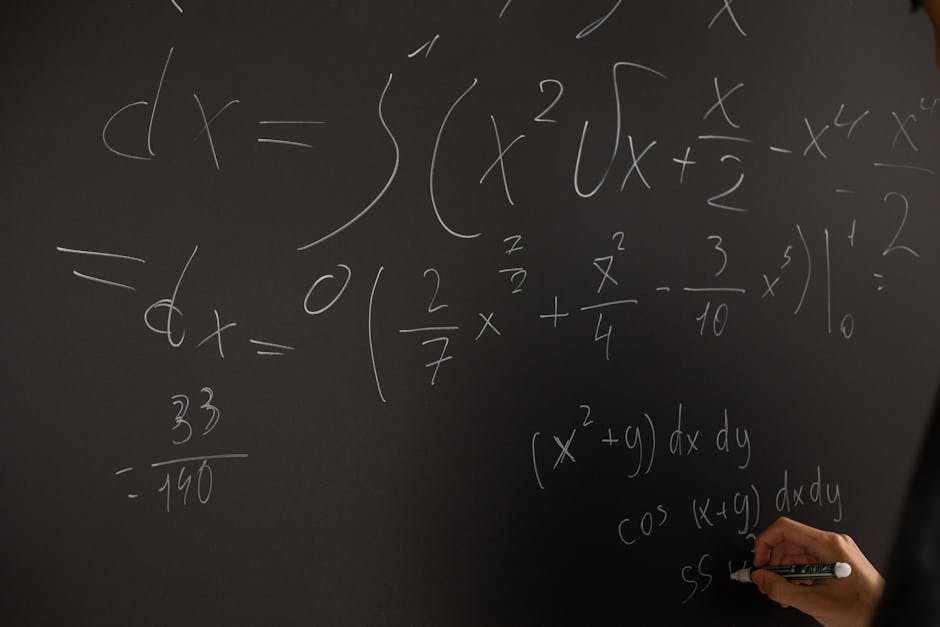
Photo by Monstera Production on Pexels
This is where it gets tricky. While $F(x)$ is continuous, it might not be differentiable at points where $f(t)$ is discontinuous. Specifically, if $f(t)$ has a jump discontinuity at $x=c$, then $F'(c)$ will not exist. This is because the slopes from the left and right of $c$ (which would be $f(c^-)$ and $f(c^+)$ respectively, if they existed) would be different, leading to a "corner" or a sharp change in the graph of $F(x)$. For $F'(c)$ to exist, $f(x)$ must be continuous at $x=c$.
Here's a diagram to help visualize the relationship:
graph TD
    A["Is f(t) integrable on [a,b]?"] --> B{Does f have finite discontinuities?};
    B -- Yes --> C["Integral F(x) = ∫f(t)dt EXISTS"];
    B -- No (f is continuous) --> D["F(x) EXISTS and is DIFFERENTIABLE"];
    C --> E["F(x) is CONTINUOUS on [a,b]"];
    E --> F{Is f(x) continuous at x=c?};
    F -- Yes --> G["F(x) is DIFFERENTIABLE at x=c"];
    F -- No (f has jump/removable discontinuity at x=c) --> H["F(x) is NOT DIFFERENTIABLE at x=c"];
Summary of Rules

Photo by K on Pexels
- Integrability: If $f(t)$ has a finite number of discontinuities, $\int_a^x f(t) dt$ exists.
- Continuity of $F(x)$: If $F(x) = \int_a^x f(t) dt$ exists, then $F(x)$ is continuous.
- Differentiability of $F(x)$: $F'(x) = f(x)$ only at points where $f(x)$ is continuous.
3. Worked Example
Let's consider the piecewise function:
$f(t) = \begin{cases} 1 & \text{if } t < 2 \\ 3 & \text{if } t \ge 2 \end{cases}$
Let $F(x) = \int_0^x f(t) dt$. We want to find $F(x)$ and check its continuity and differentiability.
First, let's find $F(x)$:
-
For $x < 2$:
$F(x) = \int_0^x 1 dt = [t]_0^x = x - 0 = x$ -
For $x \ge 2$:
We need to split the integral:
$F(x) = \int_0^2 1 dt + \int_2^x 3 dt$
$F(x) = [t]_0^2 + [3t]_2^x$
$F(x) = (2 - 0) + (3x - 3 \cdot 2)$
$F(x) = 2 + 3x - 6 = 3x - 4$
So, the antiderivative function is:
$F(x) = \begin{cases} x & \text{if } x < 2 \\ 3x - 4 & \text{if } x \ge 2 \end{cases}$
Check for Continuity of $F(x)$ at $x=2$:
* Left-hand limit: $\lim_{x \to 2^-} F(x) = \lim_{x \to 2^-} x = 2$
* Right-hand limit: $\lim_{x \to 2^+} F(x) = \lim_{x \to 2^+} (3x - 4) = 3(2) - 4 = 6 - 4 = 2$
* Function value: $F(2) = 3(2) - 4 = 2$
Since the left-hand limit, right-hand limit, and function value are all equal to 2, $F(x)$ is continuous at $x=2$. This confirms our rule: the antiderivative is continuous even if the original function is discontinuous.
Check for Differentiability of $F(x)$ at $x=2$:
Let's find $F'(x)$ by differentiating each piece:
$F'(x) = \begin{cases} 1 & \text{if } x < 2 \\ 3 & \text{if } x > 2 \end{cases}$
At $x=2$, the left-hand derivative is 1, and the right-hand derivative is 3. Since these are not equal, $F'(2)$ does not exist. This confirms our rule: $F(x)$ is not differentiable at $x=2$ because $f(x)$ has a jump discontinuity there.
4. Key Takeaways
- If a function has a finite number of discontinuities, its definite integral still exists.
- The antiderivative function $F(x) = \int_a^x f(t) dt$ will always be continuous, even if $f(t)$ isn't.
- The antiderivative $F(x)$ is only differentiable at points where the original function $f(x)$ is continuous.
- At jump discontinuities of $f(x)$, the antiderivative $F(x)$ will have a "corner" and thus won't be differentiable.
- The FTC Part 1 applies locally: $F'(x) = f(x)$ for any $x$ where $f(x)$ is continuous.
- Understanding the difference between continuity and differentiability is crucial when working with FTC.
Common Mistakes to Avoid:
- Assuming that because an integral exists, its antiderivative must be differentiable everywhere.
- Forgetting to check the limits of integration when evaluating piecewise functions.
- Incorrectly applying $F'(x) = f(x)$ at points where $f(x)$ is discontinuous.
- Not understanding that "continuity" of $F(x)$ at a point of discontinuity of $f(x)$ means the area accumulates smoothly, not that its rate of change is smooth.
5. Now Try It
Consider the function $g(t) = \begin{cases} -1 & \text{if } t < 1 \\ 2 & \text{if } t \ge 1 \end{cases}$.
Let $G(x) = \int_0^x g(t) dt$.
1. Find the piecewise definition for $G(x)$.
2. Determine if $G(x)$ is continuous at $x=1$.
3. Determine if $G(x)$ is differentiable at $x=1$.
Success looks like correctly identifying $G(x)$, showing its continuity at $x=1$, but explaining why it's not differentiable there.
Frequently asked about FTC with Discontinuous Functions: Continuity vs. Differentiability
Study this next
Get the full maths 105 curriculum
Clone the complete plan to your dashboard for unlimited AI-generated notes, practice quizzes, and a personalised revision schedule.
Save this course free