Introduction to Physics: Working Scientifically and Modules in Context
From the Physics curriculum
TL;DR
Physics is about understanding how the universe works through observation and experimentation, using a systematic approach called the scientific method. You'll learn core concepts in different modules, building a comprehensive view of the physical world. It's less about memorizing facts and more about developing problem-solving skills.
1. The Mental Model
Think of physics as a detective story where you're trying to figure out the rules of the universe. You observe clues (experiments), form hypotheses (theories), and then test those hypotheses to see if they hold up. The "modules" are like different chapters in this grand story, each focusing on a specific area, but all connected by fundamental principles.
2. The Core Material
Physics isn't just a collection of facts; it's a way of thinking. This "way of thinking" is the scientific method, a structured process for investigating phenomena, acquiring new knowledge, or correcting and integrating previous knowledge.
The Scientific Method: Your Physics Toolkit
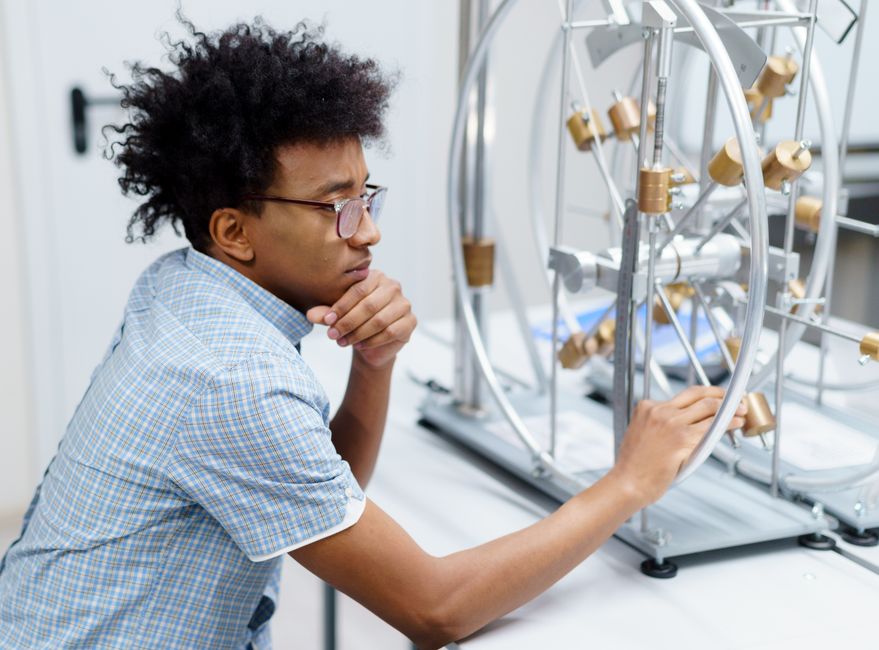
Photo by cottonbro studio on Pexels
You'll use the scientific method constantly, even if you don't explicitly call it out every time. It's a cyclical process:
graph TD
    A["Observation/Question"] --> B["Form Hypothesis"];
    B --> C["Design Experiment"];
    C --> D["Conduct Experiment/Collect Data"];
    D --> E["Analyze Data"];
    E --> F{"Hypothesis Supported?"};
    F -- "Yes" --> G["Draw Conclusions/Develop Theory"];
    F -- "No" --> B;
    G --> A;
- Observation/Question: You notice something or wonder how something works. Why does a dropped apple fall to the ground?
- Form Hypothesis: You make an educated guess that can be tested. Perhaps there's an invisible force pulling objects down.
- Design Experiment: You plan how to test your hypothesis. I'll drop different objects and measure their acceleration.
- Conduct Experiment/Collect Data: You carry out the experiment carefully and record your findings. All objects accelerate at roughly 9.8 m/s².
- Analyze Data: You look for patterns and relationships in your results. The acceleration is constant regardless of mass.
- Draw Conclusions/Revise Hypothesis: You decide if your data supports your hypothesis. If not, you revise it and start again. My hypothesis of a constant downward force (gravity) seems to hold.
Physics Modules: The Chapters of the Story

Photo by Caio on Pexels
Physics is vast, so we break it down into modules, like chapters in a textbook. These are not separate subjects but different perspectives on the same underlying reality. You'll often see them build on each other.
- Mechanics: Deals with motion, forces, energy. Think cars moving, balls being thrown, or planets orbiting. This is often where you start.
- Waves: Focuses on oscillations and disturbances that transfer energy without transferring matter. Sound, light, and water waves are examples.
- Electricity and Magnetism: Explores the fundamental forces associated with charged particles, leading to everything from circuits to motors to radio waves.
- Thermal Physics: Looks at heat, temperature, and how they relate to energy and matter. Engines, refrigerators, and climate all involve thermal physics.
- Modern Physics: Delves into topics like relativity (things moving very fast or in strong gravity), quantum mechanics (the bizarre world of the very small), and nuclear physics.
Each module introduces its own concepts, laws, and mathematical tools, but they all share the approach of the scientific method: observe, theorize, test.
3. Worked Example
Imagine you're investigating how the length of a pendulum affects its swing time (period).
1. Observation/Question: You see a grandfather clock pendulum swinging and wonder if making it longer or shorter would change how fast it ticks. "Does pendulum length affect its period?"
2. Hypothesis: "I think a longer pendulum will have a longer period (swing slower)."
3. Design Experiment:
* Independent Variable (what you change): Length of the pendulum string (e.g., 20cm, 40cm, 60cm, 80cm, 100cm).
* Dependent Variable (what you measure): Time for 10 complete swings (then divide by 10 for the average period).
* Control Variables (what you keep the same): Mass of the bob, initial release angle, location (to keep gravity constant).
* Procedure: Set up pendulum, measure length, release from a consistent angle, time 10 oscillations, repeat for accuracy, change length, repeat.
4. Conduct Experiment/Collect Data: You set up your pendulum and record your data carefully:
| Length (cm) | Time for 10 swings (s) Trial 1 | Time for 10 swings (s) Trial 2 | Average Time for 10 swings (s) | Period (Average Time / 10) (s) |
|---|---|---|---|---|
| 20 | 9.0 | 9.2 | 9.1 | 0.91 |
| 40 | 12.8 | 12.7 | 12.75 | 1.28 |
| 60 | 15.7 | 15.6 | 15.65 | 1.57 |
| 80 | 17.8 | 17.9 | 17.85 | 1.79 |
| 100 | 20.0 | 19.9 | 19.95 | 2.00 |
5. Analyze Data: You plot a graph of Period vs. Length. You notice that as the length increases, the period also increases, but not linearly (it looks more like a curve).
6. Draw Conclusions: Your data supports the hypothesis that a longer pendulum has a longer period. This simple experiment demonstrates a core concept in mechanics related to oscillations.
4. Key Takeaways
- Physics is a scientific discipline that explores the fundamental laws governing the universe.
- The scientific method is the structured approach used in physics to investigate, hypothesize, experiment, and conclude.
- Physics is broken into core modules (Mechanics, Waves, Electromagnetism, Thermal, Modern) to manage its vast scope.
- Each module builds upon fundamental principles and mathematical tools.
- Understanding how to approach problems scientifically is more important than memorizing every single formula.
- There's often a cyclical nature to scientific discovery; new observations can lead to refining old theories.
- Physics helps you develop critical thinking and problem-solving skills applicable beyond science.
Common Mistakes to Avoid:
- Don't confuse hypothesis with a proven fact; a hypothesis is an educated guess to be tested.
- Avoid changing multiple variables at once in an experiment, as it makes it impossible to know what caused the outcome.
- Don't assume measurements are perfectly accurate; acknowledge and consider potential errors.
- Don't just memorize formulas; try to understand the physical principles they represent.
5. Now Try It
Think about a simple everyday phenomenon – perhaps why ice melts faster in some places than others, or why a ball bounces higher on one surface compared to another. Choose one. For your chosen phenomenon, mentally go through the first three steps of the scientific method:
1. Formulate a clear question about it.
2. Propose a testable hypothesis that answers your question.
3. Briefly outline how you would design an experiment to test your hypothesis, identifying the independent variable, dependent variable, and at least one control variable.
Success looks like clearly articulating these three steps for a real-world scenario.
Frequently asked about Introduction to Physics: Working Scientifically and Modules in Context
Study this next
Get the full Physics curriculum
Clone the complete plan to your dashboard for unlimited AI-generated notes, practice quizzes, and a personalised revision schedule.
Save this course free