Trigonometric Fundamentals and Functions
From the BYPASS curriculum
TL;DR
Trigonometry is all about triangles, especially right-angled ones, and helps you relate angles to side lengths. It gives you special functions (sine, cosine, tangent) that describe these relationships for angles in circles and waves. Mastering these basics is key for understanding periodic patterns in math, science, and engineering.
1. The Mental Model
Imagine a Ferris wheel or a perfect circle. As you move around the circle, your height and distance from the center change predictably based on the angle you've turned. Trigonometry gives you the tools to measure and understand these changes.
2. The Core Material
Trigonometry primarily deals with the relationships between the angles and sides of triangles. While it starts with right-angled triangles, its applications extend to all triangles and, most importantly, to circular motion and wave patterns.
2.1 Right Triangles: SOH CAH TOA

Photo by Mitchell Luo on Pexels
For a right-angled triangle (one angle is 90 degrees), you can define three fundamental trigonometric ratios: Sine, Cosine, and Tangent.
- Opposite: The side across from the angle you're interested in.
- Adjacent: The side next to the angle you're interested in (not the hypotenuse).
- Hypotenuse: The longest side, always opposite the right angle.
Remember the mnemonic SOH CAH TOA:
- SOH: Sine = Opposite / Hypotenuse
- CAH: Cosine = Adjacent / Hypotenuse
- TOA: Tangent = Opposite / Adjacent
These ratios are constant for a given angle, no matter the size of the right triangle.
2.2 The Unit Circle

Photo by Jenny Uhling on Pexels
The unit circle is a circle with a radius of 1 centered at the origin (0,0) of a coordinate plane. It's super important because it extends trigonometry beyond just triangles to any angle, including angles greater than 90 degrees and negative angles.
- If you take a point (x, y) on the unit circle corresponding to an angle $\theta$ (measured counter-clockwise from the positive x-axis):
cos($\theta$) = x(the x-coordinate)sin($\theta$) = y(the y-coordinate)tan($\theta$) = y / x(since `tan($\theta$) = sin($\theta$) / cos($\theta$))
This means the values of sine and cosine always stay between -1 and 1, because they're based on coordinates within a circle of radius 1.
2.3 Radians vs. Degrees
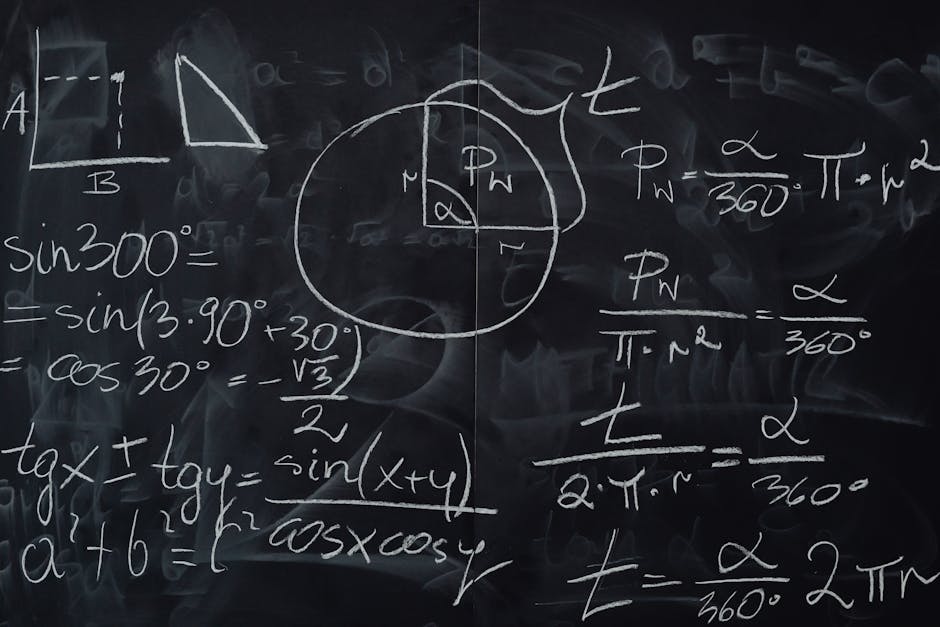
Photo by www.kaboompics.com on Pexels
Angles can be measured in degrees ($360^\circ$ for a full circle) or radians ($2\pi$ radians for a full circle). Radians are generally preferred in higher math and physics because they're "unitless" and simplify many formulas.
- Conversion:
- $180^\circ = \pi$ radians
- To convert degrees to radians:
degrees * ($\pi$ / 180) - To convert radians to degrees:
radians * (180 / $\pi$)
2.4 Basic Trigonometric Identities

Photo by olia danilevich on Pexels
Identities are equations that are always true. You'll encounter many, but these are the foundational two:
- Pythagorean Identity:
sin²($\theta$) + cos²($\theta$) = 1- This comes directly from the unit circle:
x² + y² = r²becomescos²($\theta$) + sin²($\theta$) = 1².
- This comes directly from the unit circle:
- Tangent Identity:
tan($\theta$) = sin($\theta$) / cos($\theta$)
Here's how the core components relate:
graph TD
    A["Angle ($\theta$)"] --> B["Right-Angled Triangle"]
    A --> C["Unit Circle"]

    B -- "SOH CAH TOA ratios" --> D["sin($\theta$), cos($\theta$), tan($\theta$)"]
    C -- "x-coord, y-coord" --> D

    D -- "sin²($\theta$) + cos²($\theta$) = 1" --> E["Pythagorean Identity"]
    D -- "tan($\theta$) = sin($\theta$) / cos($\theta$)" --> F["Tangent Identity"]

    C --- G["Radians & Degrees"]
    B --- G
3. Worked Example
Let's say you have a ramp that is 10 meters long and rises 3 meters vertically. You want to find the angle this ramp makes with the ground.
-
Identify the knowns:
- Hypotenuse (ramp length) = 10 meters
- Opposite (vertical rise) = 3 meters
- We want to find the angle ($\theta$).
-
Choose the correct trigonometric ratio:
- You have the Opposite and the Hypotenuse. Looking at SOH CAH TOA, SOH (Sine = Opposite / Hypotenuse) is the right choice.
-
Set up the equation:
sin($\theta$) = Opposite / Hypotenusesin($\theta$) = 3 / 10sin($\theta$) = 0.3
-
Solve for the angle:
- To find the angle $\theta$, you need to use the inverse sine function (often written as
arcsinorsin⁻¹). $\theta$ = arcsin(0.3)
- To find the angle $\theta$, you need to use the inverse sine function (often written as
-
Calculate (using a calculator):
- If your calculator is in degree mode:
$\theta$ $\approx$ 17.46 degrees - If your calculator is in radian mode:
$\theta$ $\approx$ 0.305 radians
- If your calculator is in degree mode:
So, the ramp makes an angle of about 17.46 degrees with the ground.
4. Key Takeaways
- Sine, Cosine, and Tangent are ratios of sides in a right-angled triangle (SOH CAH TOA).
- The unit circle extends these ratios to all angles, where
cos($\theta$)is the x-coordinate andsin($\theta$)is the y-coordinate. - Radians are another way to measure angles, with
$\pi$radians equal to180 degrees. - The Pythagorean Identity
sin²($\theta$) + cos²($\theta$) = 1is fundamental. - The Tangent Identity
tan($\theta$) = sin($\theta$) / cos($\theta$)is also very useful.
Common Mistakes to Avoid
- Using the wrong ratio: Double-check if you're using Opposite, Adjacent, and Hypotenuse correctly for Sine, Cosine, or Tangent.
- Calculator mode: Always make sure your calculator is in the correct mode (degrees or radians) for the problem you're solving.
- Forgetting the Unit Circle: Don't limit your thinking to only acute angles ($0-90^\circ$); trig functions apply to all angles.
- Mixing up inverse functions: Use
arcsin(orsin⁻¹) to find an angle, not1/sin($\theta$).
5. Now Try It
Take any right-angled triangle with known side lengths (e.g., sides 3, 4, 5, or make one up). Pick one of the non-90-degree angles. Calculate the sine, cosine, and tangent of that angle. Then, use the inverse trigonometric functions (arcsin, arccos, arctan) to find the measure of that angle in both degrees and radians.
What success looks like: You should be able to consistently get the same angle measure using any of the three inverse functions, given your initially calculated sine, cosine, or tangent values. And your radian and degree values should convert correctly between each other.
Frequently asked about Trigonometric Fundamentals and Functions
Study this next
Get the full BYPASS curriculum
Clone the complete plan to your dashboard for unlimited AI-generated notes, practice quizzes, and a personalised revision schedule.
Save this course free